Email:
[email protected]
Phone:
+91 93135 43530
Address:
133/1 Ground, Mansuri Block, Opp. Dudheshwar Water Tank, Ahmedabad-380004, Gujarat, India
VALVES | FASTENERS | FLANGES | FITTINGS
VALVES | FASTENERS | FLANGES | FITTINGS
3 Way Ball Valve supplier in Ahmedabad, Gujarat. L-port (diverter — one inlet to one outlet at a time, third port always blocked) and T-port (mixer/distributor — all three ports open simultaneously or straight-through) — WCB (ASTM A216) / SS304…
Price on Request
Supplier: Krishna Industries (KELOR) – Ahmedabad, Gujarat, India
Established: 2017 | GSTIN: 24AKLPP6499B1ZT | IEC: AKLPP6499B
MOQ: 10 Nos | Body: WCB / SS304 / SS316 / SS316L
Config: L-Port & T-Port | Sizes: DN15–DN200 | Pressure: Class 150 / 300
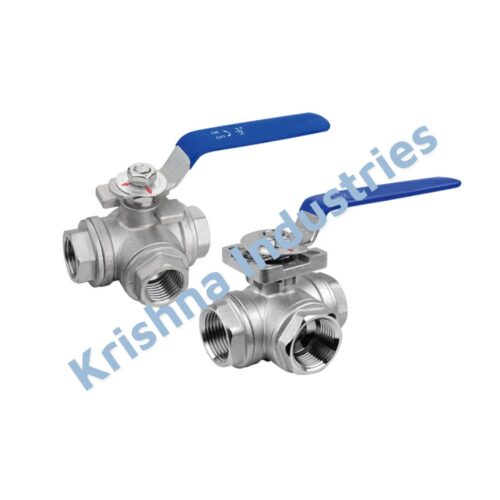
Krishna Industries (KELOR) supplies 3 Way Ball Valves from Ahmedabad, Gujarat. We stock both L-port (diverter) and T-port (mixer/distributor) configurations. Body materials include WCB, SS304 (CF8), SS316 (CF8M), and SS316L (CF3M).
Furthermore, we supply all end connection types — screwed BSP/NPT, socket weld, and flanged Class 150 and Class 300. Size range covers DN15 (½”) to DN200 (8″). All valves are API 598 tested. GST invoice included. MOQ is 10 Nos.
A 3 way ball valve combines flow diversion, mixing, distribution, and bypass in one compact body. As a result, it replaces two separate 2-way valves plus a tee fitting. However, you must specify the correct port configuration — L-port or T-port — before ordering. The wrong configuration cannot perform the required flow function.
L-port and T-port are not interchangeable. The ball bore geometry decides which ports are connected at each valve position. Therefore, always confirm port type before raising the purchase order.
| Feature | L-Port (Diverter) | T-Port (Mixer / Distributor) |
|---|---|---|
| Ball Bore Shape | L-shaped — connects two adjacent ports at 90° | T-shaped — straight channel with one 90° branch |
| Position 1 (0°) | Port A → Port B. Port C is always blocked. | ✅ Port A → Port B AND Port C together. All three ports open. Flow splits or mixes. |
| Position 2 (90°) | Port B → Port C. Port A is blocked. | Port B → Port C only. Port A is blocked. Straight-through flow. |
| All Three Ports Open Together? | ❌ Never. L-port always blocks one port. | ✅ Yes — at the 0° position, all three ports connect. |
| Primary Function | DIVERT — one inlet to one outlet at a time. CHANGEOVER — switch from main to backup source. | MIX — two inlets combine into one outlet. DISTRIBUTE — one inlet splits to two outlets. BYPASS — connect process and bypass simultaneously. |
| Typical Indian Applications | Tank switching, source changeover, sample valve diversion, drain/process switching | HVAC mixing valve, temperature blending, chemical dilution, process bypass |
| Specify When | ✅ Flow goes to ONE destination at a time. Third port must always be blocked. | ✅ Two streams must mix. OR one stream must split to two outlets simultaneously. |
Many engineers use two 2-way ball valves plus a tee for flow switching. However, a single 3-way ball valve is simpler, safer, and more compact. Here is a direct comparison.
| Factor | Two 2-Way Ball Valves + Tee | One 3-Way Ball Valve |
|---|---|---|
| Components | 2 bodies + 2 stems + 2 seat sets + tee + pipework + 2 actuators + 2 signal lines | ✅ 1 body + 1 stem + 1 seat set + 1 actuator + 1 signal |
| Leak Points | 8 flanged joints + tee joints + 2 stem seals | ✅ 3 connections + 1 stem seal |
| Automation Risk | Both valves can open simultaneously — causes cross-flow or contamination. PLC sequencing logic is required. | ✅ Single actuator controls the flow path. No sequencing needed. No simultaneous open risk (L-port). |
| Installation Space | Two bodies + tee + connecting pipework — large footprint | ✅ One body with three direct connections — compact. Ideal for OEM skids and pharmaceutical modules. |
| Body Material | Standard | Specify For | Not Suitable For |
|---|---|---|---|
| WCB | ASTM A216 WCB | ✅ Steam, oil, gas, non-corrosive chemical — most common Indian process plant spec — economical | Corrosive chemical — acid, alkali, chloride service |
| SS304 (CF8) | ASTM A351 CF8 | DM water, mild chemical, food non-chloride, pharma non-GMP utility | Chloride service — specify SS316 instead |
| SS316 (CF8M) | ASTM A351 CF8M | ✅ Corrosive chemical, chlorinated CIP, seawater cooling, coastal industrial | GMP pharma welded piping — specify SS316L |
| SS316L (CF3M) | ASTM A351 CF3M | ✅ Pharma GMP (PW, WFI, clean steam), welded SS piping, food GMP — 0.03% C max — sensitisation-free | Very high temperature above 450°C |
| Operator | Specify For | Key Note for 3-Way |
|---|---|---|
| Lever (Manual) | ✅ DN15–DN50 — low frequency switching — cost-effective — operator at valve | Lever must show clearly marked positions. Visual confirmation before leaving valve is essential. |
| Pneumatic Actuated | ✅ Most common for automation — DCS/PLC signal — spring return or double acting | Always confirm spring return direction (position 1 or 2) at order. 3-way torque is higher than 2-way of same size. |
| Electric Actuated | ✅ HVAC BMS integration — remote locations — 24V DC / 220V AC signal | Position feedback confirms active flow path. Manual override for power failure is standard. |
| Parameter | Specification |
|---|---|
| Valve Type | 3-way ball valve — L-port (diverter) or T-port (mixer) — specify at order |
| Body Material | WCB (ASTM A216) / CF8 SS304 / CF8M SS316 / CF3M SS316L (ASTM A351) |
| Ball Material | SS316 (standard) / SS304 / hard chrome plated SS |
| Seat Material | Virgin PTFE (standard — Class VI) / RPTFE (high cycle) / PPL (above 180°C) |
| Stem Material | SS316 — blow-out proof |
| End Connections | Screwed BSP (IS 554) / NPT (ASME B1.20.1) / Socket Weld ASME B16.11 / Flanged ASME B16.5 Class 150 / Class 300 |
| Size Range | DN15 (½”) to DN200 (8″) |
| Pressure Class | Class 150 / Class 300 (flanged) — Class 800 screwed/SW on request |
| Temperature Range | -20°C to +180°C (PTFE) / +220°C (PPL) / +425°C (graphite + metal seat) |
| Operation | Lever (DN15–DN80) / Gear (DN100+) / Pneumatic / Electric |
| Testing | API 598 — shell test and seat leakage at all three port positions |
| MOQ | 10 Nos |
| HSN Code | 84818090 |
T-port SS304 or WCB flanged Class 150 DN25–DN100. Used for chilled water coil bypass and supply/return blending. Furthermore, electric actuation with BMS signal enables automatic temperature control. Consequently, this is the standard 3-way mixing valve in Indian commercial buildings, hotels, and hospitals.
L-port SS316 screwed BSP or flanged Class 150 DN15–DN80. Switches chemical feed between main drum and backup. Also used for diverting process lines to sample collection. Pneumatic actuated with spring return for process automation. L-port ensures only one destination is active at a time.
T-port SS316L CF3M flanged Class 150 DN25–DN80. Mixes purified water (PW) with hot water for temperature-controlled loops. Additionally, it mixes clean steam and cold PW for warm water utility. Pneumatic actuated with position feedback to DCS. SS316L CF3M satisfies GMP documentation requirements.
L-port WCB or SS304 flanged Class 150 DN50–DN150. Switches chemical dosing between two dosing points. In addition, it diverts process streams to different treatment stages. Finally, lever operation allows manual switching during routine plant operation.
L-port or T-port SS316 screwed BSP DN15–DN50. Replaces two 2-way valves and a tee in compact skid design. As a result, a single pneumatic actuator eliminates sequencing logic. Standard for Indian OEM manufacturers in Pune, Ahmedabad, Coimbatore, and Hyderabad.
L-port WCB flanged Class 150/300 DN25–DN100. Switches boiler feed water between two boilers from one feed pump. Moreover, it handles steam header switching and condensate return diversion. Since WCB body tolerates steam and condensate, no special lining is required. Lever operated for manual control.
First, ask this question: do two inlets or outlets need to connect simultaneously at any point? If yes, specify T-port. If only one destination is active at a time, specify L-port.
For example, for tank switching (pump to tank A or tank B, never both): specify L-port. For HVAC temperature blending (hot and cold water mixed together): specify T-port. Similarly, for source changeover (main to backup, one at a time): L-port. When in doubt for simple switching, L-port is more common and easier to automate.
No. A 3-way ball valve is an on/off switching valve only. In the partially open position, high velocity flow erodes the PTFE seat and scores the ball surface rapidly. Therefore, always operate it fully at 0° or fully at 90°.
For varying the ratio of hot to cold water in blending, a 3-way globe valve or modulating control valve is the correct specification. The 3-way ball valve switches between defined flow paths — it does not modulate flow proportion.
A 3-way ball valve has three port openings instead of two. As a result, more ball surface area contacts differential pressure during switching. This increases operating torque significantly.
Therefore, always provide the valve torque data sheet to the actuator supplier. Never use a 2-way valve torque estimate. Otherwise, undersized actuators cause incomplete valve travel and incorrect flow path selection on site.
Spring return is needed when the process requires the valve to return to a safe position on air failure. For instance, an L-port diverting between process and drain needs spring return to process position. This prevents unintended line drainage if air supply is lost.
Similarly, a T-port on HVAC mixing needs spring return to straight-through. This prevents coil freeze-up in cold weather. On the other hand, double acting is correct for non-safety-critical automation. In that case, air failure position is not a safety requirement. Always define the fail-safe position — position 1 or position 2 — when ordering.
MOQ is 10 Nos. Moreover, we supply project and OEM orders of 10 to 500+ Nos. Documents include API 598 test certificate, MTC, dimensional report, and GST invoice.
For pneumatic actuated orders, also confirm port configuration (L or T), spring return direction, solenoid voltage, and limit switch requirements. Finally, WhatsApp your size list and quantity for pricing within 2 hours.
Krishna Industries (KELOR) supplies 3 Way Ball Valves for flow diversion, mixing, and bypass in Indian process plant projects. We supply both L-port and T-port configurations. Body materials include WCB, SS304, SS316, and SS316L.
Furthermore, end connections cover screwed BSP/NPT, socket weld, and flanged Class 150 and 300. Sizes range from DN15 to DN200. All valves are API 598 tested. In addition, we provide GST invoice, MTC, and Pan India dispatch from Ahmedabad. WhatsApp port configuration, body material, size, and quantity for pricing within 2 hours.
Reviews
There are no reviews yet.