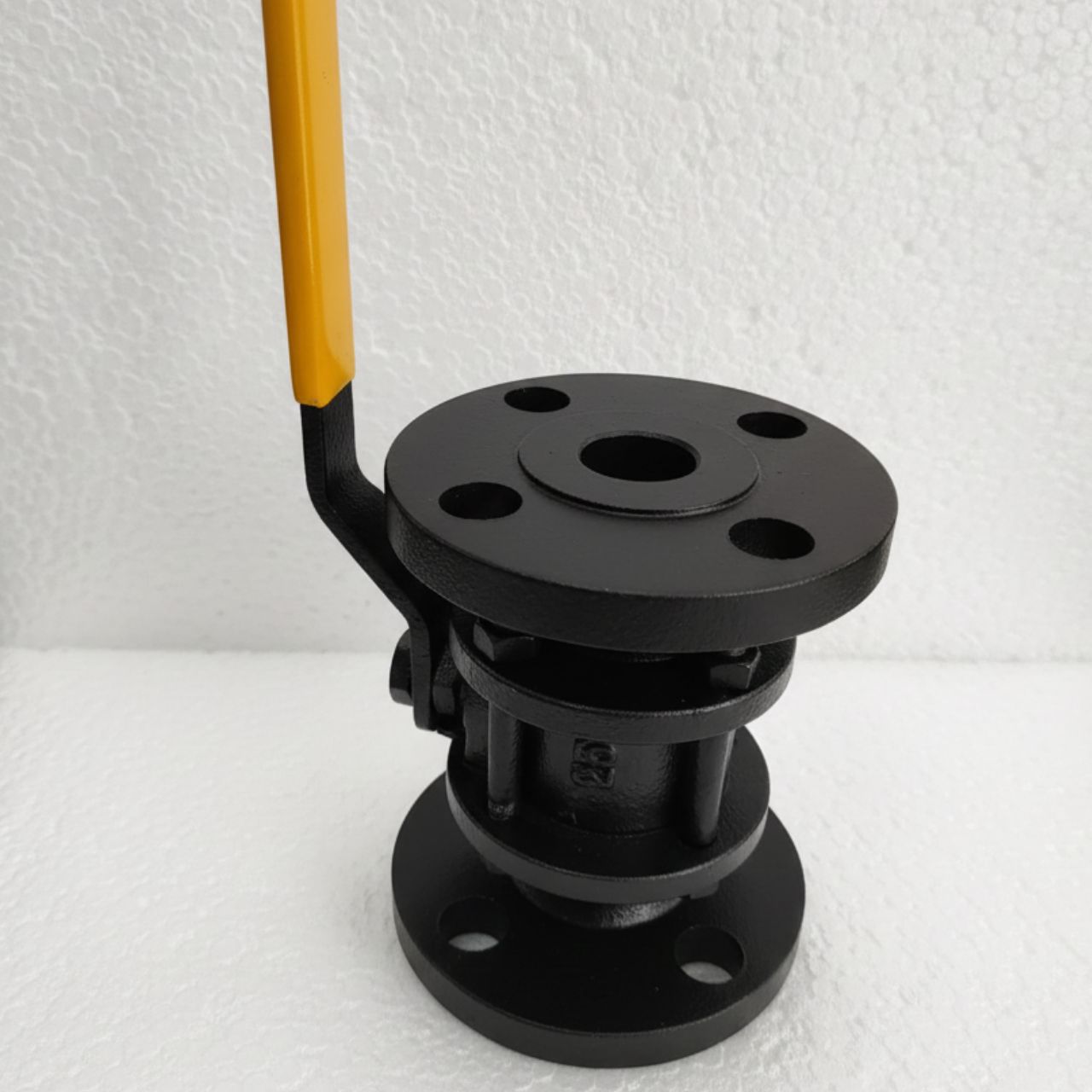
3 Piece Ball Valve — Flanged End Class 150# Supplier India | WCB / SS304 / SS316 | Full Bore | ASME B16.5 | In-Line Maintenance | KELOR

3 Piece Flanged Ball Valve Supplier India — Class 150# WCB/SS304/SS316 | KELOR

3 Piece Flanged Ball Valve Supplier in India — Class 150# — WCB / SS304 / SS316 | KELOR

Krishna Industries (KELOR), based in Ahmedabad, Gujarat, supplies 3 Piece Ball Valves with Flanged End Class 150# — WCB (ASTM A216) / SS304 (CF8 ASTM A351) / SS316 (CF8M ASTM A351) body — SS316 ball — PTFE / RPTFE seat — flanged ASME B16.5 Class 150 raised face (RF) — full bore — lever operated (DN15–DN50) and gear operated (DN65–DN100) — DN15 (½″) to DN100 (4″) — API 598 tested — GST invoice — MOQ 10 Nos — Pan India dispatch from Ahmedabad.

Mill Test Report 3.1 can be provided on request from verified vendors. API 598 test certificates, hydro test reports and dimension drawings arranged on request. BIS/ISI marked products arranged on request from BIS-certified vendors.

⚡ Quick Reference

SupplierKrishna Industries (KELOR) — Ahmedabad, Gujarat
Established2017 | GSTIN: 24AKLPP6499B1ZT
MOQ10 Nos
Body MaterialWCB / SS304 / SS316
Pressure ClassClass 150# (ASME B16.5)
Size RangeDN15 (½″) to DN100 (4″)
Design3-Piece Full Bore
HSN Code84818090

What is a 3 Piece Flanged Ball Valve?

The 3-piece flanged ball valve provides the key operational advantage of in-line maintenance — the centre body with ball and seats can be removed for inspection and seat replacement while both flanged end connections remain bolted to the pipeline. Furthermore, this eliminates the need to break flange joints and disturb the pipeline for routine ball valve maintenance. Consequently, the 3-piece flanged configuration is the standard specification for process plant ball valves in chemical, pharma, food, and industrial piping where maintenance access without pipeline disturbance is a priority.

Krishna Industries (KELOR) supplies 3-piece flanged ball valves from verified and quality-assured vendor partners, ensuring every valve meets ASME B16.5 Class 150 design requirements, API 598 testing standards, and full material traceability. With MOQ of just 10 Nos, project-specific quotations are provided within 2 hours on WhatsApp — covering body material selection (WCB, SS304 CF8, SS316 CF8M), size range (DN15 to DN100), and operation type (lever or gear).

Why 3-Piece Body — The In-Line Maintenance Advantage

The defining feature of a 3-piece flanged ball valve is its ability to allow in-line maintenance: the centre body section (containing the ball and seats) can be unbolted and slid out for inspection, cleaning, or seat replacement — while both flanged end pieces remain firmly bolted to the pipeline. This eliminates the need to break flange joints, replace gaskets, realign pipe spools, or perform hydrostatic re-testing of disturbed flanged connections. For process plants running corrosive chemicals or GMP pharmaceutical lines where maintenance frequency is high, this translates to significantly reduced downtime, lower maintenance labour cost, and fewer opportunities for pipeline contamination during maintenance activities.

Feature3-Piece Flanged Ball Valve2-Piece Flanged Ball Valve
In-Line Maintenance✅ Centre body slides out — ball and seats accessible — both end flanges remain bolted to pipeline — no pipeline disturbanceEnd piece removal disturbs one pipeline flange — more disruptive for seat replacement
Seat Replacement✅ PTFE seats replaced in-line — centre body removed — new seats installed — centre body reassembled — valve back in service without flange joint disturbanceValve must be partially removed from pipeline — flange joint broken — gasket replaced — more time and cost
Inspection Access✅ Ball surface, seat condition, and body interior fully accessible after centre body removal — maintenance team can inspect without valve removalLimited inspection access without full valve removal
Downtime✅ Shorter — in-line maintenance means faster return to service — standard for critical process plant ball valves where minimising downtime is priorityLonger — flange joint disturbance requires new gasket, retorquing, and pressure testing
CostHigher — three body components — premium justified for critical service lines✅ Lower — standard for non-critical general service where in-line maintenance is not required
Specify When✅ Critical process plant piping — chemical, pharma, food — where frequent maintenance cycles are expected — where minimising downtime has high operational valueGeneral utility service — infrequent maintenance — cost-sensitive applications

💡 Procurement Tip

For EPC contractors and project procurement teams specifying ball valves for chemical, pharma, or food process plants: always specify 3-piece flanged over 2-piece when the process line carries corrosive media requiring frequent seat inspection or replacement. The premium cost of the 3-piece body is recovered within the first 1–2 maintenance cycles through eliminated flange work, gasket replacement, and reduced shutdown time. For non-critical utility lines (cooling water, compressed air), 2-piece flanged ball valves offer adequate performance at lower cost.

Body Material Selection Guide

Selecting the correct body material for your 3-piece flanged ball valve is the single most important specification decision. The three standard body materials — WCB carbon steel, SS304 (CF8), and SS316 (CF8M) — cover the vast majority of Indian process plant applications. Your selection should be based on the process fluid chemistry, operating temperature, chloride content, GMP requirements, and project specification. The table below provides a clear material selection guide for procurement teams and piping engineers.

Body MaterialStandardSpecify ForNot For
WCB (Carbon Steel) ASTM A216 WCB ✅ Steam, oil, gas, non-corrosive process — most economical Class 150 flanged 3-piece ball valve — industrial process plant general service Corrosive chemical, seawater, DM water — CS corrodes in these services
SS304 (CF8) ASTM A351 CF8 DM water, mild chemical, food non-chloride, pharma non-GMP utility — corrosion resistant at lower cost than SS316 Chloride service, seawater, aggressive chemical — specify SS316
SS316 (CF8M) ASTM A351 CF8M ✅ Corrosive chemical, chloride service, pharmaceutical process, food GMP, seawater — 2–3% Mo provides chloride pitting resistance — standard SS grade for Indian chemical and pharma 3-piece flanged ball valves GMP pharma welded piping where sensitisation is a concern — specify SS316L
WCB BodyASTM A216 — Most Economical
SS304 (CF8) BodyASTM A351 CF8 — Mild Corrosive
SS316 (CF8M) BodyASTM A351 CF8M — Full Corrosive

Technical Specifications

ParameterSpecification
Valve Type3-piece ball valve — full bore — flanged end
Body MaterialWCB (ASTM A216) / CF8 SS304 (ASTM A351) / CF8M SS316 (ASTM A351)
Ball MaterialSS316 (standard) / SS304
Seat MaterialVirgin PTFE (standard — Class VI zero leakage) / RPTFE (high pressure / high cycle)
Stem MaterialSS316 — blow-out proof
End ConnectionFlanged ASME B16.5 Class 150 — raised face (RF) standard
BoreFull bore — pipeline bore maintained through valve
Size RangeDN15 (½″) to DN100 (4″)
Pressure ClassClass 150# (ASME B16.5) — approximately 20 bar at ambient temperature
Temperature Range-20°C to +180°C (PTFE seat) / -20°C to +200°C (RPTFE seat)
OperationLever (DN15–DN50 standard) / Gear operated handwheel (DN65–DN100)
Face to FaceASME B16.10
Testing StandardAPI 598 — shell test and seat leakage test
MOQ10 Nos
HSN Code84818090

📖 Applicable Standards

All 3-piece flanged ball valves supplied by Krishna Industries (KELOR) conform to the following Indian and international standards:

  • ASME B16.5 — Pipe flanges and flanged fittings (Class 150 pressure-temperature rating)
  • ASME B16.10 — Face-to-face and end-to-end dimensions of ferrous valves
  • API 598 — Valve inspection and testing (shell test and seat leakage test)
  • API 6D — Pipeline and piping valves (design requirements)
  • ASTM A216 — WCB carbon steel for castings
  • ASTM A351 — CF8 (SS304) and CF8M (SS316) stainless steel for castings
  • ASTM A182 — SS316 forged bar (ball and stem material)

Standard Dimensions — Flanged End Class 150#

The following dimensions conform to ASME B16.5 Class 150 raised face flanged ends and ASME B16.10 face-to-face requirements. All dimensions are in millimetres and are standard for WCB, SS304, and SS316 body construction. Verify dimensions for specific project requirements before ordering.

Size (inch)Size (DN)Face to Face (mm)Flange OD (mm)Bolt Circle Dia (mm)
½″DN151309570
1″DN2516010580
2″DN50200150110
4″DN100250200160
⚠️ Note: Dimensions shown are per ASME B16.5 / ASME B16.10 standard. Actual dimensions may vary slightly by vendor. Contact KELOR for certified dimension drawings with specific vendor measurements. Flange drilling (number of bolt holes and bolt size) can be provided on request for each size.

Applications in Indian Industries

3-piece flanged ball valves Class 150# are among the most versatile process isolation valves used across Indian industries. Their in-line maintenance capability, full bore design (zero pressure drop), and availability in three body materials (WCB, SS304, SS316) make them the preferred specification for process isolation in chemical plants, pharmaceutical facilities, food processing units, and general industrial utilities. Below are the key application segments served by KELOR across India.

🎡 Chemical Plants

Corrosive Process Isolation — SS316 CF8M body Class 150 flanged 3-piece DN25–DN100. Critical corrosive chemical process line isolation where frequent seat maintenance is expected due to chemical attack on PTFE. Furthermore, 3-piece in-line maintenance minimises process shutdown time for seat replacement on critical chemical plant process lines. Standard for Indian chemical plant projects at Ankleshwar, Vapi, and Dahej GIDC.

💊 Pharmaceutical Utility Piping

GMP-Compliant Isolation — SS316 CF8M body Class 150 flanged 3-piece DN15–DN80. Purified water (PW), WFI, and clean steam utility isolation where GMP audit requires in-line maintainability documentation. Moreover, the 3-piece body allows seat replacement and ball inspection without breaking the flanged joint — reducing contamination risk during maintenance. Mill Test Report (ASTM A351 CF8M) can be provided on request from verified vendors for GMP documentation.

🍴 Food Processing

CIP Line Isolation — SS316 CF8M body Class 150 flanged 3-piece DN25–DN80. Food process line isolation and CIP (clean-in-place) circuit block valves. In-line maintenance allows PTFE seat inspection and replacement during scheduled CIP maintenance shutdowns without pipeline disturbance. PTFE seat is food-safe and CIP chemical compatible.

⚙ Industrial Process Plant

Steam and Non-Corrosive Service — WCB body Class 150 flanged 3-piece DN25–DN100. Steam utility isolation, non-corrosive process line block valves, industrial cooling water isolation. WCB body economical for non-corrosive process where SS316 body premium is not justified. Furthermore, Class 150 flanged provides the standard process plant connection matching the piping class for most Indian industrial utility service.

Why Choose KELOR for 3-Piece Flanged Ball Valves?

Krishna Industries (KELOR) has been a trusted supplier of industrial valves, fasteners, gaskets and safety equipment to Indian process industries since 2017. Our Ahmedabad-based operations cover vendor verification, quality inspection, documentation management, and Pan India logistics — ensuring every valve we supply meets project specification and documentation requirements.

Quality Verified

API 598 shell test and seat leakage test performed. Mill Test Report 3.1 can be provided on request from verified vendors. Full material traceability maintained.

🚚

Pan India Dispatch

GST invoice with E-Way bill. Dispatch from Ahmedabad warehouse within 3–5 working days for standard sizes. Express dispatch available for urgent project requirements.

📧

Fast Quotation

WhatsApp body material, size list, and quantity — receive project pricing within 2 hours. Dedicated support for EPC contractors, pharma projects, and government tenders.

📋

Full Documentation

API 598 test certificates, hydro test reports, MTC (EN 10204 Type 3.1), dimension drawings, and GST invoice provided with every order. TPI coordination available.

💰

Competitive Pricing

Direct vendor sourcing eliminates trader margins. Bulk discount on 50+ Nos. Project-specific pricing for chemical, pharma, and food plant orders with MOQ of just 10 Nos.

🎯

Industry Experience

Supplying Indian chemical, pharma, food, and process plant industries since 2017. Ahmedabad — at the heart of Gujarat’s industrial valve corridor near Ankleshwar, Vapi, and Dahej GIDC.

Commercial Information

📈 Order & Supply Details

MOQ 10 Nos per order
Payment Terms As per mutual agreement
Dispatch 3–5 working days (standard sizes)
Invoicing GST invoice with E-Way bill
Documentation MTC 3.1, API 598 test certificate, hydro test report
Inspection Third-party inspection (TPI) coordination available
Bulk Orders 50–200+ Nos with project pricing
HSN Code 84818090

📧 Get Project Pricing in 2 Hours

WhatsApp body material (WCB / SS304 / SS316), size list, and quantity — receive competitive quotation with full documentation support.

💬 WhatsApp Now

Frequently Asked Questions

1. What is the key advantage of 3-piece body over 2-piece for a flanged ball valve?
The centre body of a 3-piece ball valve slides out with the ball and seats while both flanged end connections remain bolted to the pipeline. As a result, the seat and ball can be inspected and replaced in-line without breaking either flange joint, without disturbing pipe alignment, and without replacing gaskets. For a 2-piece flanged ball valve, one end piece must be removed which requires breaking the downstream flange joint, replacing the flange gasket, and retorquing the joint — more disruptive and time-consuming. Specify 3-piece for critical process lines where maintenance frequency is high and minimising downtime has operational value.
2. What is Class 150# pressure rating in bar?
ASME B16.5 Class 150 flanged ball valve is rated approximately 20 bar (290 psi) at ambient temperature for WCB body, and approximately 19 bar for SS304 and SS316 CF8/CF8M body. The pressure rating reduces at elevated temperature per ASME B16.5 pressure-temperature tables. For service above 20 bar, specify Class 300 flanged ball valve. Always verify the exact pressure-temperature rating from ASME B16.5 tables for the specific body material and operating temperature before specifying.
3. What flange facing is standard — RF or FF?
Raised face (RF) is the standard flange facing for ASME B16.5 Class 150 ball valves supplied by Krishna Industries. RF is the correct facing for most Indian process plant applications — it concentrates the bolt load on the raised ring surface and provides reliable sealing with a spiral wound gasket or ring gasket. Flat face (FF) is specified only when connecting to cast iron flanges (CI flanges are prone to cracking if bolted against an RF steel flange — the raised face concentrates load unevenly). Specify FF only if the mating equipment flange is cast iron.
4. What is the MOQ?
MOQ is 10 Nos. Chemical, pharma, and food plant project orders — typically 20 to 200+ Nos across sizes and body materials — with API 598 test certificate, Mill Test Report for body material (ASTM A351 CF8M for SS316), and GST invoice. WhatsApp body material (WCB / SS304 / SS316), size list, and quantity for project pricing within 2 hours.
5. What body material should I specify for chemical plant service?
For corrosive chemical service, specify SS316 (CF8M per ASTM A351) body. The 2–3% molybdenum content in CF8M provides superior chloride pitting resistance compared to SS304 (CF8). For mild chemicals and DM water, SS304 (CF8) is sufficient. For non-corrosive steam, oil, and gas service, WCB (ASTM A216) is the most economical choice. If your process contains chlorides, acids, or saline solutions, always specify SS316 (CF8M) to avoid premature corrosion failure.
6. What seat material is standard — PTFE or RPTFE?
Virgin PTFE (Polytetrafluoroethylene) is the standard seat material for Class 150 flanged 3-piece ball valves supplied by KELOR. PTFE provides Class VI zero leakage shutoff, broad chemical compatibility (resistant to most acids, alkalis, and solvents), and food-safe certification. RPTFE (reinforced PTFE with glass fibre filler) is specified for higher pressure or high cycle applications where additional seat strength and deformation resistance are required. PTFE temperature range is -20°C to +180°C; RPTFE extends to +200°C.
7. What is the difference between lever operated and gear operated?
Lever operation is standard for smaller sizes DN15 to DN50 (½″ to 2″) — the lever provides direct quarter-turn (90°) operation with clear open/closed visual indication. Gear operated (GO) handwheel is standard for larger sizes DN65 and DN100 (2½″ and 4″) where the torque required to operate the ball exceeds comfortable manual lever force. The gear operator multiplies the applied force, making valve operation smooth and easy even at higher pressures. Gear operated valves require multiple handwheel turns (typically 10–20 turns) to achieve full 90° ball rotation.
8. Can KELOR supply valves with BIS/ISI marking?
Yes. BIS/ISI marked products can be arranged on request from BIS-certified vendors. For government tenders, Jal Jeevan Mission projects, and PHED water supply orders where BIS marking is a tender requirement, KELOR coordinates with BIS-certified vendor partners to ensure compliance. Specify BIS/ISI marking requirement at the time of enquiry along with the applicable IS standard number.
9. What documentation is provided with the order?
Every order is supplied with: GST invoice, E-Way bill (for logistics), API 598 test certificate (shell test and seat leakage test), and hydro test report. Mill Test Report (MTC) per EN 10204 Type 3.1 can be provided on request from verified vendors. Dimension drawings, material certificates (ASTM A216 for WCB, ASTM A351 for CF8/CF8M), and third-party inspection (TPI) reports can be arranged for project-specific requirements. Specify your documentation requirements at the time of enquiry.
10. What is the delivery time?
Standard delivery is 3–5 working days for common sizes (DN15, DN25, DN50, DN100) in WCB, SS304, and SS316 body material from Ahmedabad warehouse stock. Project orders of 50–200+ Nos may require 7–15 working days depending on size mix and body material combination. Express dispatch (1–2 working days) available for urgent breakdown replacement requirements. Pan India dispatch via road transport with full tracking.

Krishna Industries (KELOR) supplies 3 Piece Ball Valves with Flanged End Class 150# — WCB / SS304 (CF8) / SS316 (CF8M) body — SS316 ball — PTFE / RPTFE seat — flanged ASME B16.5 Class 150 RF — full bore — lever and gear operated — DN15 (½″) to DN100 (4″) — API 598 tested — MTC — GST invoice — Pan India dispatch from Ahmedabad.

WhatsApp body material, size list, and quantity for pricing within 2 hours. The standard specification for process plant ball valves in India.

0000000