
SS304 Eye Bolt Manufacturer in India | DIN 580 Forged
Krishna Industries (KELOR) is a premier SS304 eye bolt manufacturer in India. We supply premium Forged SS304 (A2-70) Eye Bolts conforming to DIN 580 / IS 2585 standards, available in sizes M6 to M36. Choose between plain shank and shoulder (collared) types, all featuring WLL stamped on the shank and a self-colour finish for inherent corrosion resistance. Ideal for food processing, pharmaceutical GMP, chemical, marine-adjacent, and outdoor industrial lifting. MOQ 10 Nos. GST invoice under HSN 73181590. Pan-India dispatch from Gujarat.
NABL-certified MTC available on request. WhatsApp your thread size, type, and quantity for a heavy duty SS 304 lifting eye bolt bulk order quote within 2 hours during business hours.
⚠ Eye Bolts Are Safety-Critical Lifting Equipment — Read Before Ordering
- Always specify FORGED eye bolts for lifting applications — bent wire or welded eye bolts are NOT rated for lifting. The eye can open under load, causing dropped-load injury.
- Load de-rating at an angle is severe: At 45 degrees, the WLL drops to only 30% of the straight-line rated load. At 46 degrees and above — do not use.
- Use shoulder (collared) type for angled loading — plain shank eye bolts can ONLY take straight-line (axial) pull. Shoulder types handle angled pull up to 45 degrees safely.
- Full thread engagement is mandatory: Thread engagement must equal at least 1.5x the bolt diameter. Partial engagement is a common cause of eye bolt pull-out failure.
- Always verify WLL from the load table below before use — never assume load capacity from visual size alone.
⚡ Quick Reference: SS304 Eye Bolt Specifications
📜 On This Page
- Stainless Steel 304 Eye Bolt Overview
- Plain Shank vs Shoulder Collared Type
- Why SS304 Over Carbon Steel for Eye Bolts
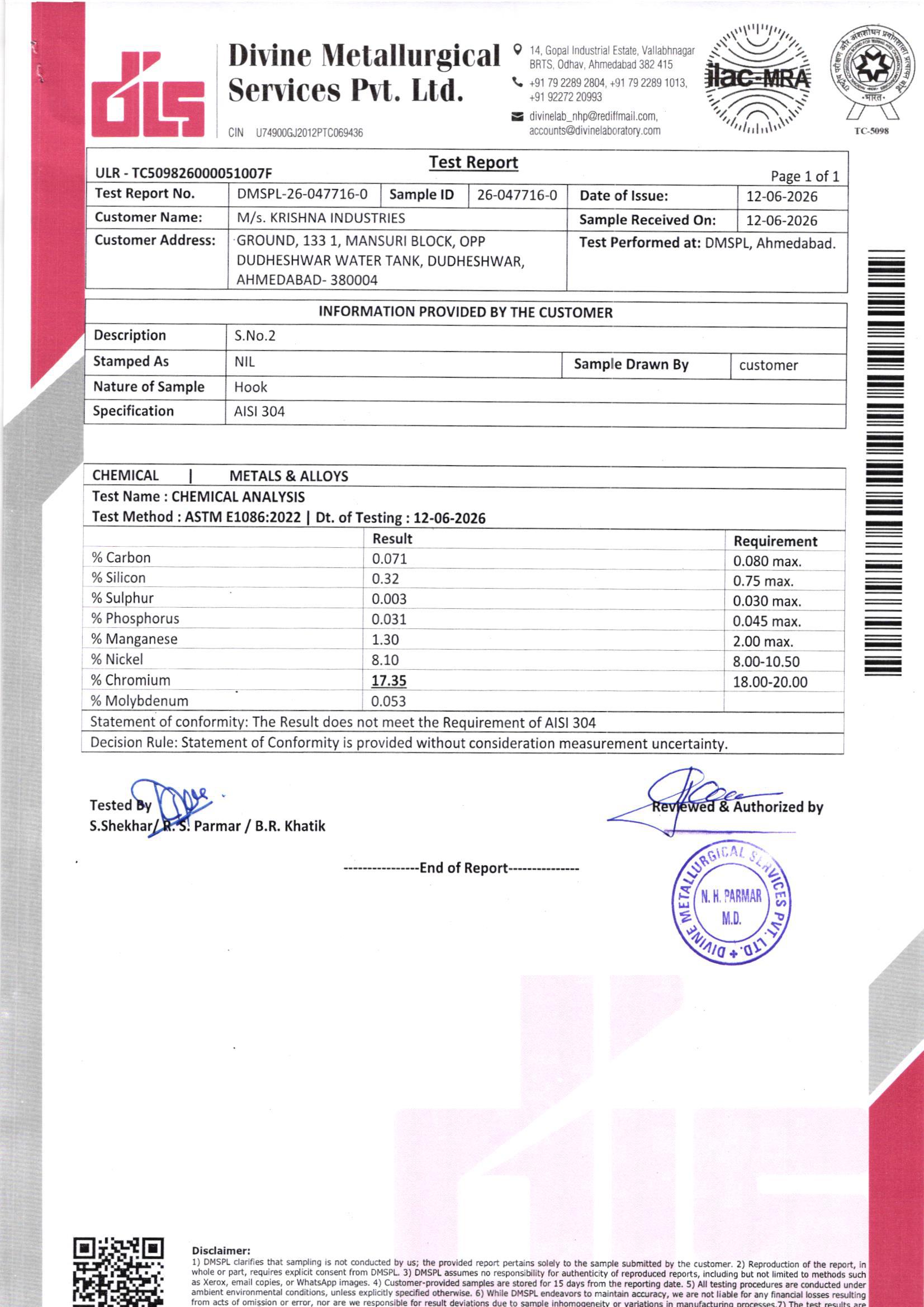
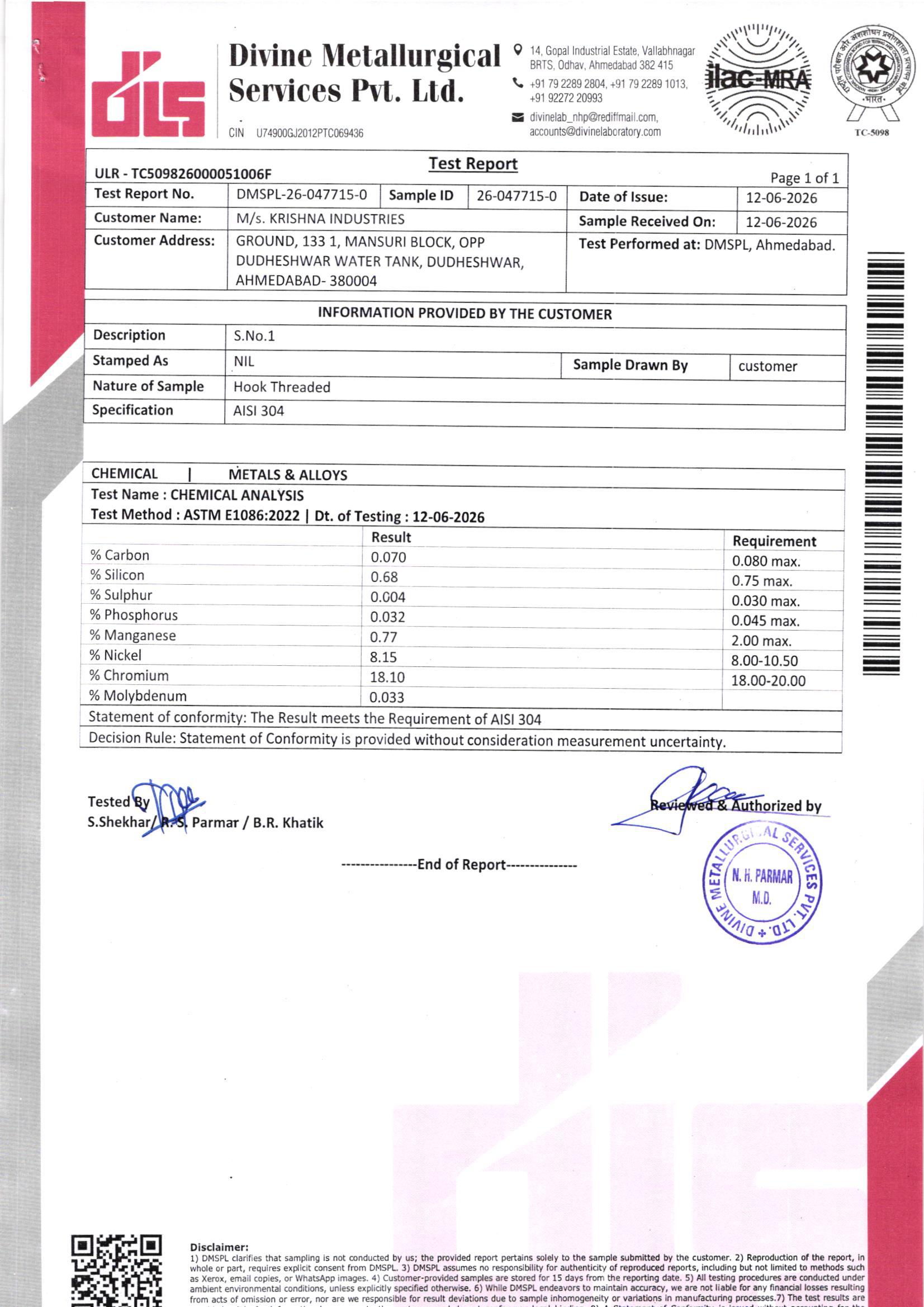
- SS304 Chemical Composition for Eye Bolts
- Technical Specifications — DIN 580 SS304
- DIN 580 WLL Table — M6 to M36
- Angular Load Reduction — Critical Safety
- Dimensional Specifications — M6 to M36
- Hot Forged vs Bent Wire vs Welded — Safety Comparison
- Installation Safety Requirements
- Inspection and Discard Criteria
- SS304 Eye Bolt Applications by Industry
- SS304 vs SS316 — When to Upgrade
- SS304 Fastener Market Snapshot
- Why Choose KELOR as Your SS304 Eye Bolt Supplier
- SS304 Eye Bolt Price & Commercial Information
- People Also Ask: SS304 Eye Bolt Questions
Stainless Steel 304 Eye Bolt: Overview & A2-70 Specs
A stainless steel 304 eye bolt is a threaded fastener with a forged circular loop (eye) at one end and a metric threaded shank at the other, manufactured from AISI 304 (A2-70) stainless steel to DIN 580 dimensional standards. As a dedicated SS304 eye bolt manufacturer in India, KELOR ensures the eye provides a secure attachment point for lifting slings, shackles, wire ropes, and chains, while the threaded shank secures the eye bolt into tapped holes in machinery, equipment, dies, structural members, and lifting frames. SS304 is the most widely specified stainless steel grade for eye bolts in India because it provides inherent corrosion resistance without requiring any protective coating, eliminates the risk of zinc flaking that occurs on zinc-plated carbon steel eye bolts, and complies with food safety and pharmaceutical GMP requirements for clean lifting hardware.
The SS304 eye bolt is manufactured by hot forging from a single continuous piece of SS304 bar stock. The forging process aligns the grain structure of the stainless steel continuously through the eye and shank, ensuring that the full tensile strength of the material is available throughout the eye under load. This is fundamentally different from bent wire eye bolts (where the eye is formed by bending a wire rod with no securing mechanism) and welded eye bolts (where the eye ring is attached to the shank by a weld joint that creates a stress concentration point). Only forged eye bolts are rated for lifting applications. KELOR supplies exclusively hot-forged SS304 eye bolts with WLL (Working Load Limit) stamped on every shank, confirming that each eye bolt meets the DIN 580 rated load capacity for its thread size.
As a trusted bulk SS304 eye bolt supplier, KELOR dispatches plain shank and shoulder collared types from M6 to M36 from our Ahmedabad warehouse. Every eye bolt is individually inspected for dimensional accuracy, surface finish, and WLL marking before dispatch. GST invoices are issued under HSN code 73181590 for all eye bolt dispatches across India, including Maharashtra, Karnataka, Tamil Nadu, Delhi NCR, Rajasthan, and all other states.

Plain Shank vs Shoulder Collared Type
Selecting between plain shank and shoulder collared type is the most critical specification decision for any eye bolt application. The wrong choice can result in a dangerous failure if the eye bolt is subjected to loading conditions it was not designed to handle. The following comparison explains the structural differences and application limitations of each type.
Plain Shank Eye Bolt (Standard)
- Straight cylindrical shank — no collar at base of eye
- For straight-line (axial) loading ONLY — pull exactly in line with bolt axis
- Most common type — standard stock item at KELOR
- DIN 580 standard dimensions — M6 to M36
- Lower cost than shoulder type
- ❌ NOT for angled loading — at 45 degrees, WLL drops to only 30%
- Use: Vertical straight lift where load is directly above the eye bolt
Shoulder (Collared) Eye Bolt
- Machined collar (shoulder) at base of shank bears against mounting surface
- Accepts angled loading up to 45 degrees safely
- Collar takes bending moment that would bend a plain shank
- DIN 580 / ISO 3266 standard — M8 to M36
- Higher cost than plain shank — justified when load angle exceeds 5 degrees
- Mandatory for rigging where load direction is not perfectly vertical
- Use: Horizontal lifts, angle lifts, machinery turning, sling rigging
⚠ Selection Rule: When in Doubt, Specify Shoulder Type
If there is any uncertainty about whether the load will be applied at an angle, always specify the shoulder collared type. The additional cost of the shoulder type is negligible compared to the safety risk of using a plain shank eye bolt in an angled loading application. Many industrial lifting accidents in India occur because a plain shank eye bolt was used where the load was applied at 20 to 45 degrees — a condition where the WLL is already reduced by 35% to 70%. KELOR recommends shoulder type for all applications except those where the lift is confirmed to be perfectly vertical and straight-line.
Why SS304 Over Carbon Steel for Eye Bolts
SS304 stainless steel eye bolts provide a distinct set of advantages over carbon steel eye bolts that justify the higher initial cost in most industrial applications. While carbon steel eye bolts with zinc plating or hot dip galvanising are the economical choice for dry indoor environments, SS304 becomes the preferred and often mandatory specification for applications involving moisture, chemicals, food contact, or cleanroom environments. The following comparison covers the key parameters that industrial buyers should evaluate when selecting the eye bolt material for their specific application.
| Parameter | SS304 Eye Bolt (A2-70) | Carbon Steel Zinc Plated | Carbon Steel HDG |
|---|---|---|---|
| Corrosion Resistance | Excellent — inherent, no coating needed | Moderate — zinc coating degrades in wet environments | Good — 45–85 micron zinc layer |
| Food / Pharma Compliance | Compliant — FDA 21 CFR Part 174 | Non-compliant — zinc contamination risk | Non-compliant — zinc contamination risk |
| Coating Flaking Risk | None — self-colour, no coating | Yes — zinc flakes under load or impact | Minimal — thick HDG layer is more durable |
| Outdoor Service Life | 15–25 years in mild environments | 3–5 years before red rust | 10–15 years |
| Chemical Resistance | Good — mild acids, alkalis, solvents | Poor — coating attacked by chemicals | Poor–Moderate — HDG attacked by acids |
| Cleaning / Sanitisation | Easy — caustic and acid CIP safe | Not recommended — cleaning damages zinc | Limited — strong cleaners attack HDG |
| Aesthetic Appearance | Bright, metallic finish — no rust staining | Bright zinc dulls to grey, then rust stains | Grey metallic, some rust staining long-term |
| Relative Cost | 2–3x carbon steel zinc plated | Lowest — baseline cost | 1.3–1.5x zinc plated |
| Recommended Application | Food, pharma, chemical, outdoor, wet, marine-adjacent | Dry indoor machinery lifting only | Outdoor construction, structural, long-term outdoor |
✅ SS304 — The Standard for Clean Environment Lifting
In food processing plants, pharmaceutical manufacturing facilities, and GMP-compliant environments, SS304 is the mandatory material specification for lifting eye bolts. Zinc-plated and HDG carbon steel eye bolts shed zinc particles and iron corrosion products that contaminate food products, pharmaceutical batches, and cleanroom environments. SS304 provides a smooth, non-shedding, easily sanitised surface that maintains its appearance and integrity through repeated cleaning cycles. For these environments, the higher initial cost of SS304 is insignificant compared to the cost of a product contamination event or regulatory non-compliance finding. KELOR supplies SS304 DIN 580 eye bolts specifically for food and pharmaceutical lifting applications.
SS304 Chemical Composition for Eye Bolts
The corrosion resistance and mechanical properties of SS304 eye bolts are determined by the chemical composition of the stainless steel used in the forging process. The following table defines the composition requirements that KELOR specifies for SS304 eye bolt material, ensuring adequate corrosion resistance and tensile strength for rated lifting applications.
| Element | AISI 304 / A2-70 Requirement | Role in Eye Bolt Performance |
|---|---|---|
| Chromium (Cr) | 18.0 – 20.0% | Forms passive Cr₂O₃ oxide layer — primary corrosion resistance mechanism |
| Nickel (Ni) | 8.0 – 10.5% | Stabilises austenitic structure — provides ductility and toughness in the forged eye |
| Manganese (Mn) | Maximum 2.0% | Deoxidiser during steelmaking — strengthens the forged structure |
| Carbon (C) | Maximum 0.08% | Low carbon for good weldability if post-processing is needed — minimises carbide precipitation |
| Silicon (Si) | Maximum 1.0% | Deoxidiser — improves fluidity during hot forging |
| Phosphorus (P) | Maximum 0.045% | Impurity — kept low to maintain ductility |
| Sulphur (S) | Maximum 0.030% | Impurity — kept low to maintain forgeability and corrosion resistance |
| Tensile Strength | Minimum 515 MPa | Exceeds Grade 4.6 carbon steel (400 MPa) — SS304 WLL equals CS WLL for same DIN 580 size |
| Yield Strength | Minimum 205 MPa | Minimum yield stress before permanent deformation |
Technical Specifications — DIN 580 SS304 Eye Bolt
| Parameter | Specification |
|---|---|
| Standard | DIN 580 (metric) / IS 2585 / ISO 3266 |
| Type | Plain shank (standard) / Shoulder collared (for angled loading) |
| Material | SS304 (AISI 304 / A2-70) — hot forged |
| Manufacturing | Hot forged from single SS304 bar — eye and shank one continuous piece — no weld joint in eye |
| Thread Type | Metric coarse (M6 to M36) — BSW / UNC on request |
| Size Range | M6 to M36 (standard) — M42 to M100 on request |
| Finish | Self-colour (passivated) — no coating required |
| WLL Marking | WLL stamped on shank with thread size — mandatory per IS safety requirements |
| Proof Load | 2x WLL minimum |
| Breaking Load | 4x WLL minimum |
| MOQ | 10 Nos per size per type |
| HSN Code | 73181590 |
DIN 580 Working Load Limit (WLL) Table — SS304 M6 to M36
The Working Load Limit (WLL) is the maximum load that may be safely applied to the SS304 eye bolt in straight-line (axial) lifting. WLL is different from proof load (2x WLL — factory test) and breaking load (4x WLL minimum — ultimate failure). Always size to WLL for safe lifting. The WLL values below apply to SS304 forged eye bolts and are equivalent to carbon steel values for the same DIN 580 thread size because SS304 tensile strength (515 MPa minimum) exceeds the Grade 4.6 carbon steel requirement (400 MPa).
| Thread Size | Shank Dia (mm) | Eye Inner Dia (mm) | Eye Outer Dia (mm) | WLL Straight Pull (kg) | WLL at 15° (kg) | WLL at 30° (kg) | WLL at 45° (kg) |
|---|---|---|---|---|---|---|---|
| M6 | 6 | 12 | 20 | 90 | 72 | 58 | 27 |
| M8 | 8 | 16 | 26 | 200 | 160 | 130 | 60 |
| M10 | 10 | 20 | 32 | 320 | 256 | 208 | 96 |
| M12 | 12 | 22 | 36 | 500 | 400 | 325 | 150 |
| M16 | 16 | 28 | 46 | 900 | 720 | 585 | 270 |
| M20 | 20 | 36 | 58 | 1,400 | 1,120 | 910 | 420 |
| M24 | 24 | 42 | 68 | 2,000 | 1,600 | 1,300 | 600 |
| M30 | 30 | 53 | 85 | 3,200 | 2,560 | 2,080 | 960 |
| M36 | 36 | 63 | 100 | 4,500 | 3,600 | 2,925 | 1,350 |
WLL values per DIN 580 for forged SS304. Angular de-rating: 15 degrees = 80% WLL, 30 degrees = 65% WLL, 45 degrees = 30% WLL. Above 45 degrees — do not use. WLL for SS304 equals carbon steel WLL for same DIN 580 size. Always use shoulder collared type for any angle greater than 5 degrees.
Angular Load Reduction — Critical Safety Information
⚠ Most Common Eye Bolt Accident in Indian Industrial Lifting
Using a plain shank eye bolt at an angle without reducing the rated load. At 45 degrees, an M20 eye bolt rated 1,400 kg straight-line is rated only 420 kg — a 70% reduction. Loads that appear safe by eye bolt size can be 3 to 4 times above the actual angled WLL, leading to sudden eye bolt failure and dropped-load injury.
| Load Angle from Vertical | % of Straight WLL Remaining | Safety Action Required |
|---|---|---|
| 0 degrees (straight vertical) | 100% | Full WLL — standard sizing applies — plain shank acceptable |
| Up to 5 degrees | 100% | Negligible deviation — plain shank acceptable |
| 6 to 15 degrees | 80% | Derate — use shoulder eye bolt — load must be 80% or less of straight WLL |
| 16 to 30 degrees | 65% | Shoulder type mandatory — load must be 65% or less of straight WLL |
| 31 to 45 degrees | 30% | Shoulder type only — severely derated — load must be 30% or less of straight WLL |
| Above 45 degrees | Do Not Use | DIN 580 eye bolt must not be used above 45 degrees — use swivel hoist ring or shackle |
Dimensional Specifications — SS304 Eye Bolt M6 to M36
| Thread | Shank Dia d (mm) | Eye Inner da (mm) | Eye Outer dk (mm) | Eye Width h (mm) | Thread Length b (mm) | Weight per pc (g) |
|---|---|---|---|---|---|---|
| M6 | 6 | 12 | 20 | 14 | 18 | 18 |
| M8 | 8 | 16 | 26 | 18 | 24 | 35 |
| M10 | 10 | 20 | 32 | 22 | 28 | 60 |
| M12 | 12 | 22 | 36 | 26 | 34 | 90 |
| M16 | 16 | 28 | 46 | 32 | 42 | 185 |
| M20 | 20 | 36 | 58 | 38 | 52 | 320 |
| M24 | 24 | 42 | 68 | 44 | 60 | 520 |
| M30 | 30 | 53 | 85 | 54 | 72 | 980 |
| M36 | 36 | 63 | 100 | 62 | 84 | 1,550 |
Hot Forged vs Bent Wire vs Welded — Safety Comparison
Forged SS304 Eye Bolt (KELOR Supplies)
- Hot forged from one continuous SS304 bar — eye and shank monolithic
- Grain structure aligned continuously through eye — full tensile strength available
- WLL stamped on shank — rated for lifting applications
- No weld joint, no discontinuity, no weak point in the eye
- Meets DIN 580 and IS 2585 dimensional and load requirements
- ✅ Safe for rated lifting — specified for all overhead applications
Bent Wire Eye Bolt (NOT for Lifting)
- Made by bending SS wire rod into eye shape — no securing mechanism at eye joint
- Eye can open under load without warning — sudden dropped load
- No WLL marking — not rated for any load
- Grain structure shows sharp bend with surface cracking potential
- Lowest cost — acceptable only for light-duty tethering and hanging
- ❌ Never use for lifting, overhead rigging, or safety-critical applications
Welded eye bolts (where the eye ring is welded to the shank) fall between forged and bent wire in safety. The weld creates a stress concentration point that is weaker than the parent material. Weld quality varies between batches and between suppliers, making the actual load capacity unpredictable. While welded eye bolts may carry a WLL rating from some suppliers, KELOR supplies only hot-forged SS304 eye bolts because the monolithic forged construction provides the most reliable, consistent, and traceable load capacity for safety-critical lifting applications.
Installation Safety Requirements
- Full thread engagement: The threaded shank must be screwed into the base material with full thread engagement — minimum engagement depth equals 1.5 times the bolt diameter (M20 requires minimum 30 mm, M24 requires minimum 36 mm). Partial engagement dramatically reduces pull-out strength and is a leading cause of eye bolt failure during lifting.
- Shoulder type must seat flat: The collar must bear fully and evenly on the mounting surface. If the collar does not contact the surface completely, the bolt is not properly installed and must not be loaded. The collar distributes bending forces from angled loads into the mounting surface rather than concentrating them in the shank.
- Use plain washer with locknut: For through-bolt applications, fit a large flat washer under the nut to distribute load over a larger area. Use a locknut to prevent loosening under vibration. The washer must be SS304 to maintain corrosion compatibility.
- Align the eye with the load plane: Orient the eye so the sling or shackle pulls through the plane of the eye ring — never apply load across the narrow dimension of the eye. Side loading on the eye creates bending stresses that are not accounted for in the WLL rating and can cause premature failure.
- Not for shock loading: Eye bolts rated WLL are for static or slowly applied lifting loads. Do not use for shock loading, drop-testing, or sudden jerking motions. WLL does not cover dynamic impact loading. For dynamic applications, derate the WLL or specify a higher-rated rigging component.
- Inspect before each use: Check every eye bolt for visible deformation, corrosion, cracks, thread damage, or illegible WLL marking before use. Discard any eye bolt with visible deformation of the eye ring — a deformed eye has been overloaded and its WLL cannot be trusted for subsequent lifts.
Inspection and Discard Criteria
| Inspection Point | Accept | Discard Immediately |
|---|---|---|
| Eye ring shape | Round, no visible deformation | Any visible bend, elongation, or distortion of the eye ring |
| Eye-to-shank transition | Smooth, continuous forging radius | Cracks, sharp bends, or visible stress marks at transition |
| Thread condition | Clean, full-depth threads, no galling | Stripped threads, cross-threading, or corrosion damage to threads |
| Surface corrosion | Light surface discolouration (SS304 passive layer) | Pitting corrosion, rust staining, or surface flaking |
| WLL marking | Legible WLL and size stamp on shank | Illegible or missing WLL marking — cannot verify rated load |
| Shoulder collar (if shoulder type) | Flat, even, no deformation | Bent, cracked, or uneven collar surface |
SS304 Eye Bolt Applications by Industry
Food Processing
Lifting mixers, conveyors, stainless steel vessels, oven frames. SS304 eliminates zinc contamination. M12 to M24. FDA compliant.
Pharmaceutical / GMP
Cleanroom equipment positioning, reactor lifting, GMP-compliant rigging. SS304 — CIP-safe surface. M10 to M20.
Chemical Plants
Reactor and vessel lifting in mildly corrosive environments. SS304 withstands most organic chemicals. M12 to M30.
Marine-Adjacent / Coastal
Outdoor equipment in coastal industrial areas with salt spray. SS304 resists atmospheric corrosion. M12 to M24.
Outdoor Industrial
Plant maintenance and MRO store stock for outdoor lifting. SS304 needs no coating renewal. M8 to M24 assortment kits.
Machinery / Equipment
Lifting machine tools, dies, presses, pumps, motors. SS304 for wet or washdown environments. M10 to M24.
Construction / Infrastructure
Precast concrete lifting inserts in coastal zones. SS304 resists corrosion from concrete chemicals. M16 to M30.
Power / Utilities
Transformer positioning, switchgear lifting, outdoor substation equipment. SS304 for long-term outdoor exposure. M16 to M36.
SS304 vs SS316 — When to Upgrade
| Parameter | SS304 (Standard — This Page) | SS316 (Upgrade — Available from KELOR) |
|---|---|---|
| Chromium | 18–20% | 16–18% |
| Nickel | 8–10.5% | 10–14% |
| Molybdenum | None | 2–3% (provides chloride pitting resistance) |
| Pitting Resistance | Adequate for mild chloride (below 200 ppm) | Superior — resists pitting up to 1000 ppm chloride |
| Seawater Immersion | Not recommended — pitting in seawater | Recommended — standard for marine/offshore |
| Food Processing | Standard for most food applications | For high-salt / high-acid food processing |
| Cost Premium over SS304 | Baseline | Approximately 1.5x SS304 cost |
For the majority of industrial applications in India, SS304 provides adequate corrosion resistance at the most economical price point. SS316 should be specified when the application involves seawater immersion, chloride concentrations above 500 ppm, high-acid food processing, or offshore and marine environments. KELOR supplies both SS304 and SS316 forged eye bolts and provides material selection guidance based on the specific environmental conditions of each application.
SS304 Fastener Market Snapshot
Why Choose KELOR as Your SS304 Eye Bolt Supplier
Hot Forged — WLL Marked
Every SS304 eye bolt is hot forged from continuous bar stock with WLL stamped on shank. No bent wire. No weld joints in the eye.
SS304 A2-70 — Self Colour
Inherent corrosion resistance. No zinc plating to flake. No coating to maintain. Compliant for food and pharma lifting applications.
Buy SS304 eye bolts with Material Test Certificate (MTC)
100% GST invoice. MTC confirming SS304 chemical composition (18% Cr, 8% Ni) available on request for full traceability.
MOQ 10 Nos
Minimum 10 Nos per size per type. Mixed size assortment kits M8–M24 available as single GST invoice consignment.
DIN 580 SS304 eye bolt supplier Pan India
M6–M24 plain shank: 5–7 working days. M30–M36 and shoulder type: 10–15 working days. From Ahmedabad.
2-Hour Quotation
WhatsApp thread size, type, and quantity. KELOR responds with bulk SS304 eye bolt pricing within 2 hours during business hours.
Ready to place a heavy duty SS 304 lifting eye bolt bulk order?
WhatsApp thread size (M__), type (plain shank / shoulder), and quantity. Get bulk SS304 eye bolt pricing within 2 hours during business hours.
WhatsApp Now for Price Email: sales@kelorvalves.com