Email:
[email protected]
Phone:
+91 93135 43530
Address:
133/1 Ground, Mansuri Block, Opp. Dudheshwar Water Tank, Ahmedabad-380004, Gujarat, India
VALVES | FASTENERS | FLANGES | FITTINGS
VALVES | FASTENERS | FLANGES | FITTINGS
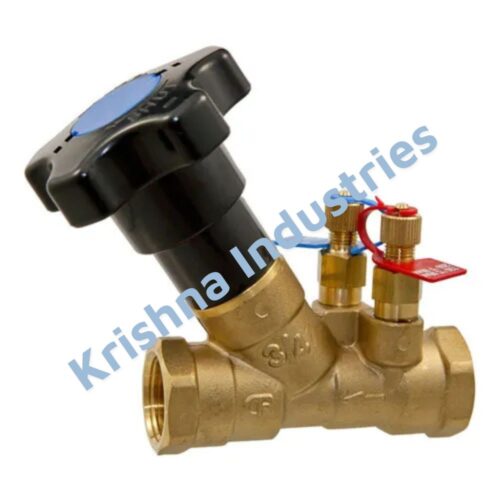
Balancing Valve supplier in Ahmedabad, Gujarat — Manual Balancing Valve (DRV / Double Regulating Valve), Dynamic Balancing Valve (DPCV), and Pressure Independent Control Valve (PICV) — Bronze (DN15–DN50 screwed), Cast Iron, Ductile Iron, Stainless Steel body — flanged and screwed…
Price on Request
Supplier: Krishna Industries (KELOR) – Ahmedabad, Gujarat, India
Established: 2017 | GSTIN: 24AKLPP6499B1ZT | IEC: AKLPP6499B
MOQ: 10 Nos | Types: Manual (DRV) / Dynamic (DPCV) / PICV
Body: Bronze / CI / DI / SS | Sizes: DN15–DN300 | Rating: PN10–PN25
Krishna Industries (KELOR), based in Ahmedabad, Gujarat, is a B2B supplier of Balancing Valves for HVAC and industrial hydronic systems — Manual Balancing Valves (DRV / Double Regulating Valve), Dynamic Balancing Valves (DPCV), and Pressure Independent Control Valves (PICV) — Bronze (DN15–DN50 screwed BSP), Cast Iron, Ductile Iron, and Stainless Steel body — flanged and screwed ends — DN15 to DN300 — PN10 / PN16 / PN25 — Kv rated with integral measuring ports — EN 1653 — GST invoice — MOQ 10 Nos — Pan India dispatch from Ahmedabad.
A balancing valve ensures each branch, zone, or terminal unit in a hydronic system receives its designed flow rate — preventing some units from receiving excess flow while others starve. Without balancing, systems run inefficiently, pumps are oversized, some rooms are overcooled or overheated, and energy is wasted. The correct type depends on whether the system is constant volume (manual balancing valve / DRV) or variable volume with fluctuating pressure (dynamic DPCV or PICV).
| Feature | Manual Balancing Valve (DRV / Double Regulating Valve) |
Dynamic Balancing Valve (DPCV) |
Pressure Independent Control Valve (PICV) |
|---|---|---|---|
| How It Works | Handwheel sets a fixed Kv (flow restriction) — technician measures flow via measuring ports and adjusts handwheel during commissioning until design flow is achieved — setting locked after commissioning | Internal cartridge automatically maintains constant differential pressure across the zone regardless of system pressure changes — flow stays constant without manual adjustment | Combines flow limiting + pressure compensation + modulating control in one body — replaces control valve + balancing valve + DPCV — flow controlled by DDC signal |
| System Type | ✅ Constant volume (CV) systems — fixed pump speed — chilled water two-pipe constant flow | ✅ Variable volume (VV / VRF) systems — variable speed pumps — where pressure fluctuates as zone valves open/close | ✅ Variable volume with DDC control — modern premium buildings with AHU/FCU individual zone control |
| Commissioning | Requires manual commissioning — ΔP meter on measuring ports — adjust Kv to achieve design flow — all branches commissioned sequentially | ✅ Self-compensating — no manual rebalancing needed when system loads change after commissioning | ✅ Flow limiting set once — control signal handles modulation — minimal commissioning effort |
| Measuring Ports | ✅ Yes — integral measuring ports for ΔP meter — essential for commissioning flow measurement | Not required — flow is self-regulated | Not required — flow limiting preset at factory or on-site |
| Lock Shield | ✅ Yes — handwheel lock prevents accidental adjustment after commissioning | N/A | N/A |
| Indian Term | “Balancing valve”, “DRV”, “double regulating valve”, “circuit setter” | “Dynamic balancing valve”, “DPCV”, “pressure independent balancing” | “PICV”, “pressure independent control valve” |
| Cost | ✅ Lowest — simple mechanical design | Medium — internal pressure compensation cartridge | Highest — three functions in one body |
| Specify For | ✅ Constant volume chilled water systems, hot water heating circuits, industrial fluid circulation, secondary pump circuits — standard for most Indian commercial HVAC projects | Variable speed pump systems, large district cooling networks, systems where pump pressure varies significantly — prevents rebalancing as loads change | Premium commercial buildings — hospitals, data centres, high-end hotels — individual DDC-controlled AHU or FCU terminal units |
Every manual balancing valve has a Kv value at each handwheel position — Kv is the flow rate in m³/h that passes through the valve at a differential pressure of 1 bar. A higher Kv means more flow at the same pressure. At each handwheel graduation, the valve’s internal geometry restricts flow to a specific Kv.
During commissioning, the engineer connects a differential pressure (ΔP) meter to the two measuring ports on the valve body. The meter reads the pressure drop across the valve. Using the formula Q = Kv × √ΔP, the engineer calculates the actual flow through the valve and adjusts the handwheel until the design flow is achieved. This is why measuring ports are not optional — without them, flow measurement requires a separate in-line flow meter, significantly increasing installation cost and complexity.
When ordering: always confirm the valve has integral measuring ports (Schraeder valve type or capped nipple type). Confirm the Kv table is supplied with the valve for commissioning reference.
| Body Material | Size Range | End Connection | Specify For |
|---|---|---|---|
| Bronze (Gunmetal) | DN15–DN50 | Screwed BSP (standard) | ✅ Small bore HVAC chilled water and hot water — standard for FCU balancing valves, fan coil unit branch balancing, terminal unit connections — better corrosion resistance than CI in closed-loop treated water with glycol and inhibitors |
| Cast Iron (CI) | DN65–DN200 | Flanged PN16 | Large bore AHU supply and return balancing, chiller plant secondary headers, cooling tower distribution — economical for large bore above DN50 |
| Ductile Iron (DI) | DN200–DN300 | Flanged PN16/PN25 | Very large bore district cooling distribution, campus chilled water networks — stronger than CI at large bore |
| Stainless Steel | DN15–DN100 | Screwed / Flanged | Pharmaceutical process water, food and beverage, aggressive media — where bronze or CI corrodes |
| Parameter | Manual DRV | Dynamic DPCV / PICV |
|---|---|---|
| Design Standard | EN 1653 / EN 1074-1 | EN 1653 / EN 1074-1 |
| Body Material | Bronze / CI / DI / SS | Bronze / CI / SS |
| Internals | SS / Bronze disc and seat | SS cartridge / bronze internals |
| End Connection | Screwed BSP / Flanged / Grooved | Screwed BSP / Flanged |
| Size Range | DN15 to DN300 | DN15 to DN150 |
| Pressure Rating | PN10 / PN16 / PN25 | PN16 / PN25 |
| Max Temperature | 120°C (standard) / 150°C on request | 90°C standard |
| Measuring Ports | ✅ Yes — Schraeder or capped nipple | Not applicable |
| Lock Shield | ✅ Yes — after commissioning setting | Not applicable |
| Kv Table | ✅ Supplied with valve | Flow limiting scale |
| MOQ | 10 Nos | |
| HSN Code | 84818030 | |
Yes — “double regulating valve” (DRV) is the British and Indian HVAC industry term for a manual balancing valve. “Double regulating” refers to the two functions: flow regulation (Kv setting) and isolation (full close). Indian MEP consultants and HVAC contractors use both terms — “balancing valve” and “DRV” — interchangeably. When a project specification says “DRV at each AHU return connection”, it is specifying a manual balancing valve with measuring ports and lock shield. All Krishna Industries manual balancing valves can be supplied with DRV designation on documentation.
A globe valve is a general-purpose flow control and isolation valve — it can throttle flow but has no calibrated Kv scale, no measuring ports, and no lock shield. It tells you nothing about actual flow rate. A balancing valve (DRV) has a calibrated handwheel with Kv values at each position, integral measuring ports for connecting a ΔP meter to measure actual flow, and a lock shield to preserve the commissioned setting. You cannot commission an HVAC system with globe valves — you need balancing valves with measuring ports to verify and set design flow at each branch.
If your system runs at constant flow with a fixed-speed pump — constant volume chilled water two-pipe system — manual DRV is the correct and more economical choice. Once commissioned, each branch stays at design flow because the pump pressure is constant. If your system has variable speed pumps or VRF/VRV systems where pump pressure fluctuates as zone control valves open and close — dynamic DPCV or PICV is needed. Manual DRV settings drift in variable pressure systems because a pressure change changes the flow through a fixed Kv. Dynamic valves compensate automatically.
Bronze (gunmetal) provides better corrosion resistance than cast iron in closed-loop chilled water and hot water systems — particularly where glycol and corrosion inhibitors are used in the water treatment programme. CI can corrode at threaded joints and internal surfaces in treated closed-loop water, producing iron oxide particles that foul valve seats and measuring ports. For DN15–DN50 screwed-end balancing valves in HVAC, bronze body is the industry standard specification. CI is acceptable at larger flanged sizes where the cost premium of bronze becomes significant.
MOQ is 10 Nos total. HVAC project orders for commercial buildings, hospitals, or data centres — 50 to 500+ Nos across sizes (DN20, DN25, DN32, DN40, DN50 bronze DRV are the most common mix for FCU balancing) — with Kv tables, technical datasheets, and GST invoice. WhatsApp valve type (manual / dynamic / PICV), body material, size list, and quantity for project pricing within 2 hours.
Krishna Industries (KELOR) supplies Balancing Valves for Indian HVAC and hydronic systems — Manual Balancing Valve (DRV / Double Regulating Valve), Dynamic Balancing Valve (DPCV), and Pressure Independent Control Valve (PICV) — Bronze (DN15–DN50 screwed), CI, DI, and SS body — flanged and screwed BSP ends — DN15 to DN300 — PN10 / PN16 / PN25 — Kv rated with measuring ports and lock shield — EN 1653. Commercial buildings, hospitals, hotels, district cooling, data centres, pharmaceutical, and industrial fluid circuits. GST invoice, Kv table supplied, Pan India dispatch from Ahmedabad. WhatsApp valve type, body material, size list, and quantity for project pricing within 2 hours.
Reviews
There are no reviews yet.