Email:
[email protected]
Phone:
+91 93135 43530
Address:
133/1 Ground, Mansuri Block, Opp. Dudheshwar Water Tank, Ahmedabad-380004, Gujarat, India
VALVES | FASTENERS | FLANGES | FITTINGS
VALVES | FASTENERS | FLANGES | FITTINGS
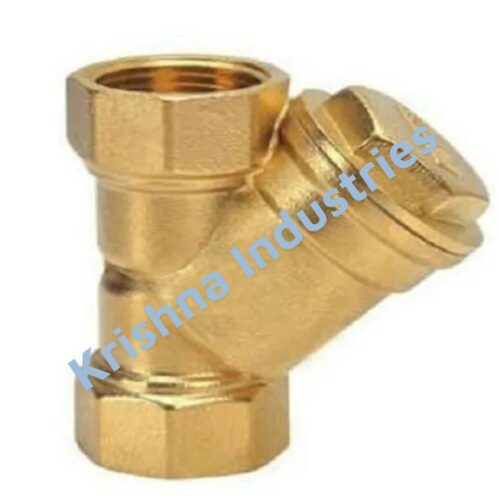
Brass Y Strainer supplier in Ahmedabad, Gujarat. Dezincification resistant brass body (CW617N / IS 319) — removable SS304 wire mesh screen (standard 40 mesh) / brass mesh screen — BSP taper thread (IS 554) and NPT (ASME B1.20.1) — PN16…
Price on Request
Supplier: Krishna Industries (KELOR) – Ahmedabad, Gujarat, India
Established: 2017 | GSTIN: 24AKLPP6499B1ZT | IEC: AKLPP6499B
MOQ: 10 Nos | Body: Dezincification Resistant Brass (CW617N / IS 319)
Thread: BSP / NPT | Sizes: DN8–DN80 | Mesh: SS304 / Brass
Krishna Industries (KELOR), based in Ahmedabad, Gujarat, supplies Brass Y Strainers — dezincification resistant brass body (CW617N / IS 319) — removable SS304 wire mesh screen (standard 40 mesh) or brass mesh screen — BSP taper thread (IS 554) and NPT (ASME B1.20.1) — PN16 — DN8 (¼”) to DN80 (3″) — mesh sizes: 20 mesh (coarse), 40 mesh (standard), 80–100 mesh (fine) — GST invoice — MOQ 10 Nos — Pan India dispatch from Ahmedabad.
A brass Y strainer is installed upstream of pumps, pressure reducing valves (PRVs), control valves, flow meters, and solenoid valves to trap solid particles — sand, rust, scale, welding slag — before they reach and damage sensitive downstream equipment. Furthermore, the Y-shaped body allows the strainer screen to be accessed and cleaned without removing the valve from the pipeline. Consequently, maintenance time is reduced to 5–10 minutes per cleaning cycle without pipeline disruption.
| Factor | Brass Y Strainer (This Page) | CS / WCB Y Strainer | SS316 Y Strainer |
|---|---|---|---|
| Body Material | Dezincification resistant brass — copper-zinc alloy with arsenic addition — prevents zinc leaching in water service | Cast carbon steel WCB — strong — suitable for high pressure — corrodes in water service without internal coating | SS316 CF8M — maximum corrosion resistance — suitable for aggressive chemical, seawater, chloride service |
| Corrosion in Water | ✅ Excellent — brass does not corrode in standard water, soft water, hot water (DR grade) — preferred over CS for water service | Corrodes internally in water — produces rust — contaminates downstream equipment — requires internal coating for water service | ✅ Excellent — SS316 resists all standard water types including chloride-rich water |
| End Connection | ✅ BSP/NPT threaded — DN8–DN80 — standard for plumbing and small bore piping | Flanged or screwed — DN15–DN200 — standard for process plant | Flanged or screwed — DN15–DN200 — standard for chemical and pharma |
| Pressure Rating | PN16 (standard) — adequate for plumbing, HVAC, and light industrial | Class 150 / 300 — higher pressure process plant service | Class 150 / 300 — higher pressure corrosive service |
| Cost | ✅ Lower than SS for light duty water and air service — economical for plumbing and HVAC | Similar to brass at small bore — higher at large bore | Higher — SS material premium — justified for corrosive or contamination-sensitive service |
| Specify For | ✅ Water supply, HVAC, compressed air, steam utility (to 150°C), diesel fuel, irrigation, plumbing, building services — DN8–DN80 BSP/NPT | Steam, oil, gas, process plant piping — flanged — DN15–DN200 — where higher pressure required | Chemical plant, pharma, food, seawater — flanged — DN15–DN200 — corrosive media |
For CS and SS flanged Y strainers for industrial process plant service, see the Y Strainer — Industrial CS and SS page.
Standard brass (CW614N) is a copper-zinc alloy. In certain water conditions — soft water, slightly acidic water, or hot water above 60°C — the zinc selectively leaches from the brass surface. This process is called dezincification. It leaves a weak porous copper structure that crumbles and fails. The failure appears as white powdery deposits at the failure point.
Dezincification resistant brass (CW617N / IS 319 DR) contains a small addition of arsenic (0.02–0.04%) that inhibits zinc leaching. As a result, the alloy maintains its mechanical properties in conditions that would dezincify standard brass.
Specify dezincification resistant brass for: hot water systems above 60°C, soft water or slightly acidic water supply, coastal areas with aggressive water chemistry, and any installation where standard brass fittings have failed prematurely with white powdery deposits.
| Mesh Grade | Mesh Count | Hole Size (Approx) | Specify For | Do Not Use For |
|---|---|---|---|---|
| Coarse | 20 mesh | ~841 micron | ✅ Pump suction protection, raw water intake, river water, water with large sand or debris loading — lower pressure drop — suitable for high flow | Upstream of solenoid valves, spray nozzles, or precision instruments where fine particles also cause damage |
| Standard | 40 mesh | ~400 micron | ✅ General purpose — HVAC chilled and hot water, potable water supply, compressed air, diesel fuel lines — upstream of PRVs, control valves, flow meters — most common Indian HVAC and plumbing specification | Applications with extremely high particle loading where 40 mesh clogs too rapidly — use 20 mesh instead |
| Fine | 80–100 mesh | ~149–178 micron | Upstream of solenoid valves, precision flow meters, spray nozzles, instrument connections, pilot valve orifices — where even small particles cause blockage or measurement error | ✅ Do not use on raw or dirty water supply — fine mesh clogs extremely rapidly — causes pressure drop and pump starvation — specify coarse or standard instead |
The most common installation error with Y strainers on Indian construction sites is incorrect orientation. The strainer pocket — the leg of the Y that holds the mesh basket — must point downward or at a downward angle. Gravity then helps particles settle into the bottom of the pocket. As a result, the basket fills from the bottom and the maximum screen area remains active for longer before cleaning is needed.
If the pocket faces upward, particles cannot settle. Instead, they float back into the flow stream and continue cycling through the screen. The basket clogs rapidly near the top. Furthermore, when the end cap is opened for cleaning, trapped debris spills back into the pipeline.
| Pipeline Orientation | Correct Y Strainer Pocket Position | Notes |
|---|---|---|
| Horizontal pipeline | ✅ Pocket pointing straight down — 6 o’clock position | Most common installation — debris settles into pocket by gravity — standard orientation |
| Horizontal pipeline — space constrained | ✅ Pocket at 45° downward angle — 4 o’clock or 8 o’clock position | Acceptable where vertical clearance below pipe is insufficient — particle settling still effective at 45° |
| Vertical pipeline — upward flow | Pocket pointing sideways — 3 o’clock or 9 o’clock position | Gravity does not assist settling in vertical flow — more frequent cleaning required — check manufacturer drawing for vertical installation suitability |
| ❌ Never | ❌ Pocket pointing upward — 12 o’clock position | Debris cannot settle — floats back into flow — basket clogs at top — cleaning is messy — do not install in this orientation under any circumstances |
Site instruction: Mark “POCKET DOWN” on the strainer body with a paint marker before dispatch for site installation. Additionally, mark the flow direction arrow. These two markings prevent the most common installation errors on Indian construction sites.
| Parameter | Specification |
|---|---|
| Body Material | Dezincification resistant brass CW617N / IS 319 DR (standard) / Standard brass CW614N (on request) |
| Screen / Basket Material | SS304 wire mesh (standard) / Brass wire mesh (on request) |
| Mesh Size | 20 mesh (coarse) / 40 mesh (standard) / 80 mesh (fine) / 100 mesh (fine) — specify at order |
| End Cap / Plug | Brass BSP threaded end cap — rubber or fibre gasket seal — reusable |
| End Connection | BSP taper thread (IS 554 / BS 21) — standard / NPT (ASME B1.20.1) — on request |
| Size Range | DN8 (¼”) to DN80 (3″) — DN8–DN50 most common |
| Pressure Rating | PN16 (standard) — PN25 on request |
| Temperature Range | Up to 120°C (standard rubber gasket) / up to 150°C (fibre gasket for steam service) |
| Media | Water, compressed air, steam (to 150°C), diesel fuel, light oil, irrigation water, mild chemicals |
| Installation | Horizontal (standard — pocket down) / vertical (pocket sideways) — never pocket up |
| MOQ | 10 Nos |
| HSN Code | 84213990 |
DN15–DN50 BSP 40 mesh — upstream of chilled water coil connections, fan coil unit supply valves, cooling tower spray nozzles, PRVs on hot water systems. Furthermore, protects control valves and balancing valves from scale and pipe debris in new HVAC installations. Standard specification for Indian MEP contractors on commercial building HVAC projects.
DN15–DN50 BSP 40 mesh — upstream of water meters, solenoid valves, pressure reducing valves, and water treatment equipment in residential buildings, hospitals, hotels, and commercial buildings. Moreover, protects overhead tank float valves from sand and debris in Indian municipal water supply systems where water quality varies significantly.
DN15–DN50 BSP 40 mesh — upstream of pneumatic tools, solenoid valves, air cylinders, and spray guns on factory compressed air lines. In addition, installed downstream of air compressor outlet to protect downstream equipment from compressor scale and particulates. Brass body resists oil-contaminated compressed air better than cast iron.
DN15–DN50 BSP 40 mesh with fibre gasket — upstream of steam traps, steam control valves, and steam-using equipment in building services and light industrial steam systems. DR brass body handles steam to 150°C. Therefore, specify fibre gasket (not rubber) for steam service to prevent gasket degradation at elevated temperature.
DN15–DN25 BSP 40 mesh — upstream of diesel generator fuel filters, burner fuel control valves, and fuel metering equipment. Brass resists diesel and light fuel oil attack. Consequently, it is the standard body material for fuel line strainers on Indian DG sets and oil burner systems.
DN25–DN80 BSP 20 mesh (coarse) — upstream of drip irrigation emitters, sprinkler heads, and fertigation injectors. Coarse mesh for raw water from bore wells and open channels with high sand and debris loading. DR brass resists aggressive bore well water chemistry common in Indian agricultural areas.
A brass Y strainer has a threaded BSP/NPT connection and is designed for DN8–DN80 plumbing, HVAC, water supply, and light industrial service. It is the correct and most economical choice for water, air, steam (to 150°C), and diesel in standard building and utility piping. An industrial CS or SS Y strainer has flanged connections and is designed for DN15–DN200 process plant piping at higher pressures and temperatures — steam, oil, gas, and chemical process lines. Specify brass for building services and light industrial screwed connections; specify CS or SS flanged for process plant piping.
Specify 40 mesh (400 micron) for standard HVAC chilled water and hot water service. This mesh size is fine enough to protect control valves, balancing valves, and coil connections from scale and debris while maintaining acceptable pressure drop. For new HVAC installations with clean pipe systems, 40 mesh may need cleaning only once or twice in the first year after flushing. For systems with old pipework and heavy scale loading, 20 mesh (coarser) prevents rapid clogging while still protecting from the largest particles that cause valve seat damage.
Yes — brass Y strainers are suitable for steam service up to 150°C at PN16 pressure rating. However, specify a fibre or PTFE gasket on the end cap instead of the standard rubber gasket — rubber gaskets degrade rapidly at steam temperatures and cause end cap leakage. DR brass body is essential for steam service as it prevents dezincification in the condensate-steam environment. For steam above 150°C or above PN16 pressure, specify a carbon steel or SS flanged Y strainer instead.
Rapid clogging within days or weeks of installation has three common causes. First, the mesh is too fine for the particle loading in the water — specify coarser 20 mesh for dirty raw water or bore well water. Second, the strainer is installed with the pocket pointing up — particles cannot settle into the pocket and immediately recoat the screen — reinstall with pocket down. Third, the pipeline was not flushed before commissioning — new pipelines contain welding slag, pipe scale, and rust that loads the strainer rapidly in the first few weeks — plan for more frequent cleaning in the first month after commissioning, then the cleaning frequency reduces significantly.
MOQ is 10 Nos. Bulk supply for HVAC contractors, plumbing traders, hardware distributors, and OEM equipment manufacturers — 50 to 5,000+ Nos — with GST invoice and size-wise packing list. WhatsApp thread type (BSP/NPT), size list, mesh size, and quantity for bulk pricing within 2 hours.
Krishna Industries (KELOR) supplies Brass Y Strainers for water supply, HVAC, compressed air, steam utility, diesel fuel, and irrigation applications across India — dezincification resistant brass body (CW617N / IS 319 DR) — SS304 wire mesh (standard 40 mesh) or brass mesh screen — BSP taper (IS 554) and NPT (ASME B1.20.1) thread — PN16 — DN8 (¼”) to DN80 (3″) — 20 mesh (coarse) / 40 mesh (standard) / 80–100 mesh (fine) — GST invoice — Pan India dispatch from Ahmedabad. WhatsApp thread type, size list, mesh size, and quantity for bulk pricing within 2 hours.
Reviews
There are no reviews yet.