Email:
[email protected]
Phone:
+91 93135 43530
Address:
133/1 Ground, Mansuri Block, Opp. Dudheshwar Water Tank, Ahmedabad-380004, Gujarat, India
VALVES | FASTENERS | FLANGES | FITTINGS
VALVES | FASTENERS | FLANGES | FITTINGS
Duplex Strainer supplier in Ahmedabad, Gujarat. SS316 (CF8M), WCB, and Cast Iron body — SS316 perforated basket with mesh lining — manual lever or automatic pneumatic changeover valve — integral ΔP gauge on each chamber — bolted cover — flanged…
Price on Request
Supplier: Krishna Industries (KELOR) – Ahmedabad, Gujarat, India
Established: 2017 | GSTIN: 24AKLPP6499B1ZT | IEC: AKLPP6499B
MOQ: 10 Nos | Body: SS316 (primary) / WCB / CI
Changeover: Manual lever / Automatic pneumatic | Sizes: DN25–DN300
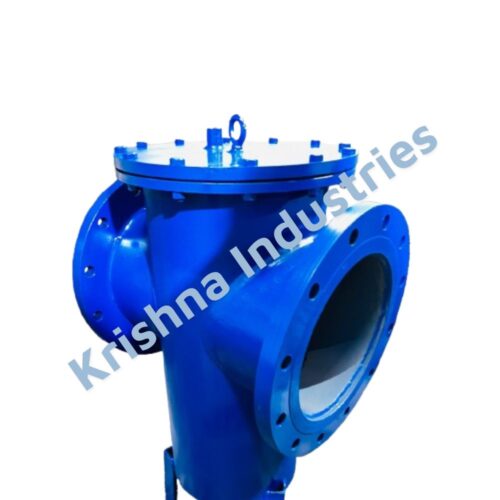
Krishna Industries (KELOR), based in Ahmedabad, Gujarat, is a B2B supplier of Duplex Strainers — SS316 (CF8M), WCB, and Cast Iron body — SS316 perforated basket with mesh lining — manual lever or automatic pneumatic changeover valve — integral differential pressure (ΔP) gauge — bolted cover — flanged ASME B16.5 — DN25 to DN300 — Class 150 / Class 300 — custom mesh from 20 micron to 3mm — MTC and hydro test report on request — GST invoice — MOQ 10 Nos — Pan India dispatch from Ahmedabad.
A duplex strainer provides continuous pipeline filtration without any process shutdown for basket cleaning. While one basket chamber is in service filtering the process fluid, the other chamber is isolated, depressurised, and available for cleaning — cover removed, basket cleaned, cover replaced, chamber re-pressurised — then the changeover valve switches flow to the clean chamber. The process line never stops flowing. This is the reason duplex strainers are specified for continuous process plants, critical pump protection, and any service where shutting down a single Y strainer or basket strainer to clean it is not acceptable.
Understanding the changeover sequence is essential for correct installation and operation. The duplex strainer has two identical basket chambers — Chamber A and Chamber B — connected to a common inlet header and outlet header through the central changeover valve body.
Normal operation — Chamber A in service: Changeover valve directs all flow through Chamber A basket. Chamber B is isolated — both inlet and outlet ports to B are closed. Chamber B is at zero pressure — cover can be safely removed at any time.
Switching to Chamber B: Operator turns manual lever (or pneumatic actuator operates automatically) to intermediate position — briefly both chambers are in parallel — flow continues uninterrupted, pressure drop actually decreases momentarily. Lever continues to full B position — Chamber A is now isolated, Chamber B is in full service.
Cleaning Chamber A: Chamber A is at zero pressure. Remove bolted cover. Lift out basket. Clean basket with compressed air, water jet, or by dipping in cleaning solution. Inspect mesh for damage. Replace basket. Refit cover. Tighten cover bolts evenly. Chamber A is now ready for next switchover.
Key point: at no point during this sequence does the process line stop flowing. The pump continues running, the process continues, and the system pressure is maintained throughout.
| Feature | Manual Lever Changeover | Automatic Pneumatic Changeover |
|---|---|---|
| Operation | Operator turns lever by hand — quarter turn redirects flow — simple and immediate | ΔP switch monitors pressure drop across active basket — when ΔP exceeds set point, pneumatic actuator automatically switches to clean chamber |
| Operator Requirement | Operator must be present at strainer location to switch chambers — suitable for manned plants with regular operator rounds | ✅ No operator presence required — switches automatically when basket is loaded — suitable for unmanned or remote installations |
| DCS / PLC Integration | Manual only — no signal to control room | ✅ ΔP switch signal to DCS — operator gets alarm in control room — automatic switchover can be logged in DCS historian — useful for maintenance scheduling |
| Response to High ΔP | Depends on operator noticing ΔP gauge reading during rounds — risk of delayed response if rounds are infrequent | ✅ Immediate automatic response — protects downstream pump and equipment from high ΔP starvation regardless of operator availability |
| Cost | ✅ Lower — no actuator, no ΔP switch, no solenoid | Higher — pneumatic actuator + ΔP switch + solenoid valve + tubing |
| Best For | ✅ Manned process plants — chemical plant, pharma, refinery — where operators make regular rounds and monitor ΔP gauge — standard specification for most Indian process plant duplex strainers | ✅ Unmanned / remote — offshore platforms, remote pumping stations, pipeline booster stations, critical pump protection where automatic response to basket loading is mandatory |
| Feature | Duplex Strainer | Y Strainer |
|---|---|---|
| Continuous Operation | ✅ Yes — one chamber in service while other is cleaned — zero process interruption | ❌ No — pipeline must be shut down and depressurised to clean screen |
| Screen Area (at same pipe size) | ✅ 10–15× pipe cross-section area — large cylindrical basket — much lower velocity through screen | 2–3× pipe cross-section area — limited by Y body geometry — higher screen velocity |
| Pressure Drop (clean) | ✅ Very low — large screen area = low approach velocity — minimal ΔP at design flow | Higher than duplex at same pipe size — smaller screen area |
| Cleaning Frequency | ✅ Less frequent — large basket holds more debris before ΔP reaches maximum — days or weeks between cleanings in moderate service | More frequent — smaller screen fills faster — may need daily cleaning in high particle loading service |
| Installation Size | Larger — dual chamber body — more piping space required | ✅ Compact — small body — fits in tight piping layouts |
| Cost | Higher — dual chamber, changeover valve, ΔP gauges | ✅ Lower — simple Y body, single screen |
| Specify For | ✅ Continuous process — cannot shut down to clean — high particle loading — critical pump protection — pharma, chemical, refinery, power plant BFW, offshore | ✅ Non-continuous service — can shut down periodically — moderate particle loading — HVAC, utility water, general industrial — where process can be interrupted briefly for cleaning |
| Mesh Specification | Filtration Size | Specify For |
|---|---|---|
| 3mm perforated plate only | 3mm | Coarse debris — irrigation, raw water, large particle removal |
| 3mm perf + 1mm mesh | 1mm (1000 micron) | General pump protection — cooling water, utility water |
| 3mm perf + 500 micron mesh | 500 micron | ✅ Standard — general process pump protection — most common Indian process plant specification |
| 3mm perf + 250 micron mesh | 250 micron | Fine pump protection — boiler feed water, condensate — protects BFP wearing rings |
| 3mm perf + 150 micron mesh | 150 micron | Control valve protection — upstream of globe control valves, cage trim control valves |
| 3mm perf + 100 micron mesh | 100 micron | Instrument protection — upstream of flow meters, pressure transmitters |
| 3mm perf + 50 micron mesh | 50 micron | Fine filtration — pharmaceutical process water, food product lines |
| 3mm perf + 20 micron mesh | 20 micron | Very fine — ultrapure water, sterile pharma, semiconductor process water |
| Parameter | Specification |
|---|---|
| Body Material | SS316 (CF8M ASTM A351) — primary WCB (ASTM A216) — on request CI (ASTM A126) — on request |
| Basket / Screen | SS316 perforated plate with SS316 wire mesh lining — custom mesh 20 micron to 3mm |
| Changeover Valve | Manual lever (standard) / Automatic pneumatic (on request) |
| ΔP Gauge | Standard — one per chamber — glycerine filled 0–4 bar |
| Cover | Bolted flat cover (DN25–DN150) / Bolted dome cover (DN200+) |
| Cover Gasket | PTFE (standard) / Spiral wound SS316+graphite / EPDM |
| End Connection | Flanged ASME B16.5 |
| Pressure Class | Class 150 (standard) / Class 300 |
| Size Range | DN25 (1″) to DN300 (12″) — DN400+ on request |
| Temperature Range | -20°C to +250°C (SS316) / -20°C to +400°C (WCB) |
| Design Basis | ASME VIII / ASME B16.5 / Client piping class |
| Testing | Hydrostatic pressure test — body and cover |
| Documents | MTC (ASTM A351/A216) / Hydro test report / Dimensional report on request |
| MOQ | 10 Nos |
| HSN Code | 84212990 |
Yes — this is the fundamental design purpose of a duplex strainer. When the operator moves the changeover lever to switch from Chamber A to Chamber B, there is a brief moment when both chambers are in parallel service — the process line never stops flowing and pressure is maintained throughout. Once Chamber A is isolated, it is at zero pressure and can be opened safely for basket cleaning. The pump keeps running, the process continues, and the system sees no interruption. This is why duplex strainers are specified in continuous process plants, pharmaceutical manufacturing, and food production lines where stopping the process has significant cost or compliance consequences.
For centrifugal pump protection — general process service — 500 micron (0.5mm) mesh lining on 3mm perforated plate is the standard Indian process plant specification. This stops particles that would damage wearing rings and mechanical seals while maintaining acceptable pressure drop. For boiler feed pumps (BFP) — 250 micron — finer protection for the close-clearance BFP impeller wearing rings and balance disc. For control valve protection upstream of cage trim control valves — 150 micron. Always specify both the perforated plate hole size AND the mesh micron rating — “3mm perf with 500 micron mesh” — to avoid ambiguity in supply.
Each chamber has a differential pressure (ΔP) gauge showing pressure drop across the active basket. A clean basket at design flow typically shows 0.1–0.3 bar ΔP. As the basket collects debris, ΔP rises. The maximum allowable ΔP before switching is set by the project specification — typically 0.5–1.0 bar for most Indian process plant applications. Operator makes rounds and reads the ΔP gauge — when it approaches the maximum, the chamber is switched. For automatic changeover units, a ΔP switch is set to the maximum allowable value and triggers the pneumatic actuator automatically.
A basket strainer is a single-chamber strainer with a large cylindrical basket — larger screen area and lower pressure drop than a Y strainer — but it is still a single strainer requiring shutdown to clean. A duplex strainer is two basket strainers in one body with a changeover valve — it has all the basket strainer advantages (large screen area, low ΔP) plus continuous operation capability. For non-critical service where the line can be shut down occasionally, a basket strainer is economical. For continuous process service, duplex is required.
MOQ is 10 Nos. Pharma, chemical, or power plant project orders — 5 to 50+ Nos across sizes — with material test certificates (ASTM A351 CF8M for SS316 body, ASTM A216 WCB), hydrostatic pressure test report, dimensional inspection report, and GST invoice. For automatic changeover units — ΔP switch datasheet, actuator torque data, and wiring diagram supplied. WhatsApp body material, size, Class, mesh specification, changeover type, and quantity for project pricing within 2 hours.
The Duplex Strainer supplied by Krishna Industries (KELOR) is the continuous-operation pipeline filtration solution for Indian process plants — SS316 (CF8M), WCB, and Cast Iron body — SS316 perforated basket with mesh lining (20 micron to 3mm) — manual lever or automatic pneumatic changeover valve — integral ΔP gauge on each chamber — bolted cover — flanged ASME B16.5 — DN25 to DN300 — Class 150 / Class 300. Pharmaceutical, chemical, food processing, power plant BFW/condensate, refinery, offshore — wherever the pipeline cannot be shut down to clean a single strainer. MTC, hydro test report, ΔP switch datasheet on request. GST invoice, Pan India dispatch from Ahmedabad. WhatsApp body material, size, Class, mesh specification, changeover type, and quantity for project pricing within 2 hours.
Reviews
There are no reviews yet.