Email:
[email protected]
Phone:
+91 93135 43530
Address:
133/1 Ground, Mansuri Block, Opp. Dudheshwar Water Tank, Ahmedabad-380004, Gujarat, India
VALVES | FASTENERS | FLANGES | FITTINGS
VALVES | FASTENERS | FLANGES | FITTINGS
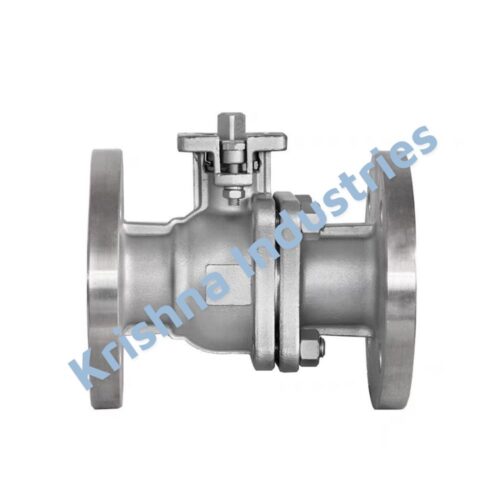
Flanged Ball Valve supplier in Ahmedabad, Gujarat. WCB, LCB, CF8M (SS316), CF3M (SS316L), Duplex body — PTFE / RPTFE / metal seat — floating and trunnion mounted — full bore and reduced bore — Class 150 / Class 300 /…
Price on Request
Supplier: Krishna Industries (KELOR) – Ahmedabad, Gujarat, India
Established: 2017 | GSTIN: 24AKLPP6499B1ZT | IEC: AKLPP6499B
MOQ: 10 Nos | Standard: ASME B16.34 / API 6D / API 607
Sizes: DN50–DN600 | Rating: Class 150 / 300 / 600
Krishna Industries (KELOR), based in Ahmedabad, Gujarat, is a B2B supplier of Flanged Ball Valves — WCB, LCB, CF8M (SS316), CF3M (SS316L), and Duplex body — PTFE, RPTFE, and metal seat — floating and trunnion mounted — full bore and reduced bore — Class 150, Class 300, Class 600 — DN50 to DN600 — ASME B16.5 flanged ends — lever, gear, pneumatic, and electric actuated — ASME B16.34 / API 6D / API 607 fire safe — anti-static device — blow-out proof stem — third-party inspection on request — GST invoice — MOQ 10 Nos — Pan India dispatch from Ahmedabad.
The flanged ball valve is the standard quarter-turn isolation valve for medium and large bore process plant, petrochemical, oil and gas, chemical, refinery, and power plant piping — DN50 and above — Class 150 to Class 600 — where screwed-end or socket weld ball valves are not suitable due to pressure class, pipe size, or piping code requirements. The flanged end connection allows the valve to be bolted securely to standard ASME B16.5 pipe flanges, provides the mechanical strength for high-pressure service, and allows removal from the pipeline without disturbing adjacent pipework.
| Feature | Floating Ball Valve | Trunnion Mounted Ball Valve |
|---|---|---|
| Ball Support | Ball supported by two seats only — ball “floats” between seats | Ball fixed by top and bottom trunnion (axle) — ball cannot move laterally |
| Sealing Mechanism | Line pressure pushes ball against downstream seat — seat provides sealing force | Spring-loaded seats float toward ball — sealing independent of line pressure |
| Operating Torque | Higher — line pressure loads ball onto seat — seat friction increases with pressure | ✅ Lower — seat load is spring force only, not line pressure — easier to operate at large bore and high pressure |
| Seat Load at High Pressure | Increases with pressure — PTFE seat can deform or extrude at large bore / high pressure | ✅ Constant — spring-loaded seat load does not increase with line pressure |
| Practical Size Limit | DN50 to DN150 at Class 150/300 — DN200+ in high pressure not recommended | ✅ DN50 to DN600 and above — standard for DN200+ or Class 300+ at any size |
| API 6D Pipeline Service | Not preferred — API 6D pipeline valves are typically trunnion | ✅ Standard for API 6D pipeline ball valves |
| Fire Safe Capability | Fire safe design possible at smaller bore — less common | ✅ Standard platform for fire safe API 607 / API 6FA design |
| Cost | ✅ Lower — simpler design, fewer components | Higher — trunnion bearings, independent spring-loaded seats |
| Specify When | ✅ DN50–DN150 Class 150/300, moderate utility and process service, cost-sensitive projects | ✅ DN200 and above at any pressure / DN50+ at Class 300 and above / API 6D pipeline service / fire safe requirement |
| Feature | Full Bore (Full Port) | Reduced Bore (Standard Port) |
|---|---|---|
| Ball Bore Diameter | Equal to pipe bore — full unobstructed flow path | One pipe size smaller than pipe bore |
| Pressure Drop | ✅ Minimal — no restriction in open position | Higher — smaller bore creates velocity increase and pressure drop |
| Pigging Capability | ✅ Yes — full bore allows pipeline pig to pass through | ❌ No — reduced bore blocks pig |
| Slurry / Solids | ✅ Better — full bore reduces settling and blockage risk | Solids may accumulate at bore step |
| Ball Size | Larger ball — higher material cost | ✅ Smaller ball — lower cost |
| Specify When | ✅ Pipeline pigging required, slurry, viscous media, low pressure drop critical, API 6D pipeline valves | Standard process isolation where pressure drop is acceptable and pigging not required — most economical choice |
| Pressure Class | Max Pressure (WCB at 38°C) | Typical Indian Applications |
|---|---|---|
| Class 150 | 19.6 bar (285 psi) | ✅ Most common — general process plant, chemical utility, water treatment, pharma, HVAC large bore, ETP — covers majority of Indian process piping applications |
| Class 300 | 51.1 bar (740 psi) | Higher pressure process lines, refinery utility, boiler feed water, steam systems, compressor discharge — where Class 150 pressure rating is insufficient |
| Class 600 | 102.1 bar (1480 psi) | High pressure oil & gas, high pressure steam, compressor inter-stage — typically trunnion mounted, fire safe, API 6D specification |
Note: Pressure rating decreases with temperature — WCB Class 150 rated at 19.6 bar at 38°C reduces to 14.8 bar at 260°C. Always confirm operating temperature AND pressure when ordering. Refer to ASME B16.34 pressure-temperature tables for exact ratings at operating temperature.
| Material | ASTM Grade | Temperature Range | Specify For |
|---|---|---|---|
| WCB (Carbon Steel) | ASTM A216 WCB | -29°C to +425°C | ✅ Most common — general process, chemical, oil & gas, steam, water — most economical carbon steel option |
| LCB (Low Temp Carbon Steel) | ASTM A352 LCB | -46°C to +345°C | Cryogenic service, cold climate installations, LNG, propane — where WCB becomes brittle at low temperature |
| WC6 (Alloy Steel) | ASTM A217 WC6 | -29°C to +593°C | High temperature refinery and steam service — 1¼Cr-½Mo alloy for elevated temperature strength |
| CF8M (SS316) | ASTM A351 CF8M | -196°C to +400°C | Corrosive chemical, pharmaceutical, food contact, marine, chloride service — where carbon steel corrodes |
| CF3M (SS316L) | ASTM A351 CF3M | -196°C to +400°C | SS316L low carbon — used where post-weld sensitisation of CF8M is a concern in welded pipework |
| Duplex SS (CD3MN) | ASTM A890 CD3MN | -46°C to +316°C | Seawater, high chloride, aggressive acid — higher strength and better pitting resistance than CF8M |
A fire safe flanged ball valve is designed so that if the soft PTFE seat is destroyed by fire, a secondary metal-to-metal seal between the ball and the body cavity prevents the valve from leaking flammable or hazardous pipeline contents into the fire zone. Without fire safe design, a burning seat can cause uncontrolled release of flammable media, accelerating the fire and creating explosion risk.
Fire safe construction features:
Fire safe is mandatory for: refineries, petrochemical plants, flammable chemical service, LPG and LNG installations, hydrocarbon process lines, and any application where leakage of media during a fire event would be dangerous. Confirm API 607 or API 6FA requirement with your project HSE specification.
| Parameter | Floating Ball | Trunnion Mounted Ball |
|---|---|---|
| Design Standard | ASME B16.34 / API 608 / API 6D (pipeline) | |
| Testing Standard | API 598 — shell, seat, backseat leakage | |
| Fire Test | API 607 (soft seat) / API 6FA (metal seat) | |
| Flange Standard | ASME B16.5 Class 150 to Class 600 | |
| Face-to-Face | ASME B16.10 | |
| Body Material | WCB / LCB / WC6 / CF8M / CF3M / Duplex | |
| Ball Material | SS316 (standard) / SS304 / Duplex — chrome plated or ENP coated | |
| Seat Material | PTFE / RPTFE / Metal (SS316+Stellite) | |
| Stem Seal | PTFE / Graphite (fire safe) — blow-out proof stem standard | |
| Body Style | Split body (2-piece) or top entry — flanged ends | |
| Bore | Full bore / Reduced bore — confirm at order | |
| Size Range | DN50 to DN150 (standard range) | DN50 to DN600 (standard range) |
| Pressure Rating | Class 150 / Class 300 | Class 150 / Class 300 / Class 600 |
| Operation | Lever (DN50–DN80) / Gear (DN100+) / Pneumatic / Electric | |
| Anti-Static Device | Standard on fire safe design / optional on standard | |
| Locking Device | Lever lock / gear lock — on request | |
| TPI / Third Party Inspection | EIL / PDIL / BVQI / Lloyds on request | |
| MOQ | 10 Nos | |
| HSN Code | 84818010 | |
In a floating ball valve, the ball is supported only by the two seats and floats between them — line pressure pushes the ball against the downstream seat to create the seal. This works well at smaller bore and lower pressure, but at large bore and high pressure, the seat load becomes very high, requiring high operating torque and risking seat deformation. In a trunnion mounted valve, the ball is fixed on top and bottom trunnion axles and cannot move laterally — independent spring-loaded seats float toward the ball — sealing force comes from the spring, not line pressure. Trunnion is the standard for DN200 and above, Class 300 and above, and all API 6D pipeline ball valves.
CF8M (ASTM A351 CF8M — cast SS316) is the standard flanged ball valve body for chemical plant and corrosive media service in India — good resistance to dilute mineral acids, organic acids, alkalis, chloride solutions, and most industrial chemicals. For more aggressive service — concentrated mineral acids, seawater, high chloride — specify Duplex (CD3MN). For non-corrosive process and utility service, WCB is the most economical and standard choice for process piping at Class 150 and 300.
Fire safe design (API 607 / API 6FA) is mandatory for any valve handling flammable, toxic, or hazardous media in a process plant — refineries, petrochemical, LPG, LNG, hydrocarbon process lines, chemical plants handling flammable solvents. Your project HSE specification and piping class document will state “fire safe per API 607” or “API 6FA” if required. If your application is non-flammable utility — cooling water, instrument air, DM water — fire safe is not required.
Third-party inspection by EIL (Engineers India Limited), PDIL, BVQI, Lloyds, and Bureau Veritas can be arranged for PSU and government project orders. TPI typically covers material identification (PMI), dimensional inspection, hydrostatic testing witnessed by TPI inspector, and review of MTR documentation. Additional cost and lead time apply — confirm TPI requirement at order placement, not at dispatch.
RPTFE is reinforced PTFE — PTFE compound filled with glass fibre, carbon fibre, or graphite particles. The reinforcement improves PTFE’s creep resistance and load-bearing capacity — under high seat load (large bore or high pressure floating ball), plain PTFE can slowly deform and extrude, causing seat leakage over time. RPTFE maintains its shape under higher load. Specify RPTFE for Class 300 and above or DN150 and above floating ball valves, and for high cycle frequency applications.
MOQ is 10 Nos. Project orders for EPC, refinery, petrochemical, or process plant — 10 to 500+ Nos across sizes and ratings — with hydro test reports (API 598), MTR (ASTM A216 WCB / A351 CF8M / A352 LCB), dimensional reports (ASME B16.34), and TPI on request. WhatsApp body material, pressure class, bore type (full/reduced), floating or trunnion, size list, and quantity for project pricing within 2 hours.
The Flanged Ball Valve supplied by Krishna Industries (KELOR) is the process plant quarter-turn isolation valve for medium and large bore applications — WCB, LCB, CF8M, CF3M, Duplex body — PTFE, RPTFE, metal seat — floating (DN50–DN150) and trunnion mounted (DN50–DN600) — full bore and reduced bore — Class 150, Class 300, Class 600 — ASME B16.5 flanged — lever, gear, pneumatic, and electric actuated — ASME B16.34 / API 6D / API 607 / API 608 — fire safe design available — anti-static device — blow-out proof stem — TPI on request. GST invoice, Pan India dispatch from Ahmedabad. WhatsApp body material, pressure class, bore type, size list, and quantity for project pricing within 2 hours.
Reviews
There are no reviews yet.