Email:
[email protected]
Phone:
+91 93135 43530
Address:
133/1 Ground, Mansuri Block, Opp. Dudheshwar Water Tank, Ahmedabad-380004, Gujarat, India
VALVES | FASTENERS | FLANGES | FITTINGS
VALVES | FASTENERS | FLANGES | FITTINGS
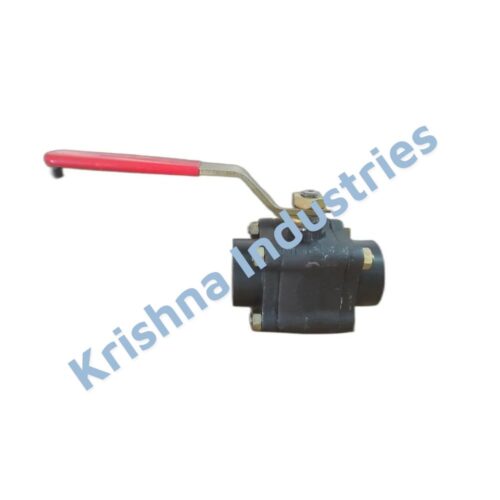
Forged 3-Piece Ball Valve supplier in Ahmedabad, Gujarat. ASTM A105 forged carbon steel body — SS316 ball — CFT (Carbon Filled PTFE) seat — PTFE / graphite stem packing — Class 800# (ASME B16.34) — Screwed BSP/NPT / Socket Weld…
Price on Request
Supplier: Krishna Industries (KELOR) – Ahmedabad, Gujarat, India
Established: 2017 | GSTIN: 24AKLPP6499B1ZT | IEC: AKLPP6499B
MOQ: 10 Nos | Body: ASTM A105 Forged CS | Ball: SS316
Seat: CFT | Pressure: Class 800# | Sizes: DN15–DN150
Krishna Industries (KELOR), based in Ahmedabad, Gujarat, is a B2B supplier of Forged 3-Piece Ball Valves — ASTM A105 forged carbon steel body — SS316 ball — CFT (Carbon Filled PTFE) seat — PTFE stem packing — Class 800# — screwed BSP/NPT / socket weld (SW ASME B16.11 Class 3000) / butt weld (BW) / flanged end connections — DN15 (½”) to DN150 (6″) — API 598 shell and seat leakage tested — GST invoice — MOQ 10 Nos — Pan India dispatch from Ahmedabad.
The forged 3-piece ball valve is the standard small bore isolation valve for Indian oil and gas, refinery, petrochemical, and high pressure process plant piping — specified wherever Class 800# pressure rating is required, forged body integrity is mandatory, and in-line seat replacement without cutting pipeline welds is essential to minimise maintenance downtime.
| Property | Cast Body (ASTM A216 WCB) | Forged Body (ASTM A105) |
|---|---|---|
| Manufacturing | Molten metal into mould — random grain structure — potential micro-porosity — heavier wall required | ✅ Billet forged — grain aligned — no porosity — thinner wall achieves higher pressure rating — denser, stronger |
| Pressure Class (ASME B16.34) | Table 1 — Class 150 / 300 / 600 / 900 — cast body — Class 800# does not exist in Table 1 | ✅ Table 2 — Class 800# / 1500# / 2500# — forged body exclusive — Class 800# cannot be supplied in cast body per ASME B16.34 |
| Size Range | DN40 and above — casting economical at large bore — structurally inferior at small bore | ✅ DN8–DN150 — forging superior for small bore — standard for all DN50 and below high pressure valves in Indian oil and gas and petrochemical piping |
| Body Integrity | RT of casting required to verify no internal voids — castings occasionally rejected on RT | ✅ No casting porosity — no RT required — 100% dimensional and material compliance |
| Weight | Heavier — thicker wall — more material | ✅ Lighter — thinner wall — compact — lower load on small bore piping supports |
| Indian Application | Process plant DN40+ — general industrial Class 150/300/600 | ✅ Small bore high pressure — oil and gas instrument root valves, drain, vent, sample valves — all Indian refinery and petrochemical Class 800# small bore piping specifications |
| Feature | 1-Piece / 2-Piece Body | 3-Piece Body |
|---|---|---|
| Seat Replacement | Weld cut → valve removed → new valve welded → PWHT if required → RT of new weld → hydro test — 4–8 hours minimum — welder + NDT team required | ✅ Depressurise → undo 4 body bolts → slide out centre body → replace CFT seats and ball → reassemble — 30–60 minutes — instrument technician only — end welds completely undisturbed |
| Maintenance Cost | High — cutting, welding, PWHT, RT, hydro test — welder and NDT mobilisation for every seat replacement | ✅ Low — seat and ball kit only — no welding, no RT, no hydro test — done during normal shutdown by in-house technician |
| In-Line Cleaning | Cannot be cleaned without removal | ✅ Centre body removed and cleaned — full access to ball and seat surfaces — reinstalled without disturbing pipeline |
| Ball Inspection | Cannot assess ball and seat condition without valve removal | ✅ Centre body removed — ball surface and seat condition visually assessed — go/no-go maintenance decision without replacement |
| End Connection | Standard | Specify For |
|---|---|---|
| Screwed BSP / NPT | ASME B16.11 Class 800# BSP: IS 554 / BS 21 NPT: ASME B1.20.1 |
✅ Instrument root valves — threaded to nozzle on process vessel or instrument tapping — drain and vent valves — DN8–DN50 — where periodic removal without cutting is needed — most economical — standard for Indian instrument hook-up drawings in oil and gas |
| Socket Weld (SW) | ASME B16.11 Class 3000 (matches Class 800# body rating) |
✅ High pressure small bore process piping — DN15–DN50 — permanent installation — cleaner bore than screwed — no thread intrusion — standard for Indian refinery and petrochemical piping class for small bore process isolation — SW Class 3000 fitting with Class 800# valve is the standard Indian oil and gas small bore combination |
| Butt Weld (BW) | ASME B16.25 API 6D |
Full penetration weld — RT testable — for lethal service (H₂S, HF acid), Category M fluid, or piping class requiring 100% RT of all welds — DN50–DN150 — where SW crevice corrosion is a concern in aggressive chemical service |
| Flanged | ASME B16.5 Class 600 / Class 900 |
DN50 and above — equipment nozzle connections — where valve removability for maintenance is required — flanged Class 800# body with ASME B16.5 Class 600 or 900 flanges |
| Property | Virgin PTFE Seat | CFT (Carbon Filled PTFE) Seat |
|---|---|---|
| Cold Flow | Deforms under sustained pressure — seat cold-flows into ball surface — valve binds at high pressure after extended time in one position | ✅ Carbon filler reduces cold flow significantly — valve operates freely after extended periods under Class 800# pressure |
| Wear Resistance | Lower — abrasive particles cut virgin PTFE faster — shorter seat life in high cycle service | ✅ Higher — carbon filler increases hardness — longer seat life in high cycle oil and gas instrument root valve service |
| Dimensional Stability | Dimensions change under pressure and temperature cycling — sealing performance varies | ✅ Carbon filler stabilises dimensions — consistent sealing across pressure and temperature cycles |
| Specify When | Low pressure, low cycle, clean non-abrasive media — standard industrial below Class 600 | ✅ Class 800# — high pressure — high cycle — oil and gas, refinery, petrochemical — any application where valve is cycled frequently and seat life is a maintenance cost factor |
| Parameter | Specification |
|---|---|
| Valve Type | 3-Piece Forged Ball Valve — full bore |
| Body Material | ASTM A105 forged carbon steel |
| Ball Material | SS316 (standard) / SS304 / hard chrome plated SS for abrasive service |
| Seat Material | CFT — Carbon Filled PTFE (standard) / Virgin PTFE / RPTFE / Graphite (high temp) |
| Stem Material | SS316 — blow-out proof stem design |
| Stem Packing | PTFE (standard) / Graphite (high temp above 180°C) |
| Body Bolts | ASTM A193 B7 studs with A194 2H nuts |
| Pressure Class | Class 800# (ASME B16.34 Table 2) — Class 1500# on request |
| Pressure at 38°C | ~138 bar (2000 psi) — refer ASME B16.34 P-T table |
| Temperature Range | -29°C to +200°C (CFT seat) / to +425°C (graphite packing) |
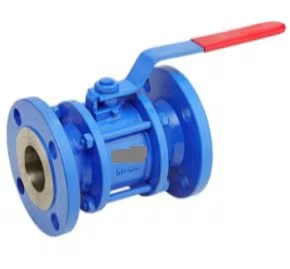
| End Connections | Screwed BSP/NPT / Socket Weld ASME B16.11 Class 3000 / Butt Weld ASME B16.25 / Flanged ASME B16.5 |
| Size Range | DN15 (½”) to DN150 (6″) |
| Bore | Full bore (standard) / Reduced bore on request |
| Testing | API 598 — shell test and seat leakage test (zero leakage — Class VI) |
| Fire Safe | API 607 on request |
| Operation | Lever (standard DN15–DN80) / Gear (DN100+) / Pneumatic / Electric on request |
| MOQ | 10 Nos |
| HSN Code | 84818090 |
Class 800# is a pressure-temperature rating defined in ASME B16.34 Table 2, which applies exclusively to forged valve bodies. The standard defines two tables — Table 1 for cast bodies (Class 150, 300, 600, 900, 1500, 2500) and Table 2 for forged bodies (Class 800, 1500, 2500). Class 800# does not appear in Table 1 because cast bodies cannot achieve the same pressure integrity as forged at small bore without disproportionately heavy wall thickness. ASTM A105 forged body at Class 800# provides approximately 138 bar working pressure at 38°C — dropping with temperature per the ASME B16.34 P-T table. For any Indian project specifying Class 800# on the valve data sheet, a forged body is mandatory — a cast WCB valve cannot be supplied as Class 800#.
When a ball valve has permanent weld end connections (SW or BW), replacing a worn seat or damaged ball in a 1-piece valve requires cutting the weld, removing the valve, welding in a new valve, performing PWHT if specified, and RT of the new weld — a full day per valve requiring welders, NDT technicians, and PWHT equipment. A 3-piece ball valve eliminates this entirely — four body bolts are undone, the centre body slides out with ball and seats, maintenance is completed, and the valve is back in service in 30–60 minutes without touching the welds. Over a 20-year plant life with multiple seat replacements, the 3-piece design saves substantially more than its cost premium over 1-piece body valves.
CFT (Carbon Filled PTFE) contains 15–25% carbon filler in a PTFE matrix, making it significantly harder and more dimensionally stable than virgin PTFE. Virgin PTFE cold-flows under sustained high pressure — the seat deforms into the ball surface and the valve becomes difficult to operate after extended time in one position. CFT resists cold flow, wears more slowly in high-cycle service, and maintains consistent sealing performance across pressure and temperature cycles. For Class 800# oil and gas and refinery service where valves are cycled frequently and seat replacement requires plant shutdown, CFT seat life advantage over virgin PTFE translates directly to lower maintenance frequency and cost.
No — a ball valve is an on/off isolation valve only. In the partially open position, high velocity flow through the restricted ball opening causes severe erosion of the ball surface and CFT seat edge. For flow control in Class 800# high pressure small bore service, a forged needle valve or globe valve is the correct specification. Automated forged ball valves (pneumatic or electric actuated) are used for remote on/off switching — not for modulating control.
MOQ is 10 Nos. Refinery and petrochemical project orders — typically 50 to 2,000+ Nos across sizes and end connection types — with API 598 test certificate, MTC for ASTM A105 body and SS316 ball, dimensional inspection report, and GST invoice. Fire safe (API 607) certification on request. WhatsApp body material, ball material, seat material, end connection type, size list, pressure class, and quantity for project pricing within 2 hours.
Krishna Industries (KELOR) supplies Forged 3-Piece Ball Valves for high pressure small bore isolation in Indian oil and gas, refinery, petrochemical, power plant, and chemical plant piping — ASTM A105 forged carbon steel body — SS316 ball — CFT (Carbon Filled PTFE) seat — Class 800# — screwed BSP/NPT / socket weld ASME B16.11 Class 3000 / butt weld / flanged — DN15 (½”) to DN150 (6″) — API 598 tested — fire safe API 607 on request — GST invoice — Pan India dispatch from Ahmedabad. WhatsApp end connection type, size list, and quantity for project pricing within 2 hours.
Reviews
There are no reviews yet.