Email:
[email protected]
Phone:
+91 93135 43530
Address:
133/1 Ground, Mansuri Block, Opp. Dudheshwar Water Tank, Ahmedabad-380004, Gujarat, India
VALVES | FASTENERS | FLANGES | FITTINGS
VALVES | FASTENERS | FLANGES | FITTINGS
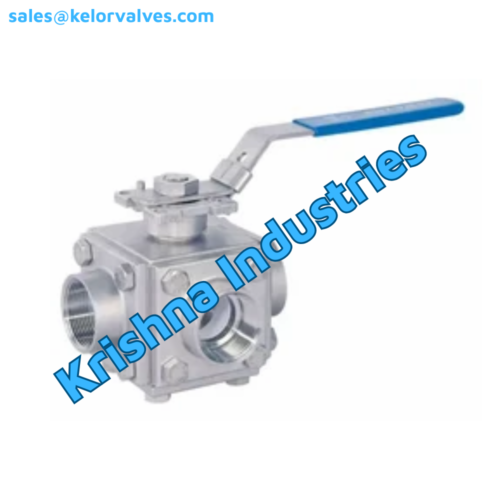
Four Way Ball Valve supplier in Ahmedabad, Gujarat. L-port (flow diversion / source selection — one active path at a time) and X-port (cross-flow / parallel flow — two active paths simultaneously) — WCB (ASTM A216) / SS304 (CF8) /…
Price on Request
Supplier: Krishna Industries (KELOR) – Ahmedabad, Gujarat, India
Established: 2017 | GSTIN: 24AKLPP6499B1ZT | IEC: AKLPP6499B
MOQ: 10 Nos | Body: WCB / CF8 / CF8M / A105 Forged
Config: L-Port & X-Port | Sizes: DN15–DN200 | Pressure: Class 150–800#
Krishna Industries (KELOR), based in Ahmedabad, Gujarat, is a B2B supplier of Four Way Ball Valves — L-port and X-port ball configurations — WCB (ASTM A216) / SS304 (CF8 ASTM A351) / SS316 (CF8M ASTM A351) / Forged CS (ASTM A105) body — SS316 ball — PTFE / RPTFE / metal seat — lever / gear / pneumatic actuated / electric actuated — flanged ASME B16.5 / screwed BSP NPT / socket weld — Class 150 / 300 / 600 (flanged) / Class 800# (forged screwed and SW) — DN15 (½”) to DN200 (8″) — API 598 tested — GST invoice — MOQ 10 Nos — Pan India dispatch from Ahmedabad.
A four way ball valve performs flow switching, diversion, source changeover, and cross-connection functions in a single compact valve body — replacing two separate two-way valves, tee fittings, and interconnecting pipework with one valve, one actuator, and four piping connections. The port configuration — L-port or X-port — determines the flow switching function and must be specified correctly before ordering.
The internal bore geometry of the ball — L-shaped or X-shaped — determines which ports are connected in each valve position and therefore what flow switching function the valve performs. L-port and X-port are not interchangeable. Specifying the wrong port configuration results in a valve that cannot perform the required switching function regardless of body material, pressure class, or actuator type.
| Feature | L-Port Configuration | X-Port Configuration |
|---|---|---|
| Ball Bore Shape | L-shaped (90° elbow) internal bore through ball — connects two adjacent ports at 90° to each other | X-shaped (cross / plus) internal bore through ball — connects all four ports or two pairs of opposite ports |
| Ports Active Simultaneously | Maximum 2 ports connected at any position — one inlet and one outlet — remaining ports blocked | ✅ Up to 4 ports active — at 0° all four ports connected — at 90° two separate pairs of opposite ports connected simultaneously |
| Flow States | 4 distinct positions (0°, 90°, 180°, 270°) each connecting a different pair of adjacent ports — sequential port selection — one path open at a time | 2 distinct states — cross flow (all four open) and parallel flow (two separate A↔C and B↔D paths simultaneously) |
| Primary Function | ✅ DIVERT — switch one inlet between two outlet lines. SELECT — connect one of two inlets to one outlet. SOURCE CHANGEOVER — switch from main supply to backup supply without stopping flow | CROSS-CONNECT — connect two separate circuits simultaneously or switch between straight-through and cross-connected states. FLOW REVERSAL — reverse flow direction through heat exchangers and regenerative systems |
| Can All 4 Ports Be Open Together? | ❌ No — L-port always blocks at least one port — one path active at a time only | ✅ Yes — at 0° cross position all four ports are open and connected |
| Indian Process Plant Applications | ✅ Most common — tank switching (filling tank A or tank B from one pump), pump duty/standby changeover, dual-media filter inlet switching, chemical injection source changeover, instrument bypass manifolds, hydraulic cylinder direction control | Heat exchanger flow reversal to prevent fouling (reverse flow through shell side periodically), mixing two streams, regenerative heat recovery systems, connecting two separate process circuits in cross-connected mode |
| Specify When | ✅ Flow must be directed to one destination at a time — source changeover required — sequential switching — the majority of Indian four way ball valve applications use L-port | Two circuits must be cross-connected or flow direction must be reversible in a single valve — heat exchanger anti-fouling — regenerative systems — less common in standard Indian process plant but standard for HX anti-fouling systems |
The most common alternative to a four way ball valve is two separate two-way ball valves installed with tee fittings and interconnecting pipework. The correct choice depends on the specific application, budget, and maintenance philosophy.
| Factor | Two Separate 2-Way Ball Valves + Tees | One Four Way Ball Valve |
|---|---|---|
| Components | 2 valve bodies + 2 stems + 2 seat sets + 2 tee fittings + interconnecting pipe spools + 2 actuators (if automated) + 2 actuator signal cables/air lines | ✅ 1 valve body + 1 stem + 1 seat set + 1 actuator + 1 actuator signal — significantly fewer components |
| Leak Paths | 8 flanged joints (2 valves × 4 nozzles) + 4 tee joints + stem seals on 2 valves — more potential leak points in the switching assembly | ✅ 4 flanged joints + 1 stem seal — minimum leak paths for a four-port switching function |
| Automation Complexity | Two actuators must be sequenced correctly — wrong sequence (both valves open simultaneously) can cause cross-contamination or pressure surge — PLC logic required for safe sequencing | ✅ Single actuator — position determines flow path — no sequencing logic required — inherently safe switching — no simultaneous open condition possible (L-port) |
| Installation Space | Larger — two valve bodies + tees + connecting pipework — significant space in compact piping areas | ✅ Compact — one valve body with four direct piping connections — standard for tight equipment skids and OEM machinery where piping space is constrained |
| Redundancy | ✅ If one valve fails, the other may still provide partial function — some redundancy in the system | If four way valve fails, entire switching function is lost — no partial function available — critical service should have bypass provision |
| Specify Four Way When | — | ✅ Compact OEM equipment skids, automation where sequencing error is a risk, applications with tight installation space, when single actuator signal is required, when minimising leak paths is important |
| Body Material | Standard | Pressure Class | Specify For |
|---|---|---|---|
| WCB (Cast Carbon Steel) |
ASTM A216 WCB ASME B16.34 |
Class 150 / 300 / 600 | ✅ Industrial process four way valves — oil, steam, compressed air, non-corrosive chemical switching — most common Indian process plant specification for four way ball valve — economical — strong — widely available with MTC |
| CF8 (SS304) | ASTM A351 CF8 ASME B16.34 |
Class 150 / 300 / 600 | Mildly corrosive switching service — DM water diversion, mild chemical source changeover, pharmaceutical utility line switching, food processing utility — where CS corrodes internally and SS316 is over-specified |
| CF8M (SS316) | ASTM A351 CF8M ASME B16.34 |
Class 150 / 300 / 600 | ✅ Corrosive chemical switching — acid/alkali source changeover, chloride-containing process, pharma GMP process line switching, food contact service — best corrosion resistance in standard cast SS range — standard for Indian chemical and pharmaceutical four way valve specifications |
| Forged CS (ASTM A105) |
ASTM A105 ASME B16.34 |
Class 800# (standard) Class 1500# on request |
High pressure small bore four way service — hydraulic system direction control, instrument manifold switching, high pressure utility source changeover — DN15–DN50 screwed BSP/NPT or socket weld — Class 800# where cast WCB Class 600 is insufficient |
Actuating a four way ball valve requires careful attention to rotation range and position stops — a standard two-way ball valve actuator rotates 90° between fully open and fully closed. A four way ball valve has four functional positions at 0°, 90°, 180°, and 270° — the actuator must be capable of stopping precisely at each required position, not just at 0° and 90°.
| Operator Type | Specify For | Key Requirement for Four Way |
|---|---|---|
| Lever (Manual) | DN15–DN50 — low frequency manual switching — maintenance changeover — operator present at valve location | Lever with detent positions at 0°, 90°, 180°, 270° — ensures operator selects exact port position — lever position indicates selected flow path visually |
| Gear Operator | DN80 and above — high torque large bore — manual operation where lever torque is too high | Gear with adjustable mechanical stops at required positions — position indicator on gear operator |
| Pneumatic Actuated | ✅ Most common for automated four way switching — DCS/PLC signal — fast response — spring return to defined safe position on air failure | Requires rack and pinion or scotch yoke actuator with defined stop positions at 0° and 90° (or 0°, 90°, 180° for three-position service) — position switches (limit switches) at each stop position — confirm with actuator supplier that four way valve torque at all four positions is within actuator output — four way valve torque is typically higher than two-way valve of same bore and pressure class |
| Electric Actuated | Remote switching where instrument air unavailable — mining, remote pump stations, unmanned locations — position feedback to SCADA | Multi-turn or part-turn electric actuator with programmable stop positions — torque switch protection at each stop — manual override for power failure — position feedback 4-20mA or digital to control room |
| Parameter | Specification |
|---|---|
| Valve Type | Four way ball valve — L-port (divert/select) and X-port (cross-connect/reverse flow) |
| Body Material | WCB (ASTM A216) / CF8 SS304 (ASTM A351) / CF8M SS316 (ASTM A351) / Forged CS ASTM A105 |
| Ball Material | SS316 (standard) / SS304 / hard chrome plated SS |
| Seat Material | PTFE (standard) / RPTFE / Metal-to-metal (high temp / fire safe) |
| Stem Material | SS316 — blow-out proof design |
| End Connections | Flanged ASME B16.5 / Screwed BSP (IS 554) or NPT (ASME B1.20.1) / Socket Weld ASME B16.11 |
| Pressure Class | Class 150 / 300 / 600 (flanged WCB/SS) — Class 800# (forged screwed/SW) |
| Size Range | DN15 (½”) to DN200 (8″) — DN15–DN100 most common |
| Bore | Full bore (standard) / reduced bore on request |
| Operation | Lever (DN15–DN50) / Gear (DN80+) / Pneumatic actuated / Electric actuated |
| Testing Standard | API 598 — shell test and seat leakage test at all four port positions |
| MOQ | 10 Nos |
| HSN Code | 84818090 |
Ask one question: do you need two circuits to be connected simultaneously at any point during operation? If yes — specify X-port. If the valve must always direct flow to only one destination at a time and the other path must always be blocked — specify L-port. For most Indian industrial flow diversion applications — tank switching, pump changeover, source selection — L-port is correct. X-port is specifically required when two separate flow paths must be cross-connected simultaneously, which occurs in heat exchanger flow reversal and certain regenerative heat recovery systems. When in doubt, specify L-port — it is the more common and more versatile configuration for standard process switching applications.
No — a four way ball valve, like all ball valves, is an on/off switching valve only. In the partially open position between switching states, high velocity flow through the restricted ball bore erodes the PTFE seat rapidly and scores the ball surface. The valve must always be in one of the defined position stops — 0°, 90°, 180°, or 270° — never in an intermediate position. For flow control in four-port systems, a combination of four way switching valve plus a separate globe or needle valve for flow rate adjustment in the active flow path is the correct approach.
A four way ball valve has higher operating torque than a two-way ball valve of the same bore, pressure class, and seat material. This is because the ball has four port openings rather than two — the ball surface area exposed to differential pressure during switching is larger, and the seat contact area is greater. When specifying a pneumatic or electric actuator for a four way ball valve, the actuator supplier must be provided with the four way valve torque data sheet (not a standard two-way valve torque estimate). Using an actuator sized for a two-way valve on a four way valve of the same size commonly results in actuator failure or incomplete valve travel in service — a frequent commissioning problem on automated four way valve installations.
MOQ is 10 Nos. Project and OEM orders — 10 to 500+ Nos — with API 598 test certificate, MTC for body material and SS316 ball, dimensional inspection report, and GST invoice. For pneumatic actuated orders: confirm port configuration (L or X), required stop positions, actuator torque data sheet, spring return direction, solenoid voltage, and position switch wiring diagram. WhatsApp port configuration, body material, end connection, size, pressure class, operator type, and quantity for project pricing within 2 hours.
Krishna Industries (KELOR) supplies Four Way Ball Valves for flow switching, diversion, source changeover, heat exchanger flow reversal, hydraulic direction control, and instrument manifold applications — L-port (one active path, divert/select function) and X-port (two active paths simultaneously, cross-connect/flow reversal function) — WCB (ASTM A216) / SS304 (CF8) / SS316 (CF8M) / Forged CS (ASTM A105) body — SS316 ball — PTFE / RPTFE / metal seat — lever / gear / pneumatic actuated / electric actuated — flanged ASME B16.5 / screwed BSP NPT / socket weld — Class 150 to Class 800# — DN15 (½”) to DN200 (8″) — API 598 tested — GST invoice — Pan India dispatch from Ahmedabad. WhatsApp port configuration, body material, size, and quantity for project pricing within 2 hours.
Reviews
There are no reviews yet.