Email:
[email protected]
Phone:
+91 93135 43530
Address:
133/1 Ground, Mansuri Block, Opp. Dudheshwar Water Tank, Ahmedabad-380004, Gujarat, India
VALVES | FASTENERS | FLANGES | FITTINGS
VALVES | FASTENERS | FLANGES | FITTINGS
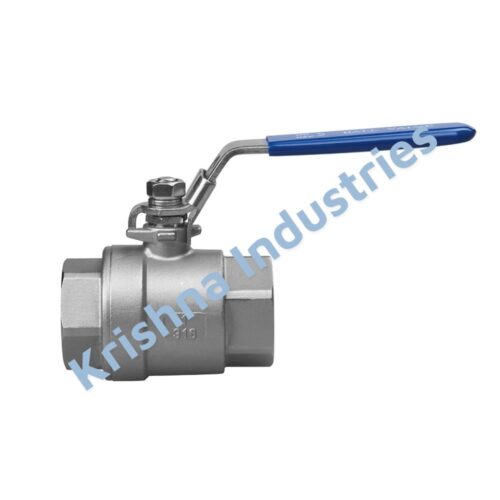
SS316L 2-Piece Ball Valve supplier in Ahmedabad, Gujarat. ASTM A351 CF3M SS316L body — full SS316L trim (ball + stem + seat ring) — PTFE seat (standard, Class VI zero leakage) / RPTFE seat (high pressure / high cycle) —…
Price on Request
Supplier: Krishna Industries (KELOR) – Ahmedabad, Gujarat, India
Established: 2017 | GSTIN: 24AKLPP6499B1ZT | IEC: AKLPP6499B
MOQ: 10 Nos | Body: ASTM A351 CF3M SS316L | Trim: Full SS316L
Seat: PTFE / RPTFE | Pressure: Class 150 / Class 300 | Sizes: DN8–DN200
Krishna Industries (KELOR), based in Ahmedabad, Gujarat, is a B2B supplier of SS316L 2-Piece Ball Valves — ASTM A351 CF3M SS316L body — full SS316L trim (SS316L ball, SS316L stem, SS316L seat ring) — PTFE seat (standard) / RPTFE seat (high pressure / high cycle) — blow-out proof stem — 2-piece body — lever operated / gear operated (DN100+) / pneumatic actuated / electric actuated — screwed BSP (IS 554) / screwed NPT (ASME B1.20.1) / flanged ASME B16.5 Class 150 / Class 300 — full bore — DN8 (¼”) to DN200 (8″) — API 598 tested — GST invoice — MOQ 10 Nos — Pan India dispatch from Ahmedabad.
SS316L (CF3M) is the low-carbon grade of SS316 — identical corrosion resistance and mechanical properties, with carbon content reduced to 0.03% maximum (vs 0.08% for standard SS316). This single difference eliminates weld sensitisation risk in SS welded piping, satisfies Indian GMP and international food safety specifications that explicitly require 316L, and provides full material traceability for pharma and food industry quality audits. Where the project specification, piping class, or GMP requirement states SS316L — CF3M — ASTM A270 316L — or simply “316L” — this valve is the compliant product.
The “L” in SS316L stands for Low Carbon. It is not a marketing distinction — it is a metallurgical difference with specific engineering consequences that determine whether SS316 or SS316L is the correct specification for a given application.
| Property | SS316 (CF8M) | SS316L (CF3M) |
|---|---|---|
| Carbon Content | Maximum 0.08% C | ✅ Maximum 0.03% C — low carbon grade |
| Weld Sensitisation Risk | Present — carbon migrates to grain boundaries during welding heat — combines with chromium to form chromium carbide — depletes chromium in grain boundary zone — this zone loses corrosion resistance — intergranular corrosion (IGC) occurs in aggressive environments at the weld heat affected zone (HAZ) | ✅ Eliminated — 0.03% C is insufficient to form significant chromium carbide at grain boundaries during welding — chromium remains in solution throughout weld HAZ — corrosion resistance maintained after welding |
| Post-Weld Heat Treatment | Required for critical service welded SS316 piping to restore corrosion resistance — adds cost and time to fabrication | ✅ Not required — low carbon prevents sensitisation — welded SS316L piping does not require PWHT to maintain corrosion resistance |
| Corrosion Resistance | Excellent in non-welded service — same molybdenum content as 316L — equivalent performance for screwed or flanged (non-welded) connections | ✅ Equivalent to SS316 in non-welded service — superior in welded service due to sensitisation resistance |
| GMP / FDA Compliance | Not acceptable where specification explicitly states 316L — Indian pharma procurement teams will reject CF8M where CF3M is specified regardless of physical corrosion resistance equivalence | ✅ Compliant with GMP utility piping specifications citing ASTM A270 316L, CF3M, or SS316L — acceptable to USFDA, WHO GMP, EU GMP auditors — standard for Indian pharma API plant utility valve specification |
| Mechanical Strength | Slightly higher yield strength than 316L — relevant only at high temperature where 316L loses strength faster | Slightly lower yield at high temperature — not relevant for standard process conditions below 400°C |
| Cost | Slightly lower — standard grade | Slightly higher — low carbon grade premium — justified by weld sensitisation protection and GMP compliance value |
| Specify When | Screwed or flanged (non-welded) connections in corrosive service where GMP 316L requirement is not specified — cost-sensitive applications where engineer has confirmed no welding and accepted SS316 | ✅ Any welded SS piping — pharma and food GMP utility — any project specification citing 316L / CF3M / ASTM A270 316L — conservative specification for all SS corrosive service where sensitisation risk cannot be fully excluded |
| Feature | 1-Piece Body | 2-Piece Body (This Page) | 3-Piece Body |
|---|---|---|---|
| Seat Access | ❌ No — ball and seats completely inaccessible — valve replaced entirely when seats wear | ✅ Yes — remove one end piece — access ball and both PTFE seats — replace seats — reassemble — for screwed end: without removing valve from line | ✅ Full — centre body slides out with ball and seats — all in-line — maximum maintenance access |
| Body Joints | ✅ None — fewest leak paths | One body joint — well-designed 2-piece SS316L valves maintain excellent joint integrity | Two body joints |
| Cost | ✅ Lowest | ✅ Medium — correct balance of seat accessibility and cost for SS process service | Highest — justified for BW/SW permanent weld connections |
| Specify When | Low pressure, low cycle utility where valve is replaced rather than maintained | ✅ Standard SS316L process ball valve — screwed or flanged connections — pharma, food, chemical — seat inspection and replacement without full valve removal — most Indian SS process ball valve specifications | SW or BW permanent weld connections in high pressure service where cutting weld to replace valve is expensive |
| Property | Virgin PTFE Seat (Standard) | RPTFE Seat (Reinforced) |
|---|---|---|
| Composition | 100% PTFE — softest, most conforming seat | PTFE reinforced with glass fibre or carbon filler — harder and more dimensionally stable |
| Sealing | ✅ Class VI zero leakage — best sealing due to soft conforming contact with ball surface — standard for most SS316L process service | Class VI zero leakage — slightly less conforming than virgin PTFE but excellent sealing in all standard service conditions |
| Cold Flow | Higher — seat deforms under sustained high pressure — can cause valve to bind after extended time at Class 300 pressure | ✅ Lower — filler reinforcement reduces cold flow — better dimensional stability under sustained high pressure — specify for Class 300 service |
| Wear Resistance | Standard — adequate for normal process cycling | ✅ Better — specify for high cycle frequency applications (automated valves cycling multiple times per day) |
| Specify When | ✅ Standard process service — Class 150 — moderate cycle frequency — pharma GMP utility, food processing, chemical utility — most SS316L ball valve applications | ✅ Class 300 high pressure — high cycle automated service — pneumatic or electric actuated valves cycling frequently — where PTFE cold flow has caused valve binding in previous installations |
| Parameter | Specification |
|---|---|
| Body Design | 2-piece — one main body + one end piece — bolted body joint |
| Body Material | ASTM A351 CF3M (SS316L cast) — low carbon 0.03% C max |
| Ball Material | SS316L (full SS316L trim) |
| Seat Material | Virgin PTFE (standard — Class VI zero leakage) / RPTFE (high pressure / high cycle) |
| Stem Material | SS316L — blow-out proof design — anti-static device on request (ATEX) |
| Seat Ring | SS316L |
| Body Seal / Stem Packing | PTFE (standard) / Graphite (high temp above 180°C) |
| Body Bolts | SS316 (standard) |
| End Connections | Screwed BSP taper IS 554 / Screwed NPT ASME B1.20.1 / Flanged ASME B16.5 Class 150 / Flanged ASME B16.5 Class 300 |
| Bore | Full bore (standard) / Reduced bore on request |
| Size Range | DN8 (¼”) to DN200 (8″) — DN8–DN50 most common screwed, DN15–DN200 flanged |
| Pressure Rating | Class 150 (standard) / Class 300 |
| Temperature Range | -196°C to +200°C (PTFE seat) — cryogenic capable |
| Operation | Lever (standard DN8–DN80) / Gear (DN100+) / Pneumatic actuated / Electric actuated |
| Testing Standard | API 598 — shell test and seat leakage test (zero leakage — Class VI) |
| Material Certification | MTC — ASTM A351 CF3M heat certificate — chemical composition + mechanical properties with heat number |
| MOQ | 10 Nos |
| HSN Code | 84818090 |
SS316L (CF3M) has a maximum carbon content of 0.03% versus 0.08% for standard SS316 (CF8M). This low carbon content prevents weld sensitisation — the process by which carbon migrates to grain boundaries during welding and depletes chromium, creating a zone of reduced corrosion resistance in the weld heat affected zone. Specify SS316L when: the valve will be installed in a welded SS piping system where adjacent welds are made after valve installation; the project specification, piping class document, or GMP requirement explicitly states SS316L, CF3M, or ASTM A270 316L; the application is pharma GMP utility where 316L is standard for all utility valves regardless of welding; or where the conservative specification is preferred to eliminate any sensitisation risk. For purely screwed or flanged (non-welded) connections in non-GMP service where the specification accepts SS316, standard CF8M SS316 is acceptable and slightly lower cost.
For screwed end (BSP/NPT) 2-piece ball valves — yes. Close the valve, depressurise, unscrew the end piece from the main body (end piece has external thread), remove end piece, slide out ball, replace PTFE or RPTFE seats, reassemble. The valve body remains threaded into the pipeline throughout — no disturbance of pipeline connections. For flanged end 2-piece ball valves — one flanged joint must be unbolted to remove the end piece, which means partial disruption of the piping. If fully in-line seat replacement without any pipeline disturbance is required for flanged service, specify a 3-piece body instead.
Material Test Certificate (MTC) for ASTM A351 CF3M (SS316L) body — shows chemical composition (confirming carbon ≤0.03%, molybdenum 2–3%, chromium 16–18%) and mechanical properties (yield strength, tensile strength, elongation) with heat number traceability. The MTC confirms the body material is genuine CF3M SS316L and not standard CF8M SS316 — this is the document GMP auditors and food safety compliance teams request to verify material specification compliance. MTC is supplied on request — specify “MTC required — GMP service” at order stage.
Yes — austenitic stainless steel SS316L maintains toughness and ductility down to -196°C (liquid nitrogen temperature). PTFE seats are also rated for cryogenic service. For cryogenic service below -100°C, specify: Class 150 or Class 300 flanged (not screwed — screwed joints can leak at cryogenic temperatures due to differential thermal contraction), extended bonnet to keep stem packing above the cryogenic zone (on request for very low temperature service), and confirm actuator selection is rated for operating temperature if pneumatic or electric actuated.
MOQ is 10 Nos. Pharma and food plant project orders — typically 50 to 1,000+ Nos across sizes and end connection types — with API 598 test certificate, CF3M MTC for GMP audit documentation, dimensional inspection report, and GST invoice. WhatsApp body material (confirm SS316L CF3M), seat material (PTFE/RPTFE), end connection type, size list, pressure class, operator type, and quantity for project pricing within 2 hours.
Krishna Industries (KELOR) supplies SS316L 2-Piece Ball Valves for pharmaceutical GMP utility, food and beverage, welded SS process piping, chemical plant, and cryogenic service — ASTM A351 CF3M SS316L body — full SS316L trim (ball + stem + seat ring) — PTFE (standard) / RPTFE (high pressure / high cycle) seat — 2-piece body (seat accessible without removing valve from line for screwed connections) — lever / gear / pneumatic actuated / electric actuated — screwed BSP (IS 554) / screwed NPT / flanged ASME B16.5 Class 150 / Class 300 — full bore — DN8 (¼”) to DN200 (8″) — API 598 tested — CF3M MTC for GMP audit supplied on request — GST invoice — Pan India dispatch from Ahmedabad. WhatsApp end connection type, size list, pressure class, and quantity for project pricing within 2 hours.
Reviews
There are no reviews yet.