Email:
[email protected]
Phone:
+91 93135 43530
Address:
133/1 Ground, Mansuri Block, Opp. Dudheshwar Water Tank, Ahmedabad-380004, Gujarat, India
VALVES | FASTENERS | FLANGES | FITTINGS
VALVES | FASTENERS | FLANGES | FITTINGS
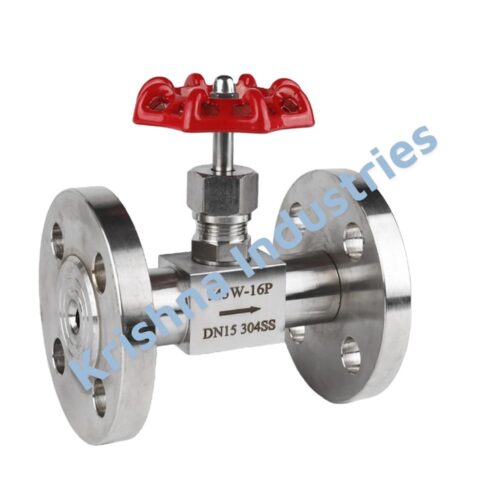
Stainless Steel Needle Valve supplier in Ahmedabad, Gujarat. SS316 (CF8M) and SS304 (CF8) body — hardened SS needle tip — metal-to-metal seat (standard) / PTFE soft seat — PTFE / graphite packing — screwed BSP (BSPT) / NPT ends (standard)…
Price on Request
Supplier: Krishna Industries (KELOR) – Ahmedabad, Gujarat, India
Established: 2017 | GSTIN: 24AKLPP6499B1ZT | IEC: AKLPP6499B
MOQ: 10 Nos | Body: SS316 / SS304 | Ends: Screwed BSP / NPT (standard)
Sizes: DN6–DN25 | Rating: PN25 / PN40 / Class 800
Krishna Industries (KELOR), based in Ahmedabad, Gujarat, is a B2B supplier of Stainless Steel Needle Valves — SS316 (CF8M) and SS304 body — hardened SS needle tip — metal-to-metal seat (standard) / PTFE soft seat — PTFE or graphite packing — screwed BSP (BSPT taper) / NPT ends (standard), flanged and socket weld on request — DN6 to DN25 (¼” to 1″) — PN25 / PN40 / Class 800 — GST invoice — MOQ 10 Nos — Pan India dispatch from Ahmedabad.
The stainless steel needle valve is a precision small bore throttling valve for instrument root valve, pressure gauge isolation, sampling connection, chemical dosing line isolation, and fine flow control in process lines — where a ball valve or gate valve gives too coarse a control action and a globe valve body is too large for small bore instrumentation connections. The very fine needle taper allows flow to be adjusted in extremely small increments — opening the valve slowly re-pressurises an instrument line gradually without pressure surge damage to the transmitter diaphragm or Bourdon tube.
In any process plant — chemical, petrochemical, refinery, power, pharmaceutical — every pressure transmitter, pressure gauge, differential pressure transmitter, and flow element is connected to the process line through a small bore impulse line. The first valve at the process tapping point — between the process pipe and the impulse line to the instrument — is called the root valve or instrument isolation valve.
The root valve must be closed to isolate the instrument for maintenance, calibration, zeroing, or replacement. When re-opening after maintenance, it must be opened very slowly — a sudden full opening sends a pressure surge into the instrument that can damage a pressure transmitter diaphragm, burst a Bourdon tube gauge, or spike a differential pressure element beyond its measuring range.
A needle valve is the correct root valve because:
| Feature | Needle Valve (This Product) |
Globe Valve | Ball Valve |
|---|---|---|---|
| Throttling Precision | ✅ Finest — very small flow increments per turn of handwheel — designed for precision throttling | Good — finer than ball valve but coarser than needle at small bore | ❌ Poor — quarter turn from closed to open — no fine control |
| Pressure Surge on Opening | ✅ Very low — gradual re-pressurisation — safe for instrument diaphragms | Low — acceptable for most service | ❌ High — sudden full open on quarter turn — dangerous for instrument elements |
| On-Off Isolation | ⚠️ Possible but not primary function — metal seat seals but needle is not designed for high-frequency on-off cycling | Good — globe valve is suitable for moderate on-off | ✅ Excellent — ball valve is the standard on-off isolation valve |
| Body Size at Same DN | ✅ Compact — small body suitable for panel mounting and instrument manifold | Larger body — more material | Compact — similar to needle at small bore |
| Pressure Rating at Small Bore | ✅ High — PN40 / Class 800 standard for screwed body — suitable for high pressure instrument lines | Good — PN25/PN40 available at small bore | Good — PN40 Class 800 available |
| Specify For | ✅ Instrument root valve, gauge isolation, sampling, chemical dosing, precision flow calibration — any application requiring very fine throttling control | Flow regulation and isolation in process lines — larger bore than needle typical application | ✅ On-off isolation — primary block valve — not throttling |
| End Connection | Standard | Specify For |
|---|---|---|
| Screwed BSP Taper (BSPT) | BS 21 / ISO 7-1 | ✅ Standard for Indian instrument root valves — matches standard instrument manifold and tube fittings — ¼” BSP most common gauge and transmitter connection |
| Screwed NPT | ASME B1.20.1 | Oil & gas and petrochemical projects following American standards — ¼” NPT instrument connections |
| Compression Fitting (Swagelok / Parker type) |
Instrument tubing OD | Instrument tubing connections — 6mm, 8mm, 10mm, 12mm OD tube — direct connection to impulse tubing without threaded adapter |
| Socket Weld (SW) | ASME B16.11 Class 3000/6000 | High pressure process plant small bore pipe — welded connection for permanent installations where threading is not acceptable — API 602 |
| Flanged | ASME B16.5 Class 600/900 | Larger needle valves DN25–DN50 for high pressure process lines where screwed connection is not permitted by piping class — less common at small bore |
| Parameter | Standard Range |
|---|---|
| Body Material | SS316 (ASTM A182 F316 forged / A351 CF8M cast) — standard SS304 (A182 F304 / A351 CF8) — on request |
| Stem / Needle | SS316 — hardened tip for seat contact |
| Seat | Metal-to-metal (machined SS body seat) — standard PTFE soft insert — on request for low pressure chemical service |
| Packing | PTFE — standard (up to 200°C) Graphite — high temperature steam (up to 450°C) |
| Handwheel | SS / Aluminium — with position indicator |
| End Connection (standard) | Screwed BSP Taper (BSPT) / NPT |
| End Connection (on request) | Compression fitting / Socket weld / Flanged |
| Size Range | DN6 (¼”) / DN8 / DN10 (⅜”) / DN15 (½”) / DN20 (¾”) / DN25 (1″) |
| Pressure Rating | PN25 / PN40 (screwed body) — Class 800 (socket weld / forged) |
| Temperature Range | -20°C to +200°C (PTFE packing) / up to +450°C (graphite packing) |
| MOQ | 10 Nos |
| HSN Code | 84818030 |
An instrument root valve is the first isolation valve at the process tapping point — between the process line and the impulse tubing to a pressure transmitter, DP transmitter, or pressure gauge. A needle valve is used because its fine taper allows very gradual re-pressurisation when opening after maintenance — preventing pressure surge damage to transmitter diaphragms and Bourdon tube gauges. A ball valve opens too suddenly and can spike an instrument beyond its measuring range. DN6 to DN15 SS316 screwed ¼” BSP PN40 is the standard specification for most Indian process plant instrument root valves.
BSPT (British Standard Pipe Taper) follows BS 21 / ISO 7-1 — the taper angle and thread form differ from NPT. BSPT is the standard in Indian instrumentation based on British industrial practice. NPT (National Pipe Taper) follows ASME B1.20.1 — used in oil and gas and petrochemical projects following American standards. The two threads are NOT interchangeable — a BSPT male into an NPT female (or vice versa) will cross-thread or leak. Always confirm which thread standard your instrument manifold or tubing fitting uses before ordering needle valves. When in doubt, specify and state BSPT or NPT explicitly in your RFQ.
Metal-to-metal (SS machined seat) is standard for instrument root valve service — it handles steam, high temperature, high pressure, and repeated open-close cycles without seat degradation. PTFE soft seat gives bubble-tight shut-off at lower pressure for chemical service at moderate temperature — but PTFE cold flows under high load and degrades above 200°C. For instrument root valve on steam, gas, or high pressure liquid — specify metal seat. For low pressure chemical dosing line isolation where bubble-tight shut-off at low pressure is required — PTFE seat is acceptable.
Not recommended as the primary on-off block valve for regular operation. A needle valve is designed for throttling — its seat and needle geometry are optimised for fine flow control, not for high-frequency full-open full-close cycling. Using it as a primary block valve accelerates needle tip and seat wear. Use a ball valve for primary on-off isolation and a needle valve downstream for throttling or instrument isolation. In instrument root valve service, the needle valve does serve an isolation function but with infrequent cycling — this is acceptable.
MOQ is 10 Nos. Mixed size and end connection orders accepted — for example 5 Nos DN15 BSPT + 5 Nos DN10 NPT = 10 Nos total. For instrument project orders — 50 to 500+ Nos across sizes — supply with material test certificates, dimensional reports, and GST invoice. WhatsApp size, thread type (BSP or NPT), seat type, and quantity for pricing within 2 hours.
The Stainless Steel Needle Valve supplied by Krishna Industries (KELOR) is the precision small bore throttling and instrument isolation valve for Indian process plants — SS316 (CF8M) and SS304 body — hardened SS needle — metal-to-metal seat (standard) / PTFE soft seat — PTFE / graphite packing — screwed BSP / NPT (standard), flanged and socket weld on request — DN6 to DN25 — PN25 / PN40 / Class 800. Instrument root valve, pressure gauge isolation, sampling, chemical dosing, fine flow calibration — wherever precise incremental flow control is required in small bore stainless steel service. GST invoice, Pan India dispatch from Ahmedabad. WhatsApp size, thread type, seat material, and quantity for pricing within 2 hours.
Reviews
There are no reviews yet.