Email:
[email protected]
Phone:
+91 93135 43530
Address:
133/1 Ground, Mansuri Block, Opp. Dudheshwar Water Tank, Ahmedabad-380004, Gujarat, India
VALVES | FASTENERS | FLANGES | FITTINGS
VALVES | FASTENERS | FLANGES | FITTINGS
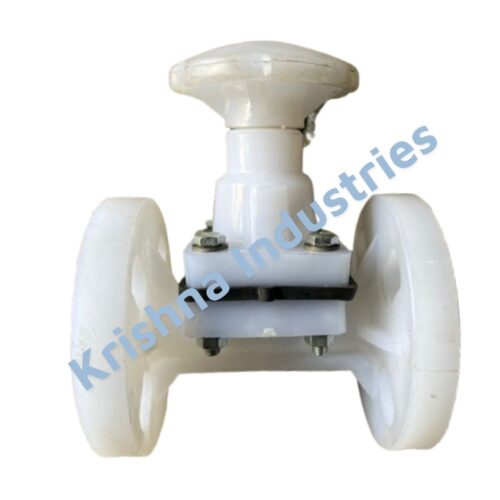
PP Flanged Diaphragm Valve (Polypropylene) supplier in Ahmedabad, Gujarat. PP body — EPDM / PTFE / PTFE-backed EPDM diaphragm — weir type and straight-through — flanged DIN/EN PN10 — DN15 to DN150 — handwheel manual / pneumatic actuated — ISO…
Price on Request
Supplier: Krishna Industries (KELOR) – Ahmedabad, Gujarat, India
Established: 2017 | GSTIN: 24AKLPP6499B1ZT | IEC: AKLPP6499B
MOQ: 10 Nos | Body: Polypropylene (PP) | Standard: ISO 16135 / DIN 3356
Sizes: DN15–DN150 | Rating: PN10 (at 20°C — derated at higher temperature)
Krishna Industries (KELOR), based in Ahmedabad, Gujarat, is a B2B supplier of PP Flanged Diaphragm Valves — Polypropylene (PP) body — EPDM, PTFE, and PTFE-backed EPDM diaphragm — weir type and straight-through type — flanged end DIN/EN PN10 — DN15 to DN150 — handwheel manual and pneumatic actuated — ISO 16135 / DIN 3356 — GST invoice — MOQ 10 Nos — Pan India dispatch from Ahmedabad.
The PP diaphragm valve is the correct valve for corrosive chemical, acid, alkali, effluent, and aggressive fluid service where metal valves would corrode, contaminate the process, or require expensive alloy upgrades. The Polypropylene body provides excellent resistance to most mineral acids, alkalis, and salt solutions at moderate temperatures. The flexible diaphragm seals against the body weir or seat — no stem penetration into the flow path — inherently leak-free stem seal, suitable for toxic and hazardous chemical service. Used extensively in Gujarat’s chemical belt (Ankleshwar, Vapi, Dahej, Bharuch), Indian ETP/STP contractors, electroplating shops, textile dyeing units, and pharmaceutical plants.
| Feature | Weir Type (Saddle Type) | Straight-Through (Full Bore) |
|---|---|---|
| Body Design | Raised weir (saddle) across bore — diaphragm presses onto weir | Flat straight bore — diaphragm travels full bore diameter to close |
| Diaphragm Travel | Short — diaphragm only needs to travel to weir height | Long — diaphragm must travel full bore diameter to close |
| Operating Torque | ✅ Lower — less diaphragm deflection required | Higher — more diaphragm deflection required |
| Diaphragm Life | ✅ Longer — less flexing per cycle | Shorter — greater flexing per cycle |
| Flow Path | Weir creates restriction — not full bore, some pressure drop | ✅ Full bore — unobstructed flow path when open |
| Slurry / Solids | ❌ Weir traps solids — not suitable for slurry or fibrous media | ✅ No obstruction — solids pass through — suitable for slurry |
| Self Draining | ❌ Weir retains liquid on downstream side when closed | ✅ Full bore — drains completely when open |
| Throttling | ✅ Good — weir provides consistent throttling characteristic | Limited — not recommended for throttling |
| Specify For | ✅ Clean chemical, acid, alkali, water treatment, pharmaceutical, ETP — most common specification | Chemical slurry, fibrous media, viscous fluids, applications requiring full bore and complete drainage |
Standard supply: Weir type is standard unless straight-through is specifically requested. Confirm valve type in RFQ for slurry or solids-containing media.
| Material | Max Temp | Chemical Resistance | Cost | Specify For |
|---|---|---|---|---|
| PP (Polypropylene) This product |
60–80°C (pressure derated) | ✅ Good — mineral acids (dilute to moderate), alkalis, salts, oxidising agents (dilute) — NOT chlorinated solvents, aromatics, concentrated oxidising acids | ✅ Lowest — most economical thermoplastic | ✅ General chemical, ETP, acid dosing, alkali lines, electroplating, textile — most Indian chemical plant applications at moderate temperature |
| PVC (Polyvinyl Chloride) | 55–60°C | Similar to PP — good acid/alkali — NOT ketones, esters, aromatics | ✅ Low — comparable to PP | General chemical at lower temperature — more rigid than PP |
| CPVC (Chlorinated PVC) | 90°C | Good — better than PVC at elevated temperature | Medium | Hot chemical service up to 90°C where PP temperature limit is insufficient |
| PVDF (Kynar / Fluoropolymer) | 120°C | ✅ Excellent — handles concentrated mineral acids, chlorinated solvents, oxidising acids where PP fails | High — 3–5x PP cost | Aggressive chemical where PP is chemically attacked — HF, concentrated H2SO4, oxidising acids, chlorinated solvents |
For most Indian chemical plant applications at temperatures below 60°C — dilute HCl, dilute H2SO4, NaOH, ferric chloride, copper sulphate, chromic acid solutions, textile dyes, ETP chemicals — PP flanged diaphragm valve is the correct and most economical specification. Upgrade to PVDF only when media or temperature exceeds PP limits.
| Chemical | PP Body | EPDM Diaphragm | PTFE Diaphragm |
|---|---|---|---|
| Hydrochloric Acid (HCl) — up to 35% | ✅ Excellent | ✅ Good | ✅ Excellent |
| Sulphuric Acid (H2SO4) — up to 70% | ✅ Good | ⚠️ Check concentration | ✅ Excellent |
| Sulphuric Acid — above 70% (concentrated) | ❌ Not recommended | ❌ Not recommended | ✅ PTFE only — upgrade body to PVDF |
| Nitric Acid (HNO3) — dilute up to 30% | ✅ Good | ✅ Good | ✅ Excellent |
| Nitric Acid — above 30% (concentrated) | ❌ Not recommended | ❌ Not recommended | ✅ PTFE only — upgrade body to PVDF |
| Sodium Hydroxide (NaOH) — caustic soda | ✅ Excellent | ✅ Excellent | ✅ Excellent |
| Ferric Chloride (FeCl3) | ✅ Excellent | ✅ Good | ✅ Excellent |
| Copper Sulphate (CuSO4) | ✅ Excellent | ✅ Good | ✅ Excellent |
| Chromic Acid (CrO3) — plating | ✅ Good | ⚠️ Limited — check concentration | ✅ Excellent |
| Chlorine (Cl2) — water treatment dosing | ✅ Good | ⚠️ Limited — EPDM oxidises | ✅ Excellent |
| Acetic Acid (dilute) | ✅ Good | ✅ Good | ✅ Excellent |
| Toluene / Xylene / Benzene (aromatics) | ❌ Not recommended | ❌ Not recommended | ✅ PTFE only — upgrade body to PVDF |
| Sodium Hypochlorite (NaOCl) — bleach | ✅ Good | ⚠️ EPDM may swell at high concentration | ✅ Excellent |
| Deionised / Demineralised Water | ✅ Excellent | ✅ Excellent | ✅ Excellent |
Compatibility guide is indicative. Always confirm media, concentration, and temperature with Krishna Industries before finalising order. Actual compatibility depends on chemical concentration, temperature, and mixture effects.
Polypropylene loses mechanical strength at elevated temperature — the pressure rating of a PP valve must be derated above 20°C. This is critical for Indian chemical plant applications where process temperatures may be 40°C to 70°C.
| Temperature | Approximate Pressure Derating | Effective PN10 Pressure |
|---|---|---|
| 20°C | 100% | 10 bar |
| 30°C | ~90% | ~9 bar |
| 40°C | ~75% | ~7.5 bar |
| 50°C | ~60% | ~6 bar |
| 60°C | ~45% | ~4.5 bar |
| 70°C | ~30% | ~3 bar |
| 80°C | ~20% | ~2 bar |
Important: Always state operating temperature AND operating pressure in your RFQ — not just one. A PP valve rated PN10 at 20°C may only be suitable for PN3 at 70°C. For hot chemical service above 60°C, consider CPVC or PVDF body instead of PP.
| Parameter | Specification |
|---|---|
| Product Type | Diaphragm Valve — Weir Type (standard) / Straight-Through |
| Design Standard | ISO 16135 / DIN 3356 |
| Body Material | Polypropylene (PP) — natural or pigmented |
| Compressor | PP / Nylon |
| Diaphragm | EPDM (standard) / PTFE / PTFE-backed EPDM (sandwich) |
| Fasteners | SS304 / coated steel |
| End Connection | Flanged — DIN/EN 1092-1 PN10 |
| Size Range | DN15 to DN150 (½” to 6″) |
| Pressure Rating | PN10 at 20°C — derated at higher temperature (see table) |
| Max Temperature | 60°C standard EPDM / 80°C PTFE diaphragm (at reduced pressure) |
| Operation | Handwheel manual (standard) / Pneumatic actuated / Electric actuated |
| MOQ | 10 Nos |
| HSN Code | 84818090 |
| Diaphragm | Temperature | Best For | Avoid For |
|---|---|---|---|
| EPDM | -10°C to +90°C | ✅ Water, dilute acid, alkali, steam, ozone, chlorinated water — standard for most ETP/STP and water treatment | Oil, fuel, aromatic solvents, concentrated oxidising acids |
| PTFE | -40°C to +120°C | ✅ Broad chemical resistance — concentrated acids, oxidising chemicals, solvents, pharma — best chemical resistance | Not suitable where high flexing cycles required — PTFE less flexible than EPDM, shorter cycle life |
| PTFE-backed EPDM | -10°C to +90°C | ✅ Best of both — PTFE chemical resistance on flow side + EPDM flexibility — recommended for chemical plant service where EPDM is attacked but cycle life must be maintained | Not for extreme temperature above 90°C |
| Neoprene (CR) | -20°C to +80°C | Oil, mild chemical, weathering resistance | Strong acids, oxidising chemicals |
Weir type has a raised saddle across the bore — the diaphragm presses onto this weir to close. Shorter diaphragm travel means lower torque and longer diaphragm life. Straight-through has a flat bore — the diaphragm must travel the full bore diameter. Weir type is correct for clean chemical, acid, alkali, and water service — the most common specification. Straight-through is specified for slurry, fibrous media, and where complete bore drainage is required.
PP body handles sulphuric acid up to approximately 70% concentration at moderate temperature. Above 70% concentration (concentrated H2SO4), PP body is not recommended — specify PVDF body with PTFE diaphragm. Always state acid concentration AND temperature in your RFQ. For dilute H2SO4 up to 50% at temperatures below 50°C — PP PTFE-backed EPDM diaphragm is the standard specification in Indian chemical plants.
Polypropylene is a thermoplastic — its mechanical strength (yield stress) decreases as temperature increases. At 20°C a PP valve is rated PN10 (10 bar). At 60°C, the same valve should only be used up to approximately 4.5 bar. Exceeding the derated pressure at operating temperature will cause body deformation or failure. Always confirm operating temperature AND pressure when ordering — not just one of the two.
EPDM is standard supply — suitable for water, dilute acid, dilute alkali, and most ETP service. PTFE (or PTFE-backed EPDM) is specified when the media attacks EPDM — concentrated acids, oxidising chemicals, chlorinated water above 200ppm, solvents. PTFE-backed EPDM (sandwich diaphragm) gives PTFE chemical resistance with better flexibility and cycle life than plain PTFE — recommended for chemical plant service where EPDM is borderline.
Yes — the top bonnet unbolts from the body, the compressor and old diaphragm are removed, and a new diaphragm drops in. The valve body stays bolted in the pipeline. Diaphragm replacement is a standard maintenance activity taking 15–20 minutes with basic tools. Keep one set of spare diaphragms per valve size on site for planned maintenance.
Standard PP can degrade with prolonged UV exposure — surface chalking and embrittlement over 2–3 years of outdoor use. For outdoor installation, specify UV-stabilised (carbon black compounded) PP body — available on request. Alternatively, paint or cover the valve body. Diaphragm should be protected from direct sunlight regardless of UV stabilisation.
MOQ is 10 Nos. Project orders for ETP, chemical plant, or electroplating shop — 20 to 200+ Nos across sizes — handled with project pricing and consolidated dispatch from Ahmedabad.
The PP Flanged Diaphragm Valve supplied by Krishna Industries (KELOR) is the correct non-metallic valve for corrosive chemical, acid, alkali, effluent, electroplating, textile, and pharmaceutical service in India — Polypropylene body — EPDM, PTFE, PTFE-backed EPDM diaphragm — weir type and straight-through — flanged DIN/EN PN10 — DN15 to DN150 — handwheel manual and pneumatic actuated — ISO 16135 / DIN 3356. Confirm media, concentration, and operating temperature in RFQ for correct diaphragm material recommendation. GST invoice, Pan India dispatch from Ahmedabad. WhatsApp valve type, size, diaphragm material, and quantity for bulk pricing within 2 hours.
Reviews
There are no reviews yet.