Email:
[email protected]
Phone:
+91 93135 43530
Address:
133/1 Ground, Mansuri Block, Opp. Dudheshwar Water Tank, Ahmedabad-380004, Gujarat, India
VALVES | FASTENERS | FLANGES | FITTINGS
VALVES | FASTENERS | FLANGES | FITTINGS
SS Blind Flange supplier in Ahmedabad, Gujarat. ASTM A182 F304 (SS304) / F316 (SS316) / F316L (SS316L) / F304L forged stainless steel — solid plate, no bore — raised face (RF) standard / flat face (FF) / ring type joint…
Price on Request
Supplier: Krishna Industries (KELOR) – Ahmedabad, Gujarat, India
Established: 2017 | GSTIN: 24AKLPP6499B1ZT | IEC: AKLPP6499B
MOQ: 10 Nos | Material: ASTM A182 F304 / F316 / F316L / F304L
Standard: ASME B16.5 / B16.47 | Sizes: DN15–DN900 | Pressure: Class 150–900
Krishna Industries (KELOR), based in Ahmedabad, Gujarat, is a B2B supplier of Stainless Steel Blind Flanges — ASTM A182 F304 (SS304) / F316 (SS316) / F316L (SS316L) / F304L forged — solid plate with no central bore — raised face (RF) standard / flat face (FF) / ring type joint (RTJ) — Class 150 / 300 / 600 / 900 — DN15 (½”) to DN900 (36″) — ASME B16.5 (DN15–DN600) / ASME B16.47 Series A/B (DN650–DN900) — ASME B16.5 thickness per class and size — MTC ASTM A182 heat certificate — GST invoice — MOQ 10 Nos — Pan India dispatch from Ahmedabad.
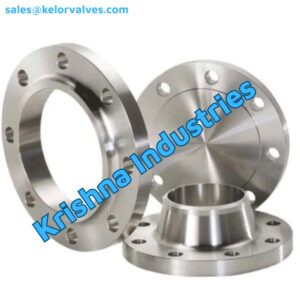
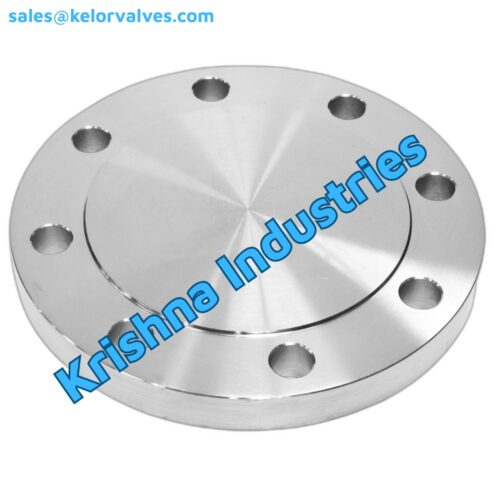
A blind flange is a solid flanged plate — no bore — that bolts to the face of any standard flanged connection to permanently or temporarily close the pipeline end. Unlike weld neck or slip-on flanges that connect two pipe sections, a blind flange terminates a pipe run, blanks a vessel nozzle, or closes a pipeline section for pressure testing. The solid plate must withstand the full line pressure across its unsupported area — ASME B16.5 specifies minimum plate thickness per pressure class and nominal pipe size, which is why blind flanges are thicker and heavier than the equivalent weld neck or slip-on flange of the same class.
| Application | Description | Specification Note |
|---|---|---|
| Permanent End Closure | Terminating a flanged pipeline at the end of a pipe run — blanking a spare nozzle on a pressure vessel, heat exchanger, or reactor — closing a branch connection that is not currently active — blind flange bolted with correct gasket and remains in service throughout plant life | Specify same grade and pressure class as the mating flange and piping system — use spiral wound SS316/graphite gasket for Class 300+ RF blind flanges — PTFE envelope gasket for chemical service — ring type joint (RTJ) metal ring for Class 600+ — MTC required for EPC project records |
| Hydrostatic Pressure Testing | Closing all open flanged ends of a pipe spool or piping section before filling with water and pressurising to hydrostatic test pressure (1.5× design pressure per ASME B31.3) — blind flanges installed at test boundaries — removed after testing — reused across multiple test sections during construction | Test pressure = 1.5× design pressure — verify blind flange pressure class is adequate for test pressure, not just design pressure — a DN150 Class 150 SS blind flange may be adequate for 20 bar design pressure but specify Class 300 if test pressure exceeds Class 150 rating at test temperature — specify correct facing (RF or FF) to match test flanges — gasket must also be rated for test pressure |
| Future Connection Provision (Tie-In Nozzle Blanking) | Blanking off flanged nozzles on vessels, headers, or large bore pipe spools that will be connected to future expansion piping or future equipment — blind flange provides leak-free closure during the interim period — removed when future tie-in is made without any cutting or welding on the existing pipeline | Select grade and class to match the nozzle specification — F316L for chemical plant nozzles where future chemical piping will be welded SS — specify RF or FF to match nozzle facing — provision for vent/drain tapping on blind flange face if required during the blanked period — mark as “future tie-in” in piping isometric for construction and maintenance records |
| Feature | Blind Flange (This Page) | Spectacle Blind (Spade and Ring) |
|---|---|---|
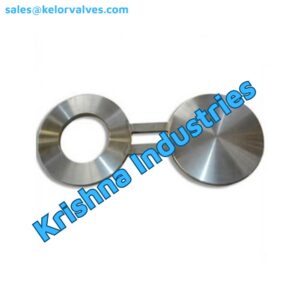
| Construction | Separate solid plate bolted to mating flange as a complete flanged joint — full flange face with bolt holes | Figure-8 shaped fitting installed between two flanges — solid half (blind) and open ring half connected by a web — rotated to switch between blinded and open positions |
| Operation | To open the connection: remove all flange bolts, remove blind flange, reinstall piping — requires full joint disassembly and reassembly | To switch blind/open: loosen (not remove) flange bolts slightly — rotate spectacle blind 180° — retighten bolts — faster than full joint disassembly — standard for frequent blind/open switching in Indian refinery isolation |
| Indian Process Plant Standard Use | ✅ Standard for: permanent end closures, pressure test boundaries, nozzle blanking, future tie-in provisions — any application where the blind is installed once and remains in place or is removed only when the connection is made permanently | Standard for: positive isolation on process vessels and equipment during maintenance — Indian refinery and petrochemical plant uses spectacle blinds to isolate vessels and equipment for maintenance (HAZOP and PSSR requirement) — rotated to blind during maintenance, rotated open for recommissioning |
| Specify When | ✅ End closure, pressure testing, nozzle blanking — the large majority of Indian piping project blind flange requirements | Process isolation where blind/open switching occurs multiple times over plant life — vessel maintenance isolation — available on request from Krishna Industries |
The same grade and facing selection rules that apply to SS weld neck and slip-on flanges apply to SS blind flanges — the blind flange must always match the mating flange in both material grade and facing type.
| Grade / Facing | Specify For |
|---|---|
| F304 RF | ✅ DM water, HVAC, food utility, mild chemical — non-chloride — most economical SS blind flange for general utility end closure and pressure testing |
| F316 RF | Chloride service, seawater cooling, coastal chemical plant — where F304 pitting resistance is insufficient |
| F316L RF | ✅ Pharma GMP utility, welded SS chemical piping, food GMP — most widely specified conservative SS blind flange grade for Indian chemical and pharma projects — matches F316L weld neck and slip-on flanges in the same piping system |
| Any grade FF | When mating nozzle or equipment flange is cast iron (CI) or ductile iron (DI) — flat face with full face gasket prevents CI flange cracking |
| F316 or F316L RTJ | Class 600 and above — oil and gas, refinery, high pressure chemical — metal ring provides highest integrity seal at high pressure blind flange closures |
For full explanation of SS grade selection (F304 vs F316 vs F316L sensitisation) and facing selection, see SS Weld Neck Flange page.
| Parameter | Specification |
|---|---|
| Flange Type | Blind — solid plate — no central bore — full ASME B16.5 bolt circle and facing |
| Material | ASTM A182 F304 / F316 / F316L / F304L — forged stainless steel |
| Standard | ASME B16.5 (DN15–DN600) / ASME B16.47 Series A or B (DN650–DN900) |
| Pressure Classes | Class 150 / 300 / 600 / 900 — Class 1500 / 2500 on request |
| Size Range | DN15 (½”) to DN900 (36″) |
| Facing | Raised Face (RF) standard / Flat Face (FF) on request / Ring Type Joint (RTJ) on request |
| Thickness | Per ASME B16.5 minimum thickness table for class and nominal pipe size — thicker than weld neck / slip-on of same class due to unsupported plate pressure load |
| Optional Features | Tapped vent/drain holes — threaded boss for instrument connection — can be supplied drilled and tapped per customer drawing |
| Material Certification | MTC — ASTM A182 heat certificate — chemical composition + mechanical properties + heat number |
| MOQ | 10 Nos per line item |
| HSN Code | 73072100 |
A weld neck or slip-on flange has a central bore — the pipe passing through the bore provides structural support and the pressure load is carried by the pipe wall, not by the flange plate itself. A blind flange has no bore — the solid plate must resist the full line pressure acting across its entire unsupported area. As pipe size increases, the unsupported area increases rapidly and the plate must be thicker to resist bending. ASME B16.5 specifies the minimum thickness for blind flanges per pressure class and nominal pipe size — a DN300 Class 300 blind flange is substantially thicker and heavier than a DN300 Class 300 weld neck flange. Always order blind flanges to ASME B16.5 minimum thickness rather than specifying the same thickness as the mating inline flange.
ASME B31.3 requires hydrostatic test pressure of 1.5 times the design pressure. If the design pressure of the piping system is close to the maximum allowable pressure for Class 150 — approximately 20 bar at ambient for SS F316 — the test pressure of 1.5× design may exceed the Class 150 blind flange rating. In this case, specify Class 300 blind flanges for the test boundary even if the system piping uses Class 150 flanges. Class 300 SS F316 blind flange is rated approximately 52 bar at ambient — providing adequate margin for the hydrostatic test. After testing, Class 300 blind flanges can be retained as the permanent end closure (Class 300 at Class 150 service is perfectly acceptable) or replaced with Class 150 blind flanges for the permanent installation.
For permanent end closures on piping systems that may need to be vented or drained during maintenance, specify a tapped vent connection (typically DN15 BSP threaded) on the blind flange face — this allows the pipeline to be vented or drained without removing the blind flange. For pressure test blind flanges, a vent tapping (DN15 BSP with plugged nipple) allows air to be purged from the top of the test section before pressurising — trapped air in a hydrostatic test creates a compressible cushion that stores energy and can cause a sudden pressure release on seal failure. For most permanent nozzle blanking applications, an untapped blind flange is standard. Specify tapped blind flanges at order stage with required tapping size and thread type.
For Class 150 raised face: compressed asbestos-free fibre (CAF) or rubber sheet gasket — economical for water, HVAC, and utility service. For Class 150–300 raised face in chemical or pharma service: PTFE envelope gasket or spiral wound SS316/PTFE gasket. For Class 300 and above raised face in process service: spiral wound SS316/graphite gasket — this is the standard Indian refinery and chemical plant gasket for Class 300+ SS flanged joints. For RTJ Class 600+: SS316 oval ring gasket — ring is replaced every time the joint is opened. Always match gasket material to the process fluid chemical compatibility — a gasket failure on a blind flange closure can result in sudden full bore release of line contents.
MOQ is 10 Nos per line item. Full project BOM supply — multiple sizes, grades, and pressure classes in one consolidated order. Documents: MTC (ASTM A182 heat certificate), dimensional inspection confirming ASME B16.5 thickness and bolt circle, GST invoice with HSN 73072100. TPI on request. WhatsApp grade, pressure class, size list, facing, and quantity for project pricing within 2 hours.
Krishna Industries (KELOR) supplies SS Blind Flanges for pipeline end closure, hydrostatic pressure testing, spare nozzle blanking, and future tie-in provisions — ASTM A182 F304 / F316 / F316L / F304L forged — raised face (RF) standard / flat face (FF) / ring type joint (RTJ) — Class 150 / 300 / 600 / 900 — DN15 (½”) to DN900 (36″) — ASME B16.5 / B16.47 — ASME B16.5 minimum thickness per class and size — MTC ASTM A182 heat certificate — GST invoice — Pan India dispatch from Ahmedabad. WhatsApp grade, pressure class, size list, facing, and quantity for project pricing within 2 hours.

Reviews
There are no reviews yet.