Email:
[email protected]
Phone:
+91 93135 43530
Address:
133/1 Ground, Mansuri Block, Opp. Dudheshwar Water Tank, Ahmedabad-380004, Gujarat, India
VALVES | FASTENERS | FLANGES | FITTINGS
VALVES | FASTENERS | FLANGES | FITTINGS
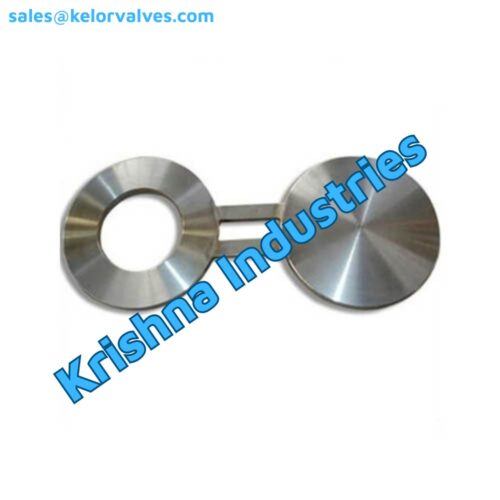
SS Spectacle Blind Flange (Figure-8 Blind) and Paddle Blind / Paddle Spacer supplier in Ahmedabad, Gujarat. ASTM A240 SS316 / SS304 plate (standard) — ASTM A182 F316 / F304 forged (Class 600+) — spectacle blind (one-piece figure-8, rotate to blind…
Price on Request
Supplier: Krishna Industries (KELOR) – Ahmedabad, Gujarat, India
Established: 2017 | GSTIN: 24AKLPP6499B1ZT | IEC: AKLPP6499B
MOQ: 10 Nos | Material: ASTM A240 SS316/SS304 / ASTM A182 F316/F304
Standard: ASME B16.48 / API 590 | Sizes: DN15–DN600 | Pressure: Class 150–600
Krishna Industries (KELOR), based in Ahmedabad, Gujarat, is a B2B supplier of SS Spectacle Blind Flanges (Figure-8 Blinds) and Paddle Blinds / Paddle Spacers — ASTM A240 Grade 316 / Grade 304 SS plate (standard, DN15–DN300) — ASTM A182 F316 / F304 forged (Class 600 and large bore) — spectacle blind (one-piece figure-8 — rotate to blind or open position) / paddle blind + paddle spacer (two-piece — slide in and out) — raised face (RF) — Class 150 / 300 / 600 — DN15 (½”) to DN600 (24″) — ASME B16.48 / API 590 — ASME B16.48 thickness per class and size — GST invoice — MOQ 10 Nos — Pan India dispatch from Ahmedabad.
Spectacle blinds and paddle blinds are positive isolation devices — physical metal barriers installed in the pipeline to provide mandatory isolation for maintenance, hot work, confined space entry, and shutdown operations. Unlike a closed valve, a spectacle blind or paddle blind cannot leak, cannot be opened inadvertently, and provides visible confirmation of isolation status through the protruding tab or handle. This makes them the standard positive isolation device in Indian refineries, petrochemical plants, and chemical plants per OISD-105 and international safety standards.
| Feature | Spectacle Blind (Figure-8) | Paddle Blind + Paddle Spacer | Standard Blind Flange |
|---|---|---|---|
| Construction | One piece — figure-8 shape — solid blind half + open ring half connected by tab/web — installed permanently between two flanges | Two separate pieces — solid paddle blind (plate with handle) + open paddle spacer (ring with handle) — stored separately when not installed | Solid plate with full bolt circle — bolted to face of one flange as complete flanged joint |
| To Isolate | Loosen flange bolts (do not remove) → spread flanges slightly → rotate figure-8 so solid half enters flow path → retighten bolts — no bolts removed | Remove all flange bolts → remove spacer ring → insert paddle blind → reinstall bolts — full joint disassembly required | Full joint disassembly and reassembly — not designed for repeated blind/open cycles |
| To Open (Restore Flow) | Loosen bolts → rotate figure-8 so ring half enters flow path → retighten — no bolts removed | Remove bolts → remove paddle blind → insert spacer ring → reinstall bolts | Remove blind flange, reinstall piping connection or equipment — time-consuming |
| Component Tracking | ✅ Cannot lose blind or spacer — they are connected — single unit installed in the flange joint permanently | Blind and spacer tracked separately — blind register required — critical safety risk if spacer is inadvertently omitted before recommissioning (pipe left blinded) | N/A — single component |
| Position Indication | ✅ Tab protrudes from flange joint on both sides — visible indication of current position (blind in or ring in) from outside insulation in many installations | Handle protrudes — visible indication of installed piece (blind or spacer) | Presence of blind flange visible on inspection |
| Suitable Size Range | ✅ DN15–DN300 most practical — figure-8 becomes very heavy at DN300+ and rotation requires significant pipe spread | ✅ DN15–DN600 — individual paddle blind and spacer are lighter than combined figure-8 at large bore — standard for DN300+ in Indian refineries | All sizes — not a process isolation device |
| Primary Indian Use | ✅ Process isolation DN15–DN200 in chemical plants, pharma, food plants — fast switching, low installation effort, one-piece safety advantage | ✅ Refinery and petrochemical DN150–DN600 — shutdown and turnaround isolation where large bore precludes figure-8 rotation — paired with formal blind register management | End closure, pressure testing, nozzle blanking — separate product, separate page |
The requirement for spectacle blinds and paddle blinds in Indian process plant maintenance is driven by formal safety standards — not by preference. Understanding the regulatory basis helps procurement teams specify the correct quantity and type for each isolation point on the plant.
| Standard / Requirement | Positive Isolation Mandate |
|---|---|
| OISD-105 (Oil Industry Safety Directorate — Work Permit System) |
Mandatory for Indian oil and gas plants — requires positive isolation (blind insertion, spectacle blind rotation, or physical disconnection of pipeline) before issuing hot work permits or confined space entry permits on any line containing hydrocarbons, toxic chemicals, or high-pressure steam. A closed valve — even double block and bleed — is not accepted as positive isolation for permit-to-work in Indian oil and gas installations. |
| HAZOP / PSSR (Hazard and Operability Study / Pre-Startup Safety Review) |
HAZOP process for Indian chemical plants typically identifies all maintenance isolation points and specifies positive isolation devices (spectacle blind or paddle blind locations) for each critical isolation scenario. PSSR before recommissioning after major maintenance requires confirmation that all installed blinds have been removed and spacers are in place — a formal blind register with sign-off is the standard practice. |
| Why Valve Closure Alone Fails | A closed valve can: leak through worn or contaminated seat; be opened inadvertently by a second operator who is unaware of the permit; fail due to actuator fault (for automated valves); allow back-diffusion of toxic gas through the valve even when closed. None of these failure modes exist with a correctly inserted spectacle blind or paddle blind — the solid metal plate in the flow path provides absolute physical isolation regardless of valve condition or human error on adjacent controls. |
| Material | Standard | Specify For |
|---|---|---|
| SS316 Plate | ASTM A240 Grade 316 | ✅ Standard for most Indian chemical plant and refinery SS spectacle blinds — Class 150/300 — chloride service, seawater cooling, aggressive chemical process — most commonly specified SS spectacle blind material in Indian EPC project piping material classes |
| SS304 Plate | ASTM A240 Grade 304 | DM water, HVAC, food and beverage utility, pharma non-GMP — non-chloride service — more economical than SS316 where chloride resistance is not required |
| SS316L Plate / Forged | ASTM A240 316L / ASTM A182 F316L | Pharma GMP piping, welded SS chemical piping where low carbon grade is specified — matches F316L piping system material throughout |
| SS316 / F316 Forged | ASTM A182 F316 | Class 600 and above — where plate thickness per ASME B16.48 at higher pressure class exceeds standard plate availability — forged blank machined to B16.48 dimensions |
| Parameter | Specification |
|---|---|
| Types Supplied | Spectacle blind (figure-8 — one piece, rotate in flange joint) / Paddle blind (solid paddle, slide in/out) / Paddle spacer (ring, slide in/out — supplied paired with paddle blind) |
| Material | ASTM A240 Grade 316 / Grade 304 (plate — standard) / ASTM A182 F316 / F304 (forged — Class 600+ and large bore) |
| Standard | ASME B16.48 (line blanks — DN15–DN600, Class 150–2500) / API 590 |
| Pressure Classes | Class 150 / 300 / 600 — Class 900 / 1500 on request |
| Size Range | DN15 (½”) to DN600 (24″) — larger on request per customer drawing |
| Facing | Raised face (RF) standard — faces seat against pipeline spiral wound or PTFE gaskets when in ring (open) position — solid face when blind half is in position |
| Thickness | Per ASME B16.48 minimum thickness for class, size, and material — blind half thicker than ring half — must withstand full line pressure when in isolated position |
| Tab / Handle | Integral tab (spectacle blind) or handle (paddle blind/spacer) — protrudes from flange joint — provides visual isolation status indication and handling grip — tab/handle marked BLIND or OPEN or B/O for field identification |
| Material Certification | MTC — ASTM A240 or A182 mill certificate — chemical composition + mechanical properties |
| MOQ | 10 Nos per line item |
| HSN Code | 73072100 |
A spectacle blind (figure-8 blind) is one piece — solid blind half connected to open ring half — permanently installed between two flanges and rotated to switch between isolated and open states without removing flange bolts. A paddle blind is a separate solid plate with handle that is slid into the flange joint (and a separate paddle spacer ring slid in when the line is open). Specify spectacle blind for DN15–DN200 where the figure-8 can be rotated within the pipe spread available when flange bolts are loosened — the single-piece design prevents component loss and is faster to operate. Specify paddle blind + paddle spacer for DN250+ where the weight and size of a figure-8 makes rotation impractical — individual paddle blind and spacer are lighter to handle at large bore. Both provide equivalent positive isolation.
OISD-105 (Oil Industry Safety Directorate Standard 105 — Work Permit System) requires positive isolation before issuing hot work or confined space entry permits on process lines in Indian oil and gas installations. A closed valve does not qualify as positive isolation because valves can leak through worn seats (especially in hydrocarbon service where valve seats erode), can be inadvertently opened by a second operator who is unaware of the ongoing maintenance work, and can fail due to actuator malfunction on automated valves. A spectacle blind or paddle blind inserted in the blind position provides a solid metal plate between the live process and the work area — physically impossible to bypass without removing the flange joint. The visible protruding tab or handle confirms isolation status to the permit supervisor and the working team. This is why every Indian refinery and petrochemical plant maintains a formal blind register tracking the location and status of every spectacle blind and paddle blind on the plant.
When the spectacle blind is in the ring (open) position, the ring half sits between the two flanges and gaskets are required on both faces of the ring — two gaskets per spectacle blind joint. When the blind half rotates into position, the solid face contacts the gasket on the upstream side only (no gasket required on downstream face of solid blind). For Class 150 SS piping: compressed fibre (CAF) or PTFE gaskets — cut to suit the raised face dimensions. For Class 300 and above: spiral wound SS316/graphite gasket — the standard Indian refinery and chemical plant gasket for medium to high pressure SS flanged joints. Gaskets must be replaced each time the spectacle blind is rotated — the gaskets deform to the flange face on first compression and do not provide reliable sealing if reused. A set of replacement gaskets should be stocked with each spectacle blind location in the plant maintenance stores.
ASME B16.48 specifies the minimum thickness for the blind half of line blanks per pressure class, nominal pipe size, and material group. The blind half must withstand the full line pressure acting across its unsupported circular area — thickness increases rapidly with pipe size and pressure class. As a reference, a DN150 Class 150 SS316 spectacle blind blind-half is approximately 8–10mm thick; a DN150 Class 300 blind-half is approximately 14–16mm. Do not accept spectacle blinds thinner than ASME B16.48 minimum — under-thickness blinds can fail in service under line pressure. Krishna Industries supplies spectacle blinds to ASME B16.48 minimum thickness with MTC confirming material grade.
MOQ is 10 Nos per line item. EPC and refinery project supply — full piping isolation BOM across all sizes and pressure classes — spectacle blinds and paddle blind/spacer pairs — with MTC, dimensional report, and GST invoice. WhatsApp type (spectacle blind / paddle blind + spacer), material grade, pressure class, size list, and quantity for project pricing within 2 hours.
Krishna Industries (KELOR) supplies SS Spectacle Blind Flanges (Figure-8 Blinds) and Paddle Blinds / Paddle Spacers for process isolation in Indian refineries, petrochemical plants, chemical plants, and pharma plants — ASTM A240 SS316 / SS304 plate (standard) — ASTM A182 F316 / F304 forged (Class 600+) — spectacle blind (one-piece figure-8, DN15–DN200) / paddle blind + paddle spacer (two-piece, DN15–DN600) — raised face (RF) — Class 150 / 300 / 600 — DN15 (½”) to DN600 (24″) — ASME B16.48 / API 590 — ASME B16.48 thickness per class and size — MTC supplied — GST invoice — Pan India dispatch from Ahmedabad. WhatsApp type, material, pressure class, size list, and quantity for project pricing within 2 hours.


Reviews
There are no reviews yet.