
What Is a Check Valve?
A check valve, also known as a non-return valve (NRV), is a mechanical device designed to allow fluid to flow in only one direction. It automatically prevents reverse flow, which could damage pumps, compressors, pipelines, and other critical equipment. Unlike gate or globe valves, check valves operate without external actuation, relying entirely on flow pressure and gravity.
According to Wikipedia-style technical definitions, check valves are classified based on their disc movement mechanism, such as swing, lift, ball, piston, wafer, and dual plate designs. Among these, swing check valves and lift check valves are the most widely used in heavy-duty industrial applications.
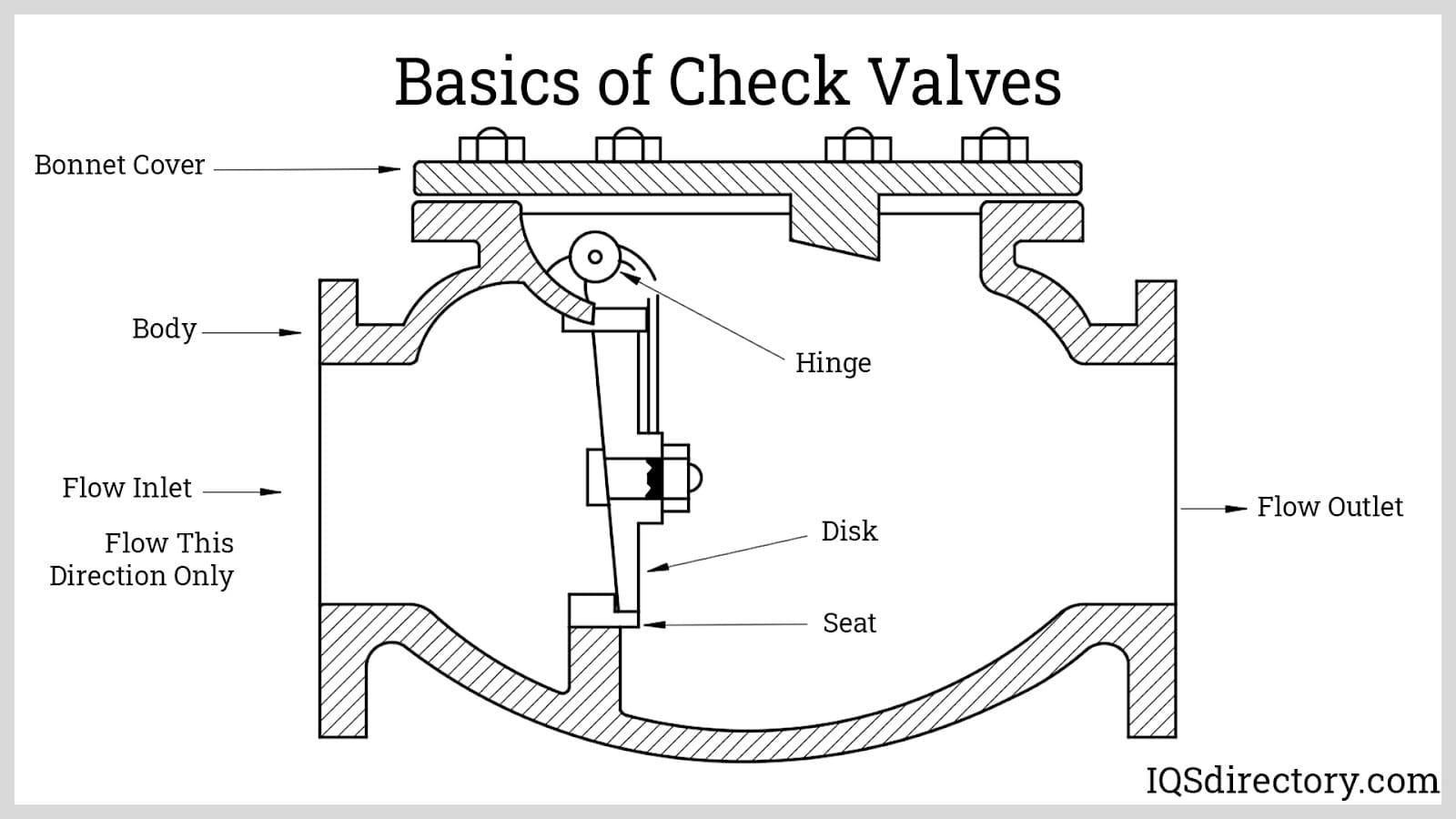
What Is a Swing Check Valve?
A swing check valve is a type of check valve in which the disc is hinged at the top and swings open when fluid flows in the forward direction. When the flow stops or reverses, the disc swings back onto the valve seat, preventing backflow.
Construction of Swing Check Valve
- Valve body (cast or forged)
- Hinged disc
- Hinge pin
- Seat ring
- Bonnet cover
Swing check valves are generally designed for full-bore flow, offering minimal pressure drop. They are commonly manufactured in cast iron, carbon steel, stainless steel (SS 304, SS 316), duplex steel, and alloy steel.

Working Principle of Swing Check Valve
When fluid enters the valve inlet, the pressure pushes the disc away from the seat, allowing unrestricted flow. As soon as the flow velocity decreases or reverses, gravity and back pressure force the disc to swing back, sealing against the seat. This automatic operation makes swing check valves highly reliable for continuous flow systems.
Due to their design, swing check valves are best suited for horizontal pipelines and applications where flow reversal is gradual rather than sudden.
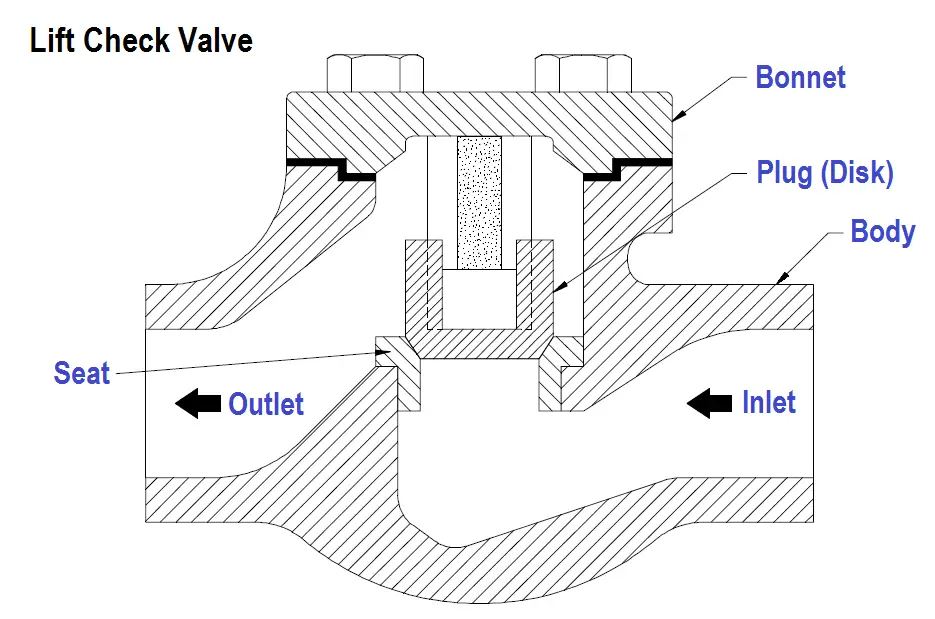
What Is a Lift Check Valve?
A lift check valve is a check valve in which the disc moves vertically (up and down) to permit or restrict flow. The disc typically rests on a seat and lifts when forward flow pressure exceeds the cracking pressure.
Construction of Lift Check Valve
- Valve body
- Disc or piston
- Guide ribs or cage
- Seat
- Bonnet
Lift check valves resemble globe valves in internal design and are commonly installed in high-pressure and high-temperature systems where tight shutoff is required.
Working Principle of Lift Check Valve
When fluid flows in the forward direction, pressure lifts the disc vertically off the seat, allowing flow. Once the flow stops or reverses, gravity and back pressure immediately force the disc back onto the seat, preventing reverse flow.
Because of the guided disc movement, lift check valves respond faster than swing check valves, making them suitable for applications with rapid flow changes.
Difference Between Swing Check Valve and Lift Check Valve
| Parameter | Swing Check Valve | Lift Check Valve |
|---|---|---|
| Disc Movement | Rotational (swing) | Vertical (lift) |
| Pressure Drop | Very low | Moderate to high |
| Flow Direction | Best for steady flow | Best for fluctuating flow |
| Installation | Mainly horizontal | Horizontal or vertical (upward flow) |
| Maintenance | Low | Moderate |
| Shutoff Tightness | Moderate | High |
| Typical Applications | Water, wastewater, oil pipelines | Steam, high-pressure fluids |
Applications of Swing Check Valves
- Water supply and distribution systems
- Wastewater treatment plants
- Oil and gas transmission pipelines
- Power plants
- HVAC and cooling water systems
Swing check valves are preferred where low pressure loss and high flow capacity are critical.
Applications of Lift Check Valves
- High-pressure steam lines
- Boiler feed water systems
- Chemical processing plants
- Refineries
- Compressed air systems
Lift check valves are ideal for applications requiring quick response and tight sealing.
Advantages and Disadvantages
Swing Check Valve – Pros & Cons
Advantages:
- Low pressure drop
- Simple design
- Cost-effective for large diameters
Disadvantages:
- Slower response to flow reversal
- Not ideal for pulsating flow
Lift Check Valve – Pros & Cons
Advantages:
- Fast response time
- Excellent sealing performance
- Suitable for high pressure
Disadvantages:
- Higher pressure drop
- Requires cleaner fluids
How to Choose Between Swing and Lift Check Valve?
When selecting between a swing check valve and a lift check valve, engineers should consider:
- Operating pressure and temperature
- Flow characteristics (steady or pulsating)
- Pipeline orientation
- Maintenance accessibility
- Industry standards and certifications
For large diameter, low-pressure water systems, swing check valves are generally recommended. For high-pressure, critical process lines, lift check valves offer superior performance.
Why Choose KELOR Check Valves?
KELOR is India’s biggest manufacturing, supplying, and exporting brand for industrial valves, offering ISO, API, and BS standard swing and lift check valves. With advanced CNC machining, in-house testing facilities, and strict quality control, KELOR valves deliver long service life and dependable performance.
KELOR check valves are widely supplied to EPC contractors, OEMs, government projects, and global distributors across Asia, the Middle East, Africa, and Europe.
Frequently Asked Questions (FAQ)
1. What is the main difference between swing and lift check valves?
The main difference lies in disc movement: swing valves rotate, while lift valves move vertically.
2. Which check valve has lower pressure drop?
Swing check valves have significantly lower pressure drop.
3. Can lift check valves be installed vertically?
Yes, lift check valves can be installed in vertical pipelines with upward flow.
4. Are swing check valves suitable for steam?
Generally no; lift check valves are preferred for steam applications.
5. Which valve responds faster to backflow?
Lift check valves respond faster due to guided disc movement.
6. What materials are used for KELOR check valves?
Cast iron, carbon steel, stainless steel, duplex, and alloy steels.
7. Which check valve is better for wastewater?
Swing check valves are commonly used in wastewater systems.
8. Do lift check valves require clean fluids?
Yes, debris can affect disc movement in lift check valves.
9. Are KELOR check valves export compliant?
Yes, they comply with international standards and export norms.
10. How long do industrial check valves last?
With proper selection and maintenance, 10–20 years or more.