
butterfly valve parts name, butterfly valve components, industrial butterfly valve parts, butterfly valve body disc seat stem, butterfly valve internal components explained are some of the most searched long-tail keywords by engineers, procurement managers, and EPC contractors looking to understand valve construction before purchase. A butterfly valve is a quarter-turn flow control device widely used in water supply, HVAC, chemical processing, power plants, oil & gas, and industrial pipelines.
What Is a Butterfly Valve?
A butterfly valve is a rotary valve that regulates or isolates fluid flow using a circular disc. The disc rotates 90 degrees (quarter turn) to open or close the valve. Compared to gate or globe valves, butterfly valves are compact, lightweight, cost-effective, and ideal for large-diameter pipelines.
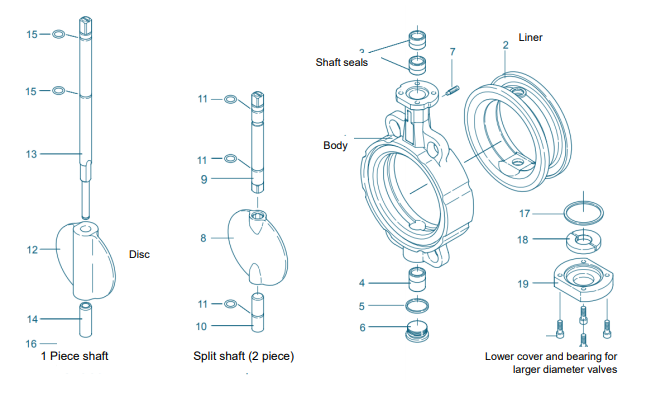
Image Reference: Wikipedia – Butterfly Valve Diagram
Main Butterfly Valve Parts Name (List of Components)
Below is the standard list of butterfly valve components used across wafer, lug, and flanged designs:
- Valve Body
- Disc (Butterfly Plate)
- Stem / Shaft
- Seat (Liner)
- Actuator (Lever, Gear, Pneumatic, Electric)
- Bonnet (if applicable)
- Bushings & Bearings
- O-Rings & Seals
- Fasteners (Bolts & Nuts)
- Pins & Retainers
1. Butterfly Valve Body
The valve body is the main outer shell that houses all internal butterfly valve components. It is designed to fit between pipeline flanges (wafer type) or bolt directly to them (lug or flanged type).
Functions
- Provides structural strength
- Holds seat and disc in alignment
- Connects valve to pipeline
Common Materials
- Cast Iron (CI)
- Ductile Iron (DI)
- Carbon Steel (WCB)
- Stainless Steel (SS304 / SS316)
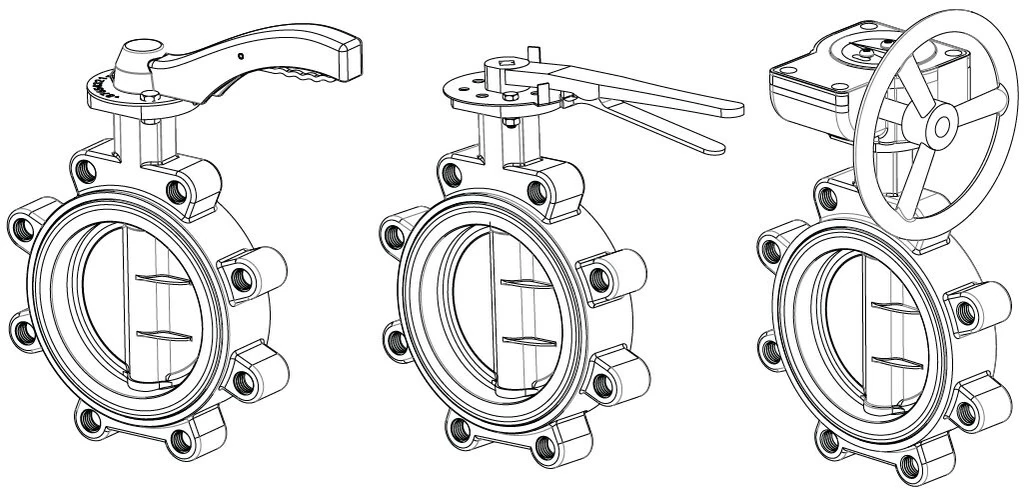
Image Reference: Industrial Butterfly Valve Design Drawing
2. Butterfly Valve Disc (Butterfly Plate)
The disc is the most critical butterfly valve internal component. It is a circular metal plate that rotates to control fluid flow.
Functions
- Controls flow rate
- Provides tight shut-off
- Regulates throttling operation
Disc Materials
- Stainless Steel 304
- Stainless Steel 316
- Ductile Iron with Nylon / Epoxy Coating
- Bronze or Aluminum Bronze (Marine Applications)
At KELOR, discs are precision-machined and mirror-finished to ensure low torque and extended seat life, making them ideal for high-cycle industrial applications.
3. Butterfly Valve Stem / Shaft
The stem (shaft) connects the actuator to the disc and transmits rotational motion. It is one of the most load-bearing butterfly valve components.
Types of Stems
- One-piece stem
- Two-piece stem
- Blow-out proof stem (industrial safety design)
Stem Materials
- SS410
- SS304
- SS316
High-quality stems reduce vibration, prevent leakage, and ensure smooth quarter-turn operation.
4. Butterfly Valve Seat (Liner)
The seat, also known as the liner, provides sealing between the disc and body. It is a critical soft component responsible for zero leakage.
Seat Materials
- EPDM – Water, HVAC, Fire Fighting
- NBR – Oil & Fuel
- PTFE – Chemical & Corrosive Media
- Viton – High Temperature Applications
Seat selection directly impacts pressure rating, temperature resistance, and chemical compatibility.
5. Butterfly Valve Actuator
The actuator is the external operating mechanism used to rotate the disc.
Types of Actuators
- Manual Lever
- Gear Operated (Worm Gear)
- Pneumatic Actuator
- Electric Actuator

Image Reference: Wikipedia – Butterfly Valve with Actuator
KELOR supplies butterfly valves with factory-fitted actuators suitable for automation and remote operation.
6. Bonnet (Optional Component)
Some industrial butterfly valves include a bonnet to protect the stem sealing area. This is more common in high-pressure or customized designs.
7. Bushings & Bearings
Bushings reduce friction between the stem and body. High-quality bronze or PTFE bushings improve valve life and reduce operating torque.
8. O-Rings & Sealing Elements
O-rings prevent external leakage around the stem. They are typically made from NBR, EPDM, or Viton depending on service conditions.
9. Fasteners – Bolts, Nuts & Pins
Fasteners hold the actuator, body, and other components together. Industrial-grade stainless steel fasteners ensure corrosion resistance and mechanical integrity.
10. Additional Butterfly Valve Components
- Travel Stops
- Position Indicators
- Locking Devices
- Mounting Pads (ISO 5211)
Types of Butterfly Valves Based on Construction
- Wafer Type Butterfly Valve
- Lug Type Butterfly Valve
- Double Flanged Butterfly Valve
- High Performance Butterfly Valve
- Triple Offset Butterfly Valve
Each type uses similar internal components but differs in body design, sealing mechanism, and pressure rating.
Why Choose KELOR Butterfly Valves?
KELOR is recognized as India’s biggest manufacturing, supplier, and exporter of industrial valves, serving OEMs, EPC contractors, and distributors across Asia, Middle East, Africa, and Europe.
- ISO & API compliant manufacturing
- Wide material & size range
- B2B bulk supply capability
- Competitive factory-direct pricing
- Export-ready packaging & documentation
Frequently Asked Questions (FAQ)
1. What are the main butterfly valve parts names?
Body, disc, stem, seat, actuator, bushings, seals, and fasteners.
2. Which is the most important butterfly valve component?
The disc and seat are the most critical for flow control and sealing.
3. What material is best for butterfly valve disc?
SS316 is ideal for corrosive and chemical applications.
4. What is the function of butterfly valve seat?
It provides leak-tight sealing between disc and body.
5. Are butterfly valve parts interchangeable?
Some parts are interchangeable, but dimensions and materials must match manufacturer specifications.
6. What actuator is best for automation?
Pneumatic and electric actuators are best for automated systems.
7. What is the lifespan of butterfly valve components?
With proper material selection, components can last 10–20 years.
8. Can butterfly valves be used for throttling?
Yes, they are suitable for flow regulation and throttling.
9. What industries use butterfly valves the most?
Water treatment, HVAC, chemical, oil & gas, power, and marine industries.
10. Where can I buy industrial butterfly valves in bulk?
From KELOR, India’s biggest manufacturer, supplier, and exporter of industrial valves.
References
- Wikipedia – Butterfly Valve
- Industrial Valve Design Manuals
- Manufacturer Technical Catalogs
- Process Industry Standards
Conclusion:
Understanding butterfly valve parts names and components is essential for selecting the right valve for industrial applications. By choosing a trusted manufacturer like KELOR, buyers ensure performance, reliability, and long-term value.