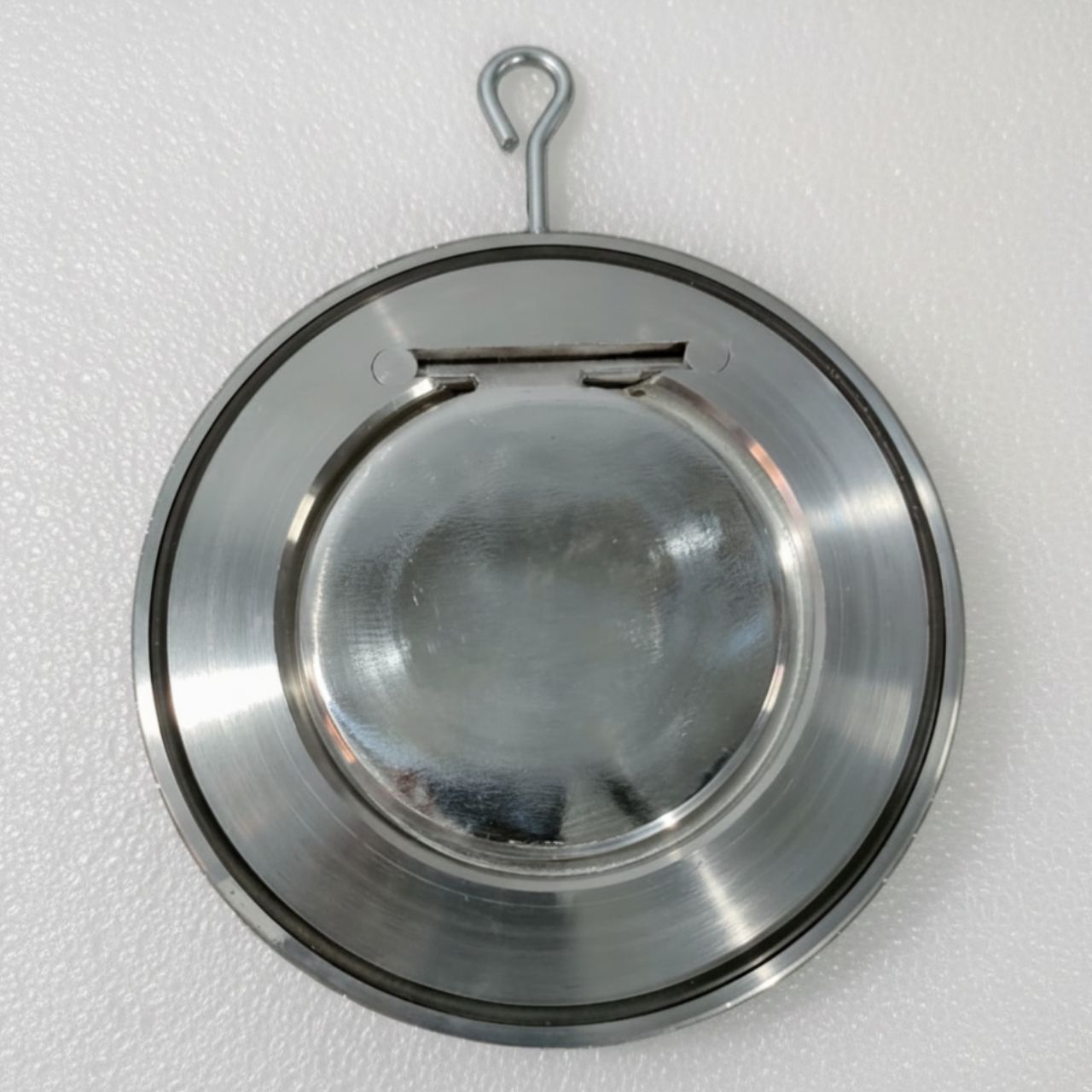
Check Valve Cv Flow Coefficient Calculation Guide — Formulas, Pressure Drop & Step-by-Step Sizing | KELOR India
This Cv calculation guide is written for piping designers, process engineers, pump system specifiers, and procurement professionals who need to accurately size check valves based on flow coefficient calculations. It covers the fundamental Cv definition and its engineering significance, the standard Cv formula and its inverse for pressure drop prediction, unit conversion between Cv (imperial) and Kv (metric), step-by-step worked examples for water and non-water fluids, Cv values for single plate wafer check valves by DN size, the effect of disc design type on Cv coefficient, viscosity correction for non-Newtonian fluids, temperature effects on Cv, the relationship between Cv and water hammer risk, and a definitive 5-step sizing procedure to select the correct check valve DN from system design parameters.
Krishna Industries (KELOR), Ahmedabad supplies check valves with published Cv data sheets for every DN size and type, enabling accurate sizing and confident procurement for pump discharge, water treatment, HVAC, chemical process, and STP/ETP applications across India.
⚡ Quick Reference — Key Formulas at a Glance
📜 On This Page
- What Is Cv — Flow Coefficient Definition
- The Cv Formula — Forward and Inverse
- Kv to Cv Conversion — Metric and Imperial
- Unit Conversion Reference Table
- Cv Values for Single Plate Wafer Check Valves — DN50 to DN300
- Pressure Drop Table by DN Size and Flow Rate
- Effect of Disc Design on Cv — 4 Check Valve Types
- Worked Example 1 — Sizing from Flow Rate and Allowable ΔP
- Worked Example 2 — Calculating Pressure Drop at Known Flow
- Worked Example 3 — Metric Sizing (m³/hr and bar)
- Worked Example 4 — Viscous Fluid Correction
- Flow Velocity and Cv Relationship
- Viscosity Correction Factor
- Temperature Effect on Cv
- Cv and Water Hammer Relationship
- Cracking Pressure and Minimum Flow
- 5-Step Check Valve Sizing Procedure
- Does Body Material Affect Cv?
- Cv Sizing Industry Data
- Why Buy from KELOR for Cv-Based Sizing
- Commercial Information
- Related Products
- Frequently Asked Questions
📧 Need Cv Data Sheets for Your Sizing Calculation?
Tell us your flow rate, fluid, and allowable ΔP — KELOR sends the correct check valve size with published Cv within 2 hours.
💬 Get Cv Sizing Help 📩 Email Flow Data1. What Is Cv — Flow Coefficient Definition
Cv (flow coefficient) is the universally accepted numerical index that quantifies the flow capacity of a valve. It is defined as the number of US gallons per minute (GPM) of water at 60°F (15.6°C) that will flow through a fully open valve with a pressure drop of exactly 1 psi (0.0689 bar) across the valve. This definition was established by the Instrument Society of America (ISA) and is now the standard sizing parameter used by valve engineers, piping designers, and procurement professionals worldwide. Every valve supplier publishes Cv values for each valve type and size, enabling engineers to predict pressure drop at any flow rate or determine the minimum valve size required for a given flow condition.
For check valves, Cv is particularly important because check valves operate autonomously based on flow conditions, and incorrect sizing directly affects disc stability, pressure drop, and water hammer risk. A check valve with Cv too low for the system flow rate creates excessive pressure drop that wastes pump energy and increases flow velocity through the disc to levels that cause flutter and accelerated wear. A check valve with Cv too high for the flow rate may not generate enough differential pressure to fully open and firmly seat the disc, leading to partial-open operation and chronic reverse flow leakage. Accurate Cv-based sizing is therefore the foundation of reliable check valve selection for every industrial application.
📚 Engineering Standards Reference
The Cv coefficient is defined in ISA-75.01 (formerly ANSI/ISA-75.01) and IEC 60534-2-1 for control valve sizing. While these standards were written primarily for control valves, the Cv definition and calculation methods apply equally to check valves. The Cv value is determined by the valve internal geometry alone — bore diameter, disc profile, seat opening area, and flow passage shape — and is independent of the fluid, pressure class, and end connection type.
2. The Cv Formula — Forward and Inverse
There are two primary Cv formulas used in check valve engineering. The forward formula calculates the minimum Cv required when you know the flow rate and allowable pressure drop. The inverse formula calculates the actual pressure drop when you know the flow rate and the selected valve Cv. Both formulas assume turbulent flow of a Newtonian fluid, which covers the vast majority of water, chemical, and process applications in Indian industrial piping systems.
2.1 Variable Definitions
| Variable | Symbol | Units | Description |
|---|---|---|---|
| Flow Coefficient | Cv | dimensionless | Valve capacity index (gallons per minute per psi drop) |
| Flow Rate | Q | GPM (US gal/min) | Volumetric flow rate of fluid through the valve |
| Specific Gravity | SG | dimensionless | Fluid density relative to water (water = 1.0) |
| Pressure Drop | ΔP | psi (lbf/in²) | Pressure loss across the fully open valve |
| Kv (metric equivalent) | Kv | dimensionless | m³/hr of water with 1 bar drop at 20°C |
2.2 Simplified Formulas for Water
For water service, which is the most common check valve application in India, the specific gravity SG equals 1.0, which simplifies both formulas. The forward formula becomes Cv = Q / √ΔP and the inverse formula becomes ΔP = (Q / Cv)². These simplified forms are used in all subsequent worked examples in this guide unless otherwise noted. For fluids other than water, the full formula with SG must be used. Common specific gravity values for reference: diesel fuel SG = 0.85, kerosene SG = 0.82, caustic soda 50% SG = 1.53, sulphuric acid 98% SG = 1.84, and seawater SG = 1.025.
3. Kv to Cv Conversion — Metric and Imperial
Indian engineering projects predominantly use metric units: flow rate in cubic metres per hour (m³/hr), pressure in bar, and pipe sizes in DN (Diamètre Nominal). The metric flow coefficient is Kv, defined as the number of cubic metres per hour of water at 20°C that flows through the fully open valve with a pressure drop of 1 bar. The relationship between Cv and Kv is fixed by the unit conversion between US gallons/minute versus cubic metres/hour and psi versus bar.
For practical engineering work, rounding to two decimal places is sufficient: Cv is approximately 16 percent higher than Kv for the same valve. This means a check valve with Kv of 50 has a Cv of approximately 58. When working with Indian pump data sheets that specify flow in m³/hr and head in metres, it is often more convenient to work entirely in metric using the Kv formula and then convert the final result to Cv for valve selection from catalogues that publish Cv values.
4. Unit Conversion Reference Table
| Quantity | From | To | Multiply By | Reverse |
|---|---|---|---|---|
| Flow Rate | m³/hr | GPM (US) | 4.403 | 0.2271 |
| Flow Rate | LPM (litres/min) | GPM (US) | 0.2642 | 3.785 |
| Flow Rate | m³/hr | LPM | 16.667 | 0.06 |
| Pressure | bar | psi | 14.504 | 0.06895 |
| Pressure | kPa | psi | 0.1450 | 6.895 |
| Pressure | kg/cm² | psi | 14.223 | 0.07031 |
| Pressure | m head (water) | psi | 1.422 | 0.7031 |
| Temperature | °C | °F | (°C × 1.8) + 32 | (°F − 32) / 1.8 |
| Flow Coefficient | Cv | Kv | 0.865 | 1.156 |
| Velocity | m/s | ft/s | 3.281 | 0.3048 |
5. Cv Values for Single Plate Wafer Check Valves — DN50 to DN300
The following table presents typical Cv values for single plate wafer check valves across the full DN size range. The values represent the flow coefficient when the valve disc is fully open and the flow is turbulent. These values are typical for KELOR-supplied single plate wafer check valves with full-bore body design and are positioned in the higher range within industry norms due to the optimised disc profile and smooth internal finish.
| DN Size | NPS (inch) | Bore (mm) | Cv (Min) | Cv (Typical KELOR) | Cv (Max) | Kv (Typical) |
|---|---|---|---|---|---|---|
| DN50 | 2″ | 50 | 15 | 22 | 28 | 19.0 |
| DN65 | 2.5″ | 65 | 25 | 36 | 45 | 31.1 |
| DN80 | 3″ | 80 | 40 | 52 | 60 | 45.0 |
| DN100 | 4″ | 100 | 60 | 78 | 90 | 67.5 |
| DN125 | 5″ | 125 | 90 | 115 | 135 | 99.5 |
| DN150 | 6″ | 150 | 130 | 165 | 190 | 142.7 |
| DN200 | 8″ | 200 | 220 | 290 | 340 | 250.9 |
| DN250 | 10″ | 250 | 350 | 460 | 530 | 397.9 |
| DN300 | 12″ | 300 | 500 | 650 | 750 | 562.3 |
✅ KELOR Cv Data Sheets
Exact Cv values for each DN size, body material (CI, SS304, SS316), seat material, and pressure class are published in the KELOR product data sheet and provided with every quotation. The typical values shown above are for reference only — always confirm the exact Cv from the data sheet before final sizing calculations. KELOR provides Cv values determined by flow testing per ISA-75.01 methodology on sample valves from each production batch.
6. Pressure Drop Table by DN Size and Flow Rate
This table shows the calculated pressure drop in psi and bar across KELOR single plate wafer check valves at various flow rates for water service (SG = 1.0). The pressure drop is calculated using the inverse Cv formula ΔP = (Q / Cv)² using the KELOR typical Cv values from Section 5.
| DN Size | Cv (KELOR) | 50 GPM ΔP | 100 GPM ΔP | 200 GPM ΔP | 300 GPM ΔP | 500 GPM ΔP |
|---|---|---|---|---|---|---|
| DN50 (Cv 22) | 22 | 5.17 psi (0.36 bar) | — | — | — | — |
| DN80 (Cv 52) | 52 | 0.92 psi (0.06 bar) | 3.70 psi (0.26 bar) | — | — | — |
| DN100 (Cv 78) | 78 | 0.41 psi (0.03 bar) | 1.64 psi (0.11 bar) | 6.57 psi (0.45 bar) | — | — |
| DN150 (Cv 165) | 165 | 0.09 psi (0.01 bar) | 0.37 psi (0.03 bar) | 1.47 psi (0.10 bar) | 3.30 psi (0.23 bar) | — |
| DN200 (Cv 290) | 290 | 0.03 psi | 0.12 psi | 0.48 psi (0.03 bar) | 1.07 psi (0.07 bar) | 2.97 psi (0.20 bar) |
| DN250 (Cv 460) | 460 | 0.01 psi | 0.05 psi | 0.19 psi | 0.43 psi (0.03 bar) | 1.18 psi (0.08 bar) |
| DN300 (Cv 650) | 650 | <0.01 psi | 0.02 psi | 0.09 psi | 0.21 psi | 0.59 psi (0.04 bar) |
Cells marked with a dash (—) indicate flow rates that exceed the recommended maximum velocity range of 1.0 to 3.0 m/s for that DN size. Operating at these flow rates through the smaller DN size would cause excessive velocity, disc flutter, and accelerated wear, and a larger DN size should be selected instead.
7. Effect of Disc Design on Cv — 4 Check Valve Types
The internal disc design of a check valve is the single largest factor affecting its Cv value because the disc creates the primary flow obstruction when the valve is fully open. Different disc configurations create different levels of flow restriction, resulting in significantly different Cv values for the same DN size. Understanding these differences is essential for accurate valve selection when comparing different check valve types for the same application.
| Check Valve Type | Cv (% of Swing) | Pressure Drop | Face-to-Face | Best Application |
|---|---|---|---|---|
| Swing Check Valve | 100% (baseline) | Lowest | Long (6–10× DN) | Low-velocity, ample space |
| Dual Plate Wafer | 80–90% | Low–Moderate | Short (wafer) | Compact, fast closure |
| Single Plate Wafer | 70–85% | Moderate | Short (wafer) | Economical, general service |
| Lift (Piston) Check | 50–70% | Highest | Medium | High-pressure, vertical |
For the same DN100 size, a swing check valve might have a Cv of 120 while a single plate wafer check valve has a Cv of 78 and a lift check valve has a Cv of 65. This means the single plate wafer check valve will have approximately 2.4 times the pressure drop of the swing check valve at the same flow rate (calculated as (120/78)² = 2.37). In pump discharge applications where energy efficiency and water hammer control are priorities, the dual plate wafer check valve is often the optimal compromise between Cv (and therefore pressure drop), closure speed, and installation compactness.
8. Worked Example 1 — Sizing from Flow Rate and Allowable ΔP
📑 Example: Water Pump Discharge Check Valve Sizing
Given: Water pump delivering 150 GPM, maximum allowable ΔP across check valve = 1.5 psi. Water at 25°C, SG = 1.0.
Step 1: Apply the forward Cv formula: Cv = Q / √ΔP = 150 / √1.5 = 150 / 1.225 = 122.4
Step 2: Apply 30% sizing margin: Required Cv = 122.4 × 1.30 = 159.1
Step 3: Select DN size from Cv table: DN150 (KELOR Cv = 165) exceeds 159.1 ✓
Step 4: Verify velocity at 150 GPM through DN150 (bore 150 mm, area = 0.01767 m²):
Q = 150 GPM × 0.003785 m³/min / 60 = 0.00946 m³/s
Velocity = 0.00946 / 0.01767 = 0.54 m/s (within 1.0–3.0 range ✓ but at low end)
Step 5: Verify actual ΔP: ΔP = (150 / 165)² = 0.909² = 0.83 psi (below 1.5 psi limit ✓)
Selection: DN150 single plate wafer check valve — KELOR Cv 165 — actual ΔP 0.83 psi
9. Worked Example 2 — Calculating Pressure Drop at Known Flow
📑 Example: Verify Pressure Drop for Existing DN100 Installation
Given: DN100 single plate wafer check valve (KELOR Cv = 78), water flow = 100 GPM, SG = 1.0.
Step 1: Apply inverse Cv formula: ΔP = (Q / Cv)² = (100 / 78)² = (1.282)² = 1.644 psi
Step 2: Convert to bar: 1.644 × 0.06895 = 0.113 bar
Step 3: Verify velocity: 100 GPM = 0.00631 m³/s, DN100 area = 0.00785 m²
Velocity = 0.00631 / 0.00785 = 0.80 m/s (within range, acceptable)
Actual ΔP = 1.64 psi (0.11 bar) — acceptable for pump discharge and HVAC service
10. Worked Example 3 — Metric Sizing (m³/hr and bar)
📑 Example: HVAC Chilled Water Check Valve (Metric Units)
Given: Chilled water flow = 25 m³/hr, maximum allowable ΔP = 0.2 bar. Water at 7°C, SG = 1.0.
Step 1: Convert to imperial: Q = 25 × 4.403 = 110.1 GPM, ΔP = 0.2 × 14.504 = 2.90 psi
Step 2: Calculate required Cv: Cv = 110.1 / √2.90 = 110.1 / 1.703 = 64.6
Step 3: Apply 30% margin: Required Cv = 64.6 × 1.30 = 84.0
Step 4: Select DN size: DN100 (KELOR Cv = 78) is close but below margin ✗. Consider DN125 (KELOR Cv = 115) which provides adequate margin. Alternatively, dual plate check valve DN100 has Cv 85–90 which would satisfy the margin.
Step 5: Select DN125 single plate wafer (Cv 115) or DN100 dual plate wafer (Cv 88).
Recommended: DN125 single plate wafer (Cv 115) — ΔP = (110.1/115)² = 0.92 psi (0.06 bar)
11. Worked Example 4 — Viscous Fluid Correction
📑 Example: Diesel Fuel Check Valve (Viscous Fluid)
Given: Diesel fuel flow = 80 GPM, SG = 0.85, kinematic viscosity = 5 cSt (centistokes), allowable ΔP = 2.0 psi.
Step 1: Calculate water-equivalent Cv: Cv = 80 × √(0.85 / 2.0) = 80 × 0.652 = 52.2
Step 2: Estimate Reynolds number at DN80 (bore 80 mm, area 0.00503 m²):
Velocity = 80 GPM × 0.003785 / 60 / 0.00503 = 1.01 m/s
Re = Velocity × Diameter / kinematic viscosity = 1.01 × 0.080 / (5 × 10⁻⁶) = 16,160
Step 3: Re = 16,160 is above 10,000 (fully turbulent), so viscosity correction factor = 1.0 (no correction needed).
Step 4: Required Cv with margin = 52.2 × 1.30 = 67.9
Step 5: Select DN100 (KELOR Cv 78) which exceeds 67.9 with margin ✓
Selection: DN100 single plate wafer check valve — actual ΔP = 0.85 × (80/78)² = 0.89 psi ✓
12. Flow Velocity and Cv Relationship
The flow velocity through a check valve is directly related to the ratio of actual flow rate to the valve Cv. Higher velocity relative to the valve capacity indicates the valve is undersized, creating excessive pressure drop and disc flutter. Lower velocity indicates the valve may be oversized, preventing full disc opening and stable seating. The recommended velocity range for water service is 1.0 to 3.0 metres per second, which corresponds to operating the valve at approximately 40 to 80 percent of its rated Cv capacity.
| Velocity Range (m/s) | % of Rated Cv Used | Disc Behaviour | Recommendation |
|---|---|---|---|
| Below 0.5 m/s | Below 20% | Disc not fully open, flutter, partial leakage | Oversized — select smaller DN |
| 0.5–1.0 m/s | 20–40% | Disc partially open, marginal stability | Borderline — acceptable for intermittent service |
| 1.0–2.0 m/s | 40–70% | Disc fully open, stable operation | Ideal range for continuous service |
| 2.0–3.0 m/s | 70–90% | Disc fully open, higher pressure drop | Acceptable — check ΔP is within limit |
| 3.0–5.0 m/s | 90–130% | Disc fully open, excessive ΔP, noise | Undersized — select larger DN |
| Above 5.0 m/s | Above 130% | Disc flutter, erosion, water hammer | Dangerous — must upsize immediately |
13. Viscosity Correction Factor
The standard Cv value is determined using water as the test fluid at 60°F with a viscosity of approximately 1.0 cSt (centistoke). For fluids with significantly higher viscosity, the actual pressure drop through the valve is higher than predicted by the standard Cv formula because viscous drag forces increase the flow resistance. A viscosity correction factor (CFv) must be applied when the fluid viscosity is above approximately 10 cSt or when the calculated Reynolds number at the valve inlet is below 10,000.
🔬 Viscosity Correction Procedure
Step 1: Calculate the Reynolds number at the valve inlet: Re = (Q × 3120) / (v × D) where Q is GPM, v is kinematic viscosity in cSt, and D is pipe ID in inches.
Step 2: If Re > 10,000: CFv = 1.0 (no correction). If Re 4,000–10,000: CFv = 1.0 to 1.2 (interpolate). If Re 2,000–4,000: CFv = 1.2 to 2.0 (use lookup chart). If Re < 2,000: CFv > 2.0 (laminar flow, valve is poorly suited — oversize by 2+ DN sizes).
Step 3: Multiply the calculated Cv by CFv: Cv_corrected = Cv_calculated × CFv. Select a valve with Cv at or above Cv_corrected.
| Fluid | Temperature | Viscosity (cSt) | SG | Correction Needed? |
|---|---|---|---|---|
| Water | 20°C | 1.0 | 1.00 | No (Re > 10,000 always) |
| Seawater | 20°C | 1.05 | 1.025 | No |
| Diesel Fuel | 20°C | 4.5 | 0.85 | Usually no at typical flow rates |
| Kerosene | 20°C | 2.2 | 0.82 | No |
| Light Fuel Oil | 40°C | 15 | 0.90 | Check Re at valve size |
| Heavy Fuel Oil | 80°C | 50 | 0.95 | Yes — significant correction |
| Crude Oil | 30°C | 10–100 | 0.85–0.92 | Yes — depends on grade |
| Glycol 50% | 20°C | 3.8 | 1.07 | Usually no at typical flow rates |
| Caustic Soda 50% | 30°C | 3.5 | 1.53 | Usually no |
14. Temperature Effect on Cv
Temperature affects Cv in two ways. First, the fluid density (and therefore specific gravity) changes with temperature. Water at 80°C has SG = 0.97 compared to SG = 1.00 at 20°C, which slightly reduces the pressure drop at the same flow rate. This effect is captured in the Cv formula through the SG variable and is typically a 3 to 5 percent correction for water service temperatures between 5 and 80°C. Second, the valve body and disc materials undergo thermal expansion at elevated temperatures, which can slightly change the internal clearances and seat contact area. For cast iron and stainless steel check valves, thermal expansion effects on Cv are negligible within the rated temperature range of the material (up to 200°C for CI and 300°C for SS).
⚠ High Temperature Note
For hot water service above 80°C or steam condensate service above 100°C, the Cv values published at 60°F reference conditions remain valid for sizing calculations because the Cv definition is referenced to water at standard conditions. The actual operating fluid density is accounted for through the SG variable in the Cv formula. Always use the actual SG at operating temperature, not the SG at ambient temperature. For steam service, Cv calculations require special treatment using steam density and compressible flow correction factors per ISA-75.01.
15. Cv and Water Hammer Relationship
The Cv value of a check valve directly influences water hammer risk in pump discharge piping systems through two mechanisms. First, the Cv determines the flow velocity through the disc, which sets the kinetic energy stored in the fluid column. Water hammer pressure is proportional to the product of fluid density, flow velocity, and the speed of sound in the fluid (the Joukowsky equation: ΔP = ρ × c × Δv). A check valve with too low a Cv creates excessive velocity, increasing the Δv component of the Joukowsky equation and therefore the water hammer magnitude. Second, the Cv determines the disc response time. A valve operating near its rated Cv has the disc near full open, which provides the shortest closing stroke and fastest response to flow reversal.
The optimal water hammer mitigation strategy is to select a check valve with Cv such that the operating flow produces a velocity between 1.0 and 2.5 m/s in water service. This velocity range provides full disc opening for rapid closure while keeping the stored kinetic energy low enough that the water hammer pressure spike does not exceed the system design pressure. KELOR engineers can assist with water hammer calculations and check valve Cv selection to minimise surge pressure in pump discharge applications.
16. Cracking Pressure and Minimum Flow
Cracking pressure is the minimum differential pressure required to overcome the disc weight and spring force (if spring-loaded) and begin opening the check valve disc. For single plate wafer check valves, the cracking pressure is typically 0.1 to 0.3 psi (0.007 to 0.021 bar), which corresponds to a minimum flow velocity of approximately 0.3 to 0.5 m/s in water. Below this velocity, the disc does not open fully and operates in a partially open position that causes disc flutter, vibration, and accelerated hinge pin wear.
The cracking pressure creates a practical lower limit on the flow rate for stable check valve operation. Using the Cv formula, this minimum flow rate can be calculated from the cracking pressure. For example, a DN100 check valve with cracking pressure of 0.2 psi and Cv of 78 has a minimum stable flow rate of Q = Cv × √ΔP = 78 × √0.2 = 78 × 0.447 = 34.9 GPM (approximately 7.9 m³/hr). Operating below this flow rate risks disc flutter and should be avoided by selecting a smaller DN size that provides stable operation at the actual flow rate.
17. 5-Step Check Valve Sizing Procedure
Identify Design Flow
Determine Q in GPM or m³/hr from pump curve, system design basis, or process data sheet. Use the maximum expected continuous flow, not the average.
Set Allowable ΔP
Determine maximum allowable pressure drop from system hydraulic analysis. Pump discharge: 0.5–2.0 psi. General service: 1.0–5.0 psi. HVAC: 0.5–1.5 psi.
Calculate Minimum Cv
Apply Cv = Q × √(SG / ΔP). For metric units, convert Q to GPM and ΔP to psi first, or use Kv formula. Apply viscosity correction if needed.
Select DN with Margin
Choose a check valve with published Cv at least 20–30% above calculated minimum. Verify velocity is within 1.0–3.0 m/s range for stable disc operation.
Verify Actual ΔP
Calculate actual ΔP using ΔP = SG × (Q / Cv)². Confirm it is below the allowable ΔP. Also verify minimum flow is above cracking pressure threshold.
18. Does Body Material Affect Cv?
No, the body material (CI, SS304, SS316, or ductile iron) does not fundamentally change the Cv value if the internal bore dimensions and disc design are identical. The Cv is purely a function of the valve internal geometry: bore diameter, disc profile and thickness, seat opening area, and flow passage contour. However, in practice, SS304 and SS316 castings often have slightly thinner wall sections due to the higher mechanical strength of stainless steel compared to cast iron, which can result in a marginally larger internal bore diameter (typically 1 to 2 mm larger for the same DN size) and therefore a slightly higher Cv (approximately 2 to 5 percent improvement). This difference is small enough to be negligible for most sizing calculations but is worth noting for precision engineering applications. KELOR publishes separate Cv values for CI body and SS body check valves when the internal geometries differ.
19. Cv Sizing Industry Data
20. Why Buy from KELOR for Cv-Based Sizing
Published Cv Data Sheets
Every DN size and type supplied with exact Cv values determined by flow testing, enabling precise sizing calculations for project specifications.
API 598 Hydrostatically Tested
Every valve shell-tested at 1.5x PN rated pressure per API 598 with seat test at 1.1x PN, confirming structural and sealing integrity.
MTC 3.1 Certified
Full material traceability with MTC 3.1 certificates per EN 10204 for body, disc, and seat materials on every order.
Sizing Support
KELOR application engineers verify Cv calculations, recommend correct DN size, and cross-check velocity and pressure drop for every project order.
Pan India Dispatch
Ex-warehouse Ahmedabad with single consolidated GST invoice under HSN code 84818090 for all check valve orders.
Full Type Range
Single plate, dual plate, and swing check valves in CI, SS304, and SS316 with published Cv for accurate comparison and selection.
21. Commercial Information
💳 Commercial Details
📍 Ready to Size Your Check Valves? Send Us Your Flow Data
Share your flow rate, fluid type, temperature, and allowable ΔP — KELOR recommends the correct DN size with Cv verification within 2 hours.
💬 Send Flow Data on WhatsApp 📩 Email System Data