
manual butterfly valve classification, butterfly valve structure diagram, manual operated butterfly valve types, industrial butterfly valve manufacturer in India, and butterfly valve parts and functions are among the most searched technical queries by engineers, EPC contractors, OEM buyers, and industrial procurement teams. Manual butterfly valves remain one of the most widely used flow control solutions across water supply, chemical processing, HVAC, fire protection, power plants, and general industrial pipelines.
What Is a Manual Butterfly Valve?
A manual butterfly valve is a quarter-turn rotary valve used to regulate, isolate, or control the flow of liquids, gases, and slurries in a pipeline. Unlike actuated valves, manual butterfly valves are operated using mechanical hand mechanisms such as levers, gearboxes, or chain wheels.
The valve consists of a circular disc mounted on a rotating shaft. When the disc is rotated parallel to the flow, the valve is fully open; when rotated perpendicular, the valve is fully closed. Due to its compact design, low pressure drop, and cost-effectiveness, butterfly valves are extensively used in industrial systems.
Why Manual Butterfly Valves Are Widely Used in Industry
- Simple construction and easy operation
- Compact size and lightweight design
- Lower cost compared to gate and globe valves
- Quick shut-off with quarter-turn operation
- Minimal maintenance requirements
- Suitable for large diameter pipelines
As a leading Indian valve manufacturer, KELOR supplies manual butterfly valves that comply with international standards and are engineered for durability in demanding industrial environments.
Manual Butterfly Valve Classification
Manual butterfly valves can be classified based on multiple technical and operational parameters. Understanding this classification helps engineers and buyers select the correct valve for their application.
1. Classification Based on Operation Mechanism
a) Lever Operated Butterfly Valve
Lever operated butterfly valves are manually controlled using a hand lever. These are typically used for small to medium-sized valves where torque requirements are low.
- Size range: DN25 to DN150
- Quick open and close operation
- Common in water supply and HVAC systems

Image Reference: Wikipedia – Butterfly Valve
b) Gear Operated Butterfly Valve
Gear operated butterfly valves use a worm gear gearbox for operation. This mechanism reduces operating torque and allows precise flow control.
- Suitable for large diameter valves
- High torque handling
- Used in water treatment plants, refineries, and power stations
KELOR manufactures heavy-duty gear operated butterfly valves designed for long service life and smooth operation under high pressure.
c) Chain Wheel Operated Butterfly Valve
Chain wheel operated butterfly valves are used where the valve is installed at height or in inaccessible locations. Operation is done using a hanging chain.
- Ideal for overhead pipelines
- Common in fire protection and industrial utilities
2. Classification Based on Valve Body Design
a) Wafer Type Manual Butterfly Valve
Wafer type butterfly valves are designed to fit between two pipe flanges. They are lightweight and economical.
- Easy installation
- Cost-effective solution
- Used in low to medium pressure systems
.png)
Image Reference: JSC Valve – Butterfly Valve Design Drawing
b) Lug Type Manual Butterfly Valve
Lug type butterfly valves feature threaded lugs that allow end-of-line service and easy maintenance.
- Allows pipe disconnection on one side
- Higher mechanical strength
- Preferred in industrial isolation applications
c) Double Flanged Butterfly Valve
Double flanged butterfly valves have flanges on both sides, providing superior alignment and strength.
- Used for high-pressure pipelines
- Robust and durable construction
3. Classification Based on Disc Design
- Concentric Butterfly Valve
- Double Offset Butterfly Valve
- Triple Offset Butterfly Valve
Manual concentric butterfly valves are most common for soft-seated applications, while offset designs are used for higher temperature and pressure services.
4. Classification Based on Seat Material
- EPDM Seated Butterfly Valve
- NBR Seated Butterfly Valve
- PTFE Seated Butterfly Valve
- Metal Seated Butterfly Valve
KELOR offers a complete range of seat materials to suit water, chemicals, steam, oil, and gas applications.
Butterfly Valve Structure Diagram and Construction
Understanding the butterfly valve structure is critical for correct selection, operation, and maintenance. Below is a detailed explanation of each component.
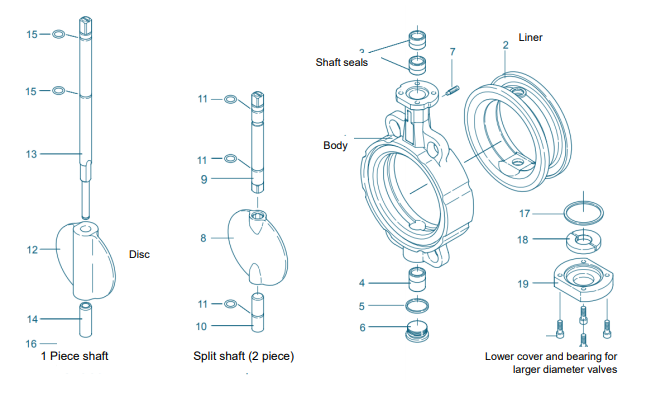
Image Reference: Wikipedia – Butterfly Valve Diagram
Main Parts of a Manual Butterfly Valve
1. Valve Body
The body forms the outer shell of the valve and connects it to the pipeline. Common materials include cast iron, ductile iron, carbon steel, and stainless steel.
2. Disc
The disc controls flow by rotating inside the valve body. Disc materials vary based on application, including SS304, SS316, and coated iron.
3. Stem (Shaft)
The stem transmits motion from the operator to the disc. Precision machining ensures smooth operation and long service life.
4. Seat
The seat provides sealing between the disc and body. Elastomer or metal seats are selected based on pressure, temperature, and media.
5. Operator (Lever/Gear)
The manual operator allows the user to open or close the valve. Gearboxes are preferred for larger valves.
Working Principle of Manual Butterfly Valve
When the handle or gear is rotated, the stem turns the disc inside the valve body. A 90-degree rotation moves the disc from fully closed to fully open. Partial rotation allows throttling of flow.
Due to its streamlined disc profile, pressure loss is minimal compared to other valve types.
Industrial Applications of Manual Butterfly Valves
- Water supply and distribution systems
- HVAC and cooling water lines
- Chemical and pharmaceutical plants
- Oil and gas pipelines
- Fire fighting systems
- Power generation plants
KELOR butterfly valves are widely installed across Indian and international industrial projects due to their reliability and competitive pricing.
Why Choose KELOR – India’s Biggest Butterfly Valve Manufacturer
KELOR is recognized as India’s biggest manufacturing, supplier, and exporter of industrial valves, delivering premium-quality butterfly valves to domestic and global markets.
- ISO certified manufacturing facilities
- Wide product range from DN25 to DN1200
- Export-quality compliance
- Bulk order capability for EPC projects
- Competitive B2B pricing
Frequently Asked Questions (FAQ)
1. What is a manual butterfly valve?
A manually operated valve that uses a rotating disc to control flow.
2. What are the types of manual butterfly valves?
Lever operated, gear operated, and chain wheel operated.
3. What is a wafer type butterfly valve?
A compact valve designed to fit between pipe flanges.
4. What materials are used in butterfly valves?
Cast iron, ductile iron, carbon steel, and stainless steel.
5. Where are butterfly valves used?
Water, HVAC, oil & gas, chemical, and fire systems.
6. What is the function of a butterfly valve disc?
To regulate or stop flow by rotating inside the valve.
7. Can butterfly valves be used for throttling?
Yes, they allow partial opening for flow control.
8. What is the difference between lug and wafer type?
Lug type allows end-line service; wafer type is lighter.
9. Are KELOR butterfly valves export quality?
Yes, manufactured to international standards.
10. How do I select the right butterfly valve?
Based on pressure, temperature, media, and application.
Conclusion: Manual butterfly valves remain an essential component in industrial flow control systems. Understanding their classification and internal structure ensures optimal performance, safety, and long-term reliability. With its extensive manufacturing capability and global supply network, KELOR continues to lead the Indian industrial valve market.