Twin Lobe Air Blower — Roots Type Twin Lobe Roots Blower for ETP, STP & Industrial Aeration
KELOR Roots Type Twin Lobe Air Blower — A twin lobe roots blower is a positive displacement machine that delivers a fixed volume of air at moderate pressure with 100% oil-free discharge, using two synchronised lobed rotors rotating in opposite directions inside a precision-machined casing. The KELOR twin lobe air blower delivers 50 to 600 M3/HR at 0.2 to 0.8 kg/cm2 with 3 to 50 HP IEC-standard motors — factory engineered, factory guaranteed, and trusted across ETP aeration, STP aeration, aquaculture, sugar plants, and cement plants throughout India.
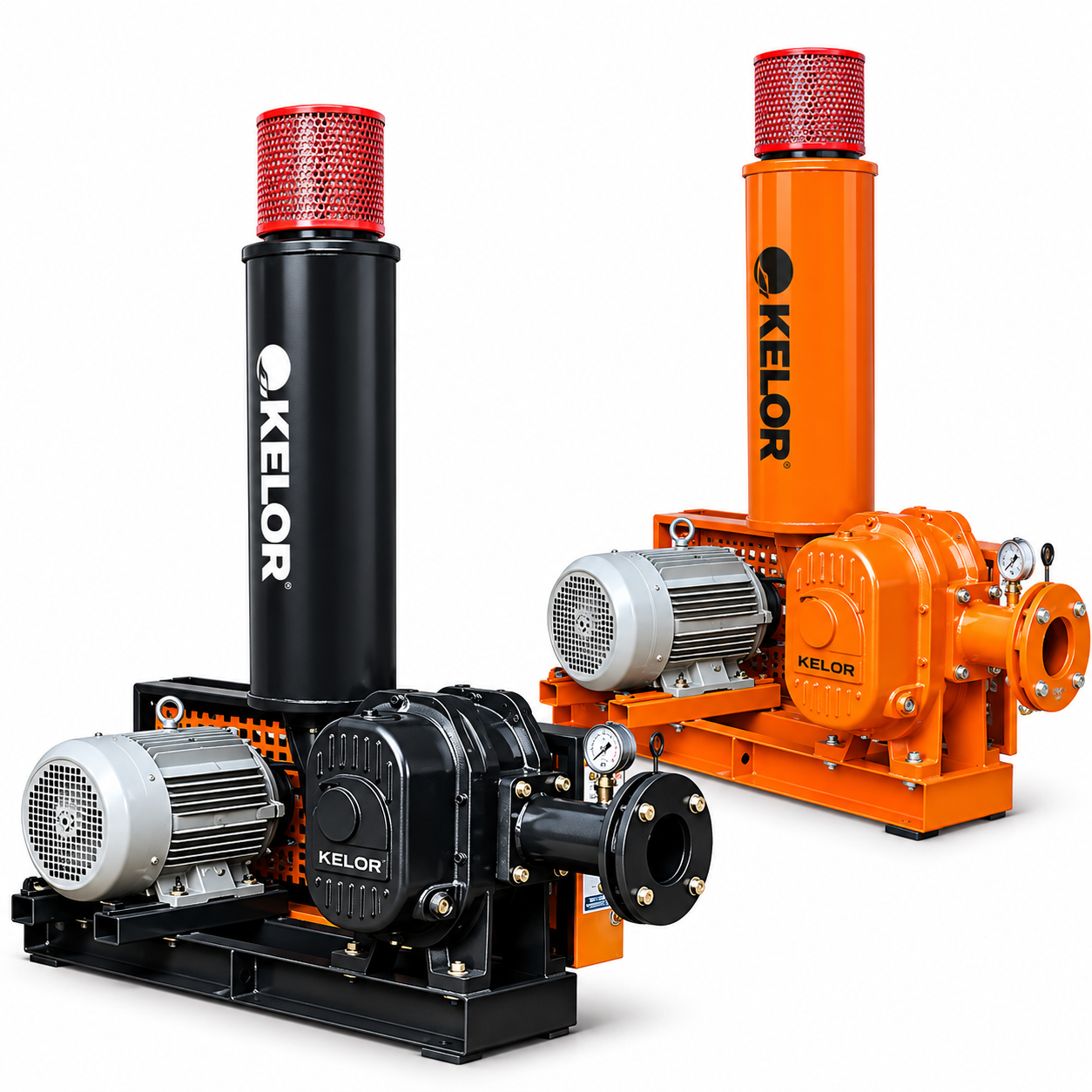
KELOR Twin Lobe Roots Blower — factory engineered for 100% oil-free, continuous-duty air delivery
Quick Specification
On This Page
- What Is a Twin Lobe Roots Blower?
- Working Principle
- Technical Specifications
- Twin Lobe Air Blower Price in India
- Product Features
- Twin Lobe vs Tri-Lobe vs Centrifugal
- Twin Lobe Air Blower for ETP & STP
- All Applications & Industries
- How to Select Your Blower
- Air Filters by Application
- Servicing & Spares Across India
- Troubleshooting Guide
- FAQs — 12 Questions Answered
1. What Is a Twin Lobe Roots Blower?
A twin lobe roots blower — also written as a Roots Type Twin Lobe Air Blower or simply a twin lobe air blower — is a positive displacement rotary machine that moves a fixed volume of air from inlet to outlet using two figure-eight-shaped lobed rotors. The rotors are synchronised by external timing gears so they rotate in opposite directions without touching each other or the casing. Because compression happens outside the machine (at the discharge line) rather than inside it, the design is classified as an “external compression” or “Roots principle” blower, named after the Roots brothers who patented the concept in 1860.
The result is a blower that produces constant, steady airflow at a fixed speed regardless of reasonable pressure variation — exactly what biological aeration processes and pneumatic conveying systems need. Unlike piston compressors, there are no reciprocating parts, so the air is delivered smoothly and continuously. Unlike oil-injected screw compressors, the air chamber is completely isolated from lubricant, so the delivered air is 100% oil-free. These two properties — constant flow and oil-free delivery — explain why the twin lobe roots blower is the default air mover for sewage treatment plants, effluent treatment plants, aquaculture farms, and powder conveying installations across India.
2. How a Twin Lobe Roots Blower Works — Step by Step
Understanding the working principle helps buyers compare quotes correctly and operators run the machine well. The air path through a twin lobe roots blower follows four stages:
Stage 1: Air Enters at Inlet
Ambient air passes through the inlet filter and silencer into the blower inlet port. Large inlet connections keep suction velocity low, minimising pressure drop and the power cost of pulling air in.
Stage 2: Lobes Trap Air
As the two synchronised lobes rotate past the inlet, a fixed pocket of air is trapped between each lobe and the casing wall. The trapped air is NOT compressed here — its pressure stays at suction level.
Stage 3: Transport to Outlet
Each rotation carries the trapped air pockets around the casing walls from the inlet side to the discharge side. Tight, precision-machined clearances between lobes and casing prevent air from leaking backwards.
Stage 4: External Compression at Discharge
When the pocket opens to the higher-pressure discharge line, air rushes back momentarily and the pocket pressure equalises — this is the “external compression” Roots principle. Air then exits through the discharge silencer into your process line.
Because each revolution moves a fixed number of air pockets, airflow is directly proportional to speed (RPM). This gives the operator a simple control lever: set the speed, get a predictable flow. And because the lobes never touch — a controlled clearance of a few hundredths of a millimetre separates them — there is no internal friction to lubricate, which is why the air stays 100% oil-free and why the machine runs cool enough for continuous duty.
Why 100% Oil-Free Air Matters in Practice
The KELOR twin lobe blower isolates its oil-lubricated gear and bearing chambers from the air chamber using non-contact labyrinth seals, so no lubricant ever contacts the conveyed air. In ETP and STP aeration, this protects the bacterial cultures that do the biological work — oil droplets coat flocs and sharply reduce treatment efficiency. In aquaculture, oil-free air keeps pond water uncontaminated for fish and shrimp stock. In cement and sugar plants, product purity depends on clean conveying air. This is why the Roots Type Twin Lobe Air Blower is the default choice wherever air touches product, process, or biology.
3. Technical Specifications — KELOR Twin Lobe Roots Blower
KELOR twin lobe blowers are offered in two engineered performance ranges covering the majority of Indian industrial aeration and conveying requirements. Both ranges use the same core architecture — synchronised twin lobes, anti-friction bearings, toughened alloy steel shafts ground to close tolerances — with sizing and motor selection optimised for each flow band. Application-specific air filters are provided depending upon the application and working environment.
| Parameter | Range A — Standard Duty | Range B — High Flow |
|---|---|---|
| Air Flow | 50 to 600 M3/HR | 100 to 500 M3/HR |
| Speed (RPM) | 1200 to 1850 RPM | 1400 RPM |
| Pressure | 0.5 to 0.7 kg/cm2 | 0.2 to 0.8 kg/cm2 |
| Motor Power | 3 to 30 HP | 5 to 50 HP |
| Motor Frame | Standard IEC frame, shaft height matched | Standard IEC frame, shaft height matched |
| Air Quality | 100% oil-free | 100% oil-free |
| Bearings | Anti-friction (rolling element) | Anti-friction (rolling element) |
| Shafts | Alloy steel, toughened, ground to close tolerances | Alloy steel, toughened, ground to close tolerances |
| Connections | Large inlet and outlet for minimum loss | Large inlet and outlet for minimum loss |
| Duty | Continuous 24/7 | Continuous 24/7 |
| Typical Use | ETP/STP aeration, aquaculture ponds | Sugar plants, cement plants, pneumatic conveying |
Shaft Height Matched with IEC Motor Frames
A common installation problem with generic blowers is shaft misalignment with the motor, causing vibration, coupling wear, and bearing failure. The KELOR twin lobe blower solves this at the design stage: machine shaft height is matched with standard IEC motor frame sizes, so blower and motor align perfectly on a common baseplate. This design detail reduces installation time, extends coupling and bearing life, and keeps vibration low for quiet, stable operation — one reason KELOR units run noticeably quieter than generic equivalents.
4. Twin Lobe Air Blower Price in India (2026)
Twin lobe air blower prices in India depend primarily on three variables: airflow capacity (M3/HR), operating pressure (kg/cm2), and motor power (HP). The indicative 2026 price bands below help buyers budget aeration and conveying projects before requesting firm quotations. KELOR provides exact pricing within one working day of receiving your airflow and pressure requirement.
| Blower Size | Air Flow | Motor | Typical Application | Indicative Price (INR) |
|---|---|---|---|---|
| Compact | 50-100 M3/HR | 5-10 HP | Small ETP/STP (50-200 KLD), small ponds | 45,000 – 1,20,000 |
| Small | 100-200 M3/HR | 10-15 HP | Medium ETP/STP, 0.5-1 ha aquaculture | 1,20,000 – 1,80,000 |
| Medium | 200-400 M3/HR | 15-25 HP | Large STP (1-5 MLD), sugar plant utilities | 1,80,000 – 2,50,000 |
| Large | 400-600 M3/HR | 25-50 HP | Cement conveying, industrial parks, large ETPs | 2,50,000 – 4,50,000 |
What’s included in a complete KELOR supply: blower unit, inlet filter with silencer, discharge silencer, safety relief valve, pressure gauge, common baseplate with matched IEC motor, belt guard or coupling guard, foundation bolts, and the operation and maintenance manual. When comparing twin lobe air blower price quotes from different suppliers, always confirm these accessories are included — a “cheap” quote excluding silencers, filters, and the safety valve can cost 15-25% more once completed.
Price Traps Buyers Should Avoid
Three quote tricks inflate real cost. First, quoting free air delivery (FAD) at “zero pressure” instead of your actual working pressure — a blower that claims 300 M3/HR free-delivery may deliver only 240 M3/HR at 0.6 kg/cm2. Second, excluding the inlet filter and silencers from the base price. Third, specifying an IE1 motor instead of IE3 — an IE3 motor costs 8-12% more upfront but saves 2-4% electricity every running hour, paying back within 12-18 months on a 24/7 duty. KELOR quotes state FAD at working pressure, include the full accessory package, and specify IE3 motors as standard.
5. Product Features — Roots Type Twin Lobe Air Blower
The Roots Type Twin Lobe Air Blower from KELOR incorporates a set of factory-engineered features that directly address the failure modes and inefficiencies found in generic blowers. Each feature is built into the machine — not an optional extra.
Core Feature Set
- 100% oil-free air delivery — labyrinth seal isolation between oil chambers and air chamber protects process air purity in every duty.
- Factory engineered, factory guaranteed, superior product — every unit is assembled, performance-tested, and guaranteed at the factory before dispatch.
- Anti-friction bearings — rolling-element bearings rated for 40,000+ hour L-10 life support smooth rotation and long maintenance-free intervals.
- Large inlet and outlet connections for minimum loss — generous port sizing keeps suction and discharge velocities low, reducing pressure drop and power waste.
- Improved volumetric efficiency and reduced operating temperatures — optimised clearances and port geometry return more delivered air per revolution while running cooler.
- Alloy steel toughened shafts ground to close tolerances — hardened, precision-ground shafts resist deflection and wear, holding rotor clearances for years.
- High-efficiency design for optimal airflow — twin lobe geometry optimised to deliver maximum usable airflow per HP consumed.
- Durable materials ensure long service life — corrosion-resistant construction throughout the air path for harsh, humid, and dusty environments.
- Quiet operation minimises noise pollution — balanced rotors and matched IEC shaft heights keep vibration and noise low for the plant working environment.
- Twin lobe design enhances airflow stability — synchronised lobes produce steady, dependable output that biological aeration processes rely on.
- User-friendly controls for easy operation — simple start/stop and monitoring arrangements plant operators can run without specialist training.
- Special air filters depending on application and environment — filter selection matched to site conditions, from clean plant air to heavy cement dust.
6. Twin Lobe vs Tri-Lobe vs Centrifugal Blower — Which to Choose?
Buyers comparing aeration blowers typically evaluate three technologies: twin lobe roots blowers, tri-lobe roots blowers, and centrifugal (turbo) blowers. Each has a distinct cost-performance envelope, and the right choice depends on your pressure, flow, budget, and maintenance capability.
| Criterion | Twin Lobe Roots | Tri-Lobe Roots | Centrifugal (Turbo) |
|---|---|---|---|
| Working principle | Positive displacement, external compression | Positive displacement, external compression | Dynamic, kinetic impeller |
| Typical pressure | 0.1-1.0 kg/cm2 | 0.1-1.0 kg/cm2 | 0.3-1.2 kg/cm2 |
| Flow control | Speed (VFD) or bypass | Speed (VFD) or bypass | Inlet guide vanes / VFD |
| Capital cost | Lowest of the three | 10-20% above twin lobe | Highest (2-4x twin lobe) |
| Noise level | Moderate (with silencers) | Lower (finer pulse splitting) | Lowest at design point |
| Maintenance | Simple — oil changes, filter, belts | Simple, slightly more precision parts | Specialist — impeller, bearings, controls |
| Sensitivity to load swings | Insensitive — flow constant with pressure | Insensitive | Surge risk outside design curve |
| Best for | ETP, STP, aquaculture, conveying — best value | Noise-sensitive urban STPs | Large plants (5,000+ M3/HR) with skilled maintenance |
For the pressure band up to 0.8-1.0 kg/cm2 where Indian ETPs, STPs, aquaculture farms, and conveying systems operate, the twin lobe roots blower delivers the lowest total cost of ownership: lowest purchase price, simplest maintenance that local technicians can perform, and load-swing tolerance that centrifugal machines cannot match without complex anti-surge controls. This is why twin lobe units remain the highest-volume roots blower type sold in India, and why KELOR concentrates its engineering investment in this proven architecture.
7. Twin Lobe Air Blower for ETP & STP Aeration
Aeration is the heart of every biological treatment plant, and the blower is its lung. The twin lobe air blower for ETP duty must run continuously, deliver stable airflow despite filter loading and diffuser fouling, and never introduce oil into the aeration basin. KELOR twin lobe blowers are specified for ETP and STP duty across India precisely because they satisfy all three requirements with the lowest life-cycle cost.
Sizing the Blower to Your Plant
Biological treatment consumes oxygen in proportion to organic load. As a working rule, conventional activated sludge plants require 1.5-2.0 kg of oxygen per kg of BOD removed, and fine-bubble diffusers transfer 2-3 kg O2 per kWh of blower power. Translating plant size into blower selection:
| Plant Size | Typical Air Demand | Recommended KELOR Blower | Motor |
|---|---|---|---|
| ETP/STP up to 100 KLD | 50-100 M3/HR | Range A compact | 5-10 HP |
| 100-500 KLD | 100-200 M3/HR | Range A small | 10-15 HP |
| 500 KLD – 1 MLD | 200-400 M3/HR | Range A/B medium | 15-25 HP |
| 1-5 MLD | 400-600 M3/HR | Range B large | 25-50 HP |
System pressure adds up from diffuser submergence (about 0.1 kg/cm2 per metre of water depth), plus pipeline friction, filter drop, and silencer drop — typically landing between 0.5 and 0.7 kg/cm2 for standard plants, squarely inside KELOR Range A. Send KELOR your tank dimensions, diffuser count, and target dissolved oxygen, and the engineering team returns an exact blower model, motor rating, and quotation within one working day.
Why STP Consultants Specify Twin Lobe
STP design consultants favour twin lobe blowers for three practical reasons. First, airflow stays constant even as diffusers foul and filter loading rises — the biological process keeps its oxygen supply without operator intervention. Second, maintenance is so simple that municipal plant operators handle it in-house: monthly oil checks, quarterly filter cleaning, annual belt inspection. Third, standby strategy is straightforward — two 50% blowers or duty-standby pairs at 100% keep the plant compliant through any single machine outage, and twin lobe economics make that redundancy affordable.
8. All Applications & Industries
Beyond ETP and STP aeration, KELOR twin lobe blowers serve industries wherever continuous oil-free air at 0.2-0.8 kg/cm2 is needed. The most common duties follow.
ETP Aeration
Effluent treatment plants depend on continuous oxygen for biological degradation of organic load. A twin lobe air blower for ETP duty runs 24/7, so oil-free air and stable output are essential. Range A (50-600 M3/HR, 3-30 HP) covers plants from small industrial units to common effluent facilities.
STP Aeration
Sewage treatment plants using activated sludge and MBBR processes need constant diffused aeration. KELOR twin lobe blowers hold dissolved oxygen inside process bands around the clock, with corrosion-resistant construction handling the humid STP blower-room atmosphere.
Aquaculture
Shrimp and fish farms feed diffuser grids from twin lobe blowers to maintain dissolved oxygen across pond area. Quiet operation matters near farm facilities, and 100% oil-free air is non-negotiable where bubbles contact water and stock. Range A 3-30 HP units serve most installations.
Sugar Plant
Sugar mills use twin lobe blowers for juice aeration, bagasse handling support, and vacuum system assistance. Range B (100-500 M3/HR at 1400 RPM, 5-50 HP) matches higher flow demands, with heavy-duty filters handling the fibrous, dust-laden environment.
Cement Plant
Cement plants apply twin lobe blowers to pneumatic conveying of raw meal and cement powder, fluidising silos and aerating hoppers. Abrasive dust demands toughened shafts, anti-friction bearings, and special air filters — all standard in the KELOR design for this environment.
Pharma & Fluid Beds
Fluid bed dryers and granulators in pharmaceutical plants need clean, pulsed air at controlled pressure. 100% oil-free delivery protects product contact surfaces, and stable flow keeps fluidisation uniform batch to batch.
Food Processing
Pneumatic conveying of flour, sugar, grains, and spices uses twin lobe air at low pressure. Oil-free air is a food-safety requirement, and corrosion-resistant air-path materials support hygiene compliance.
Biogas & More
Biogas plant digester mixing, paper mill vacuum and conveying duties, textile aeration, and landfill gas boosting all use the same proven twin lobe architecture across the KELOR flow and pressure envelope.
9. How to Select Your Twin Lobe Blower — With a Worked Example
Selecting the right twin lobe air blower means matching three parameters: required airflow (M3/HR), required pressure (kg/cm2), and the motor power that delivers both. Follow the four-step method below.
Step 1: Define Required Airflow
Calculate process air demand: aeration from BOD load and diffuser count; aquaculture from pond area and stocking density; conveying from material transfer rate. Express in M3/HR at site temperature and altitude.
Step 2: Determine System Pressure
Sum static losses: diffuser submergence (~0.1 kg/cm2 per metre of water depth), pipeline friction, filter drop, silencer drop. Most aeration systems land at 0.2-0.8 kg/cm2 — the KELOR operating band.
Step 3: Match to Range and Motor
Select the range covering both values: Range A (50-600 M3/HR, 1200-1850 RPM, 0.5-0.7 kg/cm2, 3-30 HP) or Range B (100-500 M3/HR, 1400 RPM, 0.2-0.8 kg/cm2, 5-50 HP). Add 15-20% motor margin for filter loading.
Step 4: Confirm Site Environment
Share the working environment — humid aeration room, dusty cement plant, outdoor aquaculture shed. Application-specific filters, coatings, and silencer packages are matched to your conditions before dispatch.
Worked Example — 500 KLD Sewage Treatment Plant
A residential township STP treats 500 KLD with activated sludge. Design BOD removal is 150 kg/day; oxygen demand at 1.8 kg O2 per kg BOD is 270 kg O2/day, or about 11.3 kg/hour average. With fine-bubble diffusers at 2.5 kg O2/kWh, blower shaft power needed is roughly 4.5 kW continuous — but air volume matters more than power for selection. At standard aeration intensity, 500 KLD needs approximately 150-180 M3/HR diffused through 1.5-2 m of water depth plus line losses, giving 0.55-0.65 kg/cm2 system pressure. Selection: KELOR Range A blower, 170 M3/HR, 1500 RPM, 15 HP IE3 motor — comfortably inside Range A (50-600 M3/HR, 0.5-0.7 kg/cm2, 3-30 HP), with headroom for diffuser fouling.
Avoid Undersizing the Motor
Twin lobe blowers absorb more power as system pressure rises — when diffusers clog or the filter loads up. Size the motor with margin above the clean-system power draw. The KELOR ranges step through generous motor sizes (3, 5, 7.5, 10, 15, 20, 25, 30, 40, 50 HP) rather than forcing a borderline rating. If your duty sits near the top of a motor band, step up one size.
10. Twin Lobe Air Blower Filters — Choosing the Right One
The inlet filter is the blower’s first line of defence, and twin lobe air blower filters must be matched to the working environment. A correctly chosen filter keeps dust out of the precise lobe clearances; a clogged or undersized filter raises suction vacuum, increases power draw, and can overheat the machine. KELOR provides special air filters depending upon the application and working environment, and supplies replacement elements for all operating units.
| Environment | Recommended Filter | Typical Change Interval | Applications |
|---|---|---|---|
| Clean indoor blower room | Standard panel filter (G4/MERV 8) | 6 months | Indoor ETP/STP blower rooms |
| Outdoor, humid, coastal | Pleated synthetic filter (MERV 10-11) | 4-5 months | Aquaculture farms, coastal STPs |
| Dust-laden industrial | High-efficiency cartridge filter (MERV 13+) | 2-3 months | Cement plants, sugar plants |
| Heavy powder environment | Cyclone pre-cleaner + cartridge | 1-2 months | Conveying intakes near silos |
Fit a differential pressure gauge across the filter and replace the element when the reading reaches 150-200 mmWC. A new filter should read under 100 mmWC at full flow. In cement and sugar service, inspect monthly — powder dust loads elements far faster than general plant air. KELOR ships matched filter packages with every blower and stocks replacement elements for repeat supply.
11. Twin Lobe Air Blower Servicing & Spares — Support Across India
A twin lobe roots blower is a long-service machine, and its life depends on simple routine care. KELOR supports every installation with scheduled twin lobe air blower servicing, genuine spare parts, and application-matched filter supply — for units supplied by KELOR and, on request, for other makes installed in the field.
Routine Care Schedule
- Monthly: check gear-end oil level and top up as required; listen for abnormal noise; record discharge pressure and motor current.
- Every 500 hours (first change): replace gear-end oil; thereafter every 2000-3000 hours depending on duty.
- Every 3-6 months: clean or replace the air filter element; check belt tension on belt-driven units; verify safety valve lift setting.
- Every 10,000-15,000 hours: inspect anti-friction bearings, lobe clearances, and shaft seal condition; genuine KELOR spares are supplied for overhaul.
Service Coverage by City
KELOR provides on-site scheduled servicing for plants in Gujarat and neighbouring states, and parts-plus-technical-guidance support for installations across India. For southern-India enquiries — including twin lobe air blower servicing in Chennai, Coimbatore, and Hyderabad — KELOR dispatches spare kits with fitting instructions and coordinates service through regional partners.
Ahmedabad & Gujarat
Home ground. Same-day spare dispatch from the Ahmedabad warehouse, next-day on-site service for Vapi, Ankleshwar, Surat, Vadodara, Rajkot and the GIDC industrial belt — India’s densest concentration of chemical and effluent plants.
Chennai & Tamil Nadu
Twin lobe air blower supply and servicing support for Chennai, Coimbatore, Tirupur, and Salem. Tamil Nadu’s textile dyeing effluent plants and municipal STPs are major KELOR application areas; spare kits ship within 3-5 working days.
Mumbai & Maharashtra
Serving the Mumbai-Pune-Nashik industrial corridor: textile ETPs, distillery effluent plants, and food processing conveying. Dispatch from Ahmedabad reaches most Maharashtra sites within 2-3 working days.
Hyderabad & Telangana
Pharma bulk-drug park ETPs around Hyderabad are heavy twin lobe users — oil-free air protects biological treatment stages. Blower supply, filters, and service support routed through Ahmedabad with 3-4 day lead time.
Delhi NCR & North India
Common effluent treatment plants in Panipat, Ludhiana, and the Yamuna-basin industrial belt. Northern aquaculture and pond aeration installations in Haryana and Punjab also supported with parts and guidance.
Kolkata & East India
Tannery ETP clusters around Kolkata, paper mill duties in West Bengal, and shrimp farm aeration in Odisha and Andhra coast. Regional partner network handles installation supervision and periodic servicing.
12. Twin Lobe Blower Troubleshooting Guide
Most twin lobe blower problems trace back to five root causes. This guide covers the symptoms operators report most often, the probable cause, and the corrective action — written for plant technicians rather than specialists.
| Symptom | Probable Cause | Corrective Action |
|---|---|---|
| Blower runs hot, discharge temperature above 100 degrees C | Clogged inlet filter; excessive system pressure; relief valve set too high | Clean/replace filter element; verify line losses; reset relief valve; confirm operating pressure within rating |
| Airflow lower than rated | Filter clogged; slipping belts; lobe clearance opened by wear | Replace filter; re-tension or replace belts; inspect clearances at next overhaul |
| Motor overload tripping | Discharge line blocked; water backing into blower; wrong rotation direction | Clear line blockage; drain and check non-return valve; verify rotation per arrow on casing |
| Abnormal noise or knocking | Worn bearings; timing gear backlash; lobe contact from clearance loss | Stop unit immediately; inspect bearings and gears; restore clearances with genuine spares |
| Excessive vibration | Foundation bolts loose; misalignment after motor change; rotor deposit build-up | Re-torque foundation bolts; realign coupling; clean deposits from lobes and casing |
| Oil level dropping between checks | Shaft seal wear; breather clogging pressurising gear case | Replace shaft oil seals; clean breather; inspect seal faces at oil change |
Never Dead-Head a Twin Lobe Blower
A roots blower must never run against a fully closed discharge valve — with nowhere to go, trapped air heats rapidly and can damage lobes and seals within minutes. Always install the safety relief valve supplied with the unit, set slightly above working pressure, and keep the discharge path open before start-up. This single rule prevents the most expensive twin lobe failure mode seen in the field.
13. Frequently Asked Questions — Twin Lobe Air Blowers
Need a Twin Lobe Blower Quotation?
Share your airflow (M3/HR), pressure (kg/cm2), and application — KELOR engineers will confirm the model, motor rating, and exact price within one working day.
Email: sales@kelorvalves.com WhatsApp Us