
Water Treatment Blower — Air Blower for Water & Wastewater Treatment Plants
KELOR Water Treatment Blower — A water treatment blower is the machine that keeps a treatment plant alive: it delivers the continuous, oil-free airflow that aeration tanks need to sustain the bacteria that actually clean the water. This guide covers everything a plant owner, operator or consultant needs — what a water treatment blower does, which blower type fits which plant, exact sizing tables from 50 KLD to 5 MLD, indicative prices in India, the complete maintenance schedule, troubleshooting, and the questions buyers most often ask. KELOR twin lobe water treatment blowers supply 50-600 M3/HR at 0.2-0.8 kg/cm2 with 100% oil-free air, factory tested and supported nationwide.
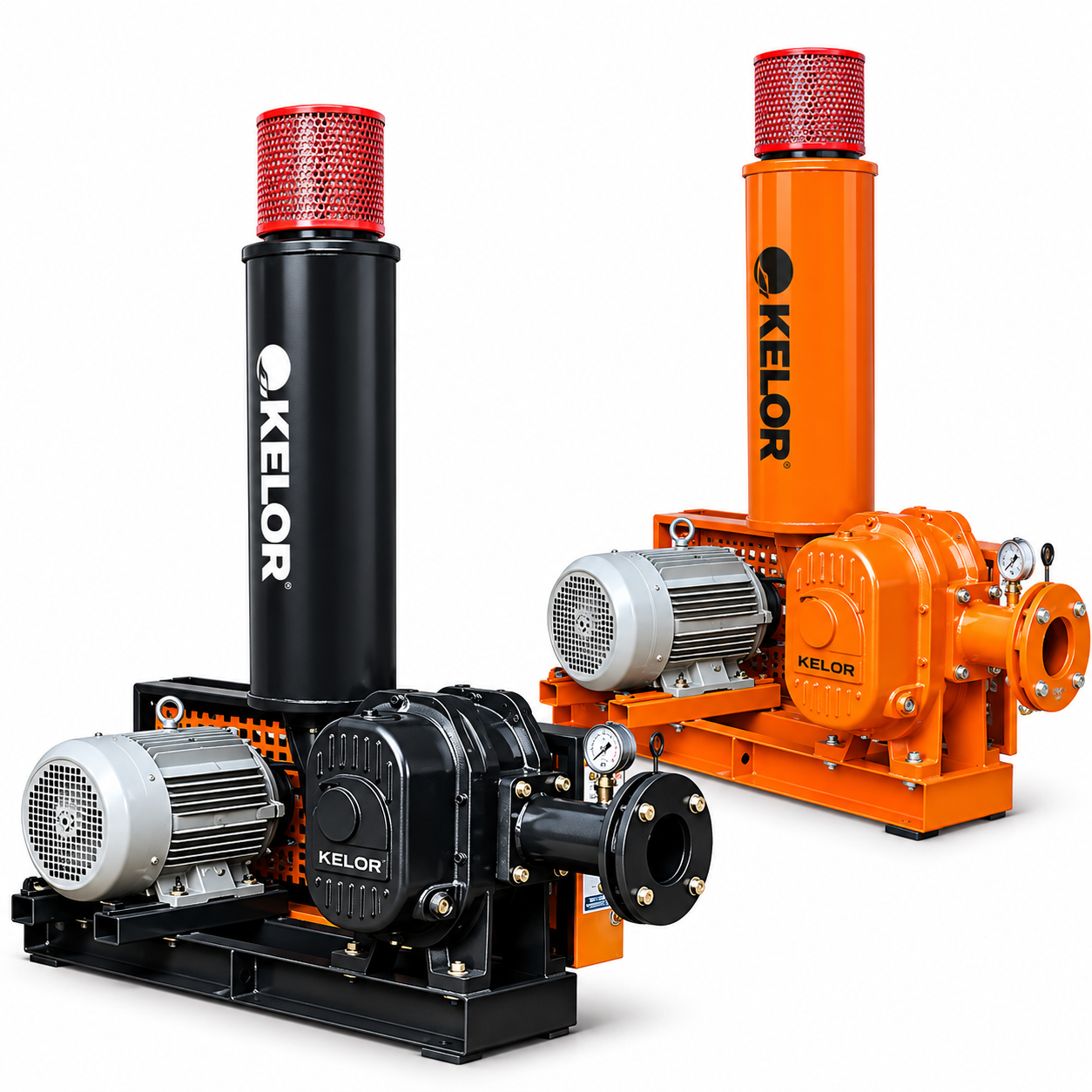
KELOR twin lobe water treatment blower — 100% oil-free air for STP, ETP and CETP aeration
Quick Specification
On This Page
- What Is a Water Treatment Blower?
- What Happens Without a Proper Blower
- How an Aeration Blower Works
- Blower Types for Water Treatment
- KELOR Blower Specifications
- Water Treatment Blower Price in India
- Sizing Tables — 50 KLD to 5 MLD
- Energy: The 50-70% Cost Centre
- Applications Across Treatment Stages
- KELOR Product Features
- Maintenance Schedule
- Troubleshooting Guide
- Supply & Service Across India
- FAQs — 12 Questions Answered
1. What Is a Water Treatment Blower?
A water treatment blower is a machine that supplies a constant, controlled volume of air to the aeration stages of water and wastewater treatment systems. In biological treatment, communities of aerobic bacteria consume the organic pollutants in sewage and industrial effluent — and those bacteria need dissolved oxygen to work. The blower is what provides it: air is compressed to a modest pressure (typically 0.3-0.8 kg/cm2), pushed through pipelines, and released at the bottom of aeration tanks through diffusers that break it into millions of fine bubbles. As the bubbles rise, they transfer oxygen into the water and mix the tank contents at the same time.
This makes the water treatment blower the functional heart and lungs of every Sewage Treatment Plant (STP), Effluent Treatment Plant (ETP), Common Effluent Treatment Plant (CETP), and packaged treatment system. Pumps move the water; screens and clarifiers separate solids; but the biological conversion of dissolved pollutants — the step that actually cleans the water — runs entirely on the oxygen the blower supplies. Most Indian plants use twin lobe roots blowers for this duty because they hold airflow constant as conditions change, deliver 100% oil-free air, run continuously for years, and cost the least to buy and maintain of all aeration blower types.
2. What Happens When the Water Treatment Blower Fails or Is Undersized
Because aeration bacteria work continuously, blower problems surface as treatment failures — usually within hours, not weeks. Every plant operator learns this list the hard way; engineers and consultants use it as the justification for investing in correct blower sizing and a duty-standby arrangement.
| Blower Problem | Immediate Effect in Tank | Visible Symptom | Consequence |
|---|---|---|---|
| Blower stopped / trips frequently | Dissolved oxygen falls below 1-2 mg/L | Black septic sludge, foul odour from tank | Bacterial die-off; plant violates discharge norms within hours |
| Blower undersized for load | Chronic low DO in peak hours | Cloudy treated water, rising BOD/COD in outlet | Sludge bulking, filamentous growth, persistent compliance risk |
| Airflow drifting down (filter/leaks) | Uneven oxygen distribution | Dead zones, surface crusting over diffuser grid | Partial treatment; odour complaints from neighbourhood |
| Oil contamination entering air | Oil film coats bacterial floc | Greasy surface film on aeration tank | Microbial activity sharply reduced; diffuser pores clog |
| Excess airflow (oversized blower) | Turbulent over-mixing, sheared floc | Tiny pin floc that settles poorly in clarifier | Wasted electricity; turbid overflow; higher sludge volume |
The Most Expensive Mistake: One Blower, No Standby
Biological treatment has almost no buffer: once dissolved oxygen collapses, the bacterial community takes days to recover even after the blower is fixed. Plants that run a single blower without a standby unit accept the risk of a full process crash on every unscheduled stoppage. Standard practice for STPs and ETPs is a duty-standby pair (100% each) or two blowers at 50% each with a third portable spare — and because twin lobe machines are the most affordable aeration blower class, that redundancy costs less than a single turbo blower.
3. How an Air Blower for Water Treatment Plant Works
The aeration air path has five stages, and understanding them explains both how to size the machine and why output falls when any single stage degrades:
1. Intake & Filtration
Ambient air enters through the inlet filter, which removes dust before it can reach the precision lobe clearances. A clogged filter here is the number one cause of falling plant airflow.
2. Compression (Roots Principle)
Inside the blower, two synchronised twin lobes trap fixed pockets of air and carry them from the inlet side to the discharge side. Compression happens externally at the discharge — flow stays constant by design.
3. Silencing & Check Valve
The discharge silencer dampens pulsation noise; a non-return valve stops water or air back-flowing into the machine when it stops, protecting rotors from reverse rotation.
4. Pipeline Delivery
Air flows through the plant’s header and drop pipes sized to keep velocity moderate. Every unnecessary bend, reducer or long run adds pressure loss the blower must pay for in power.
5. Diffuser Oxygen Transfer
Fine-bubble diffusers shear the air into micro-bubbles with enormous surface area. Oxygen dissolves into the wastewater as bubbles rise over the 3-5 m water column, feeding bacteria and mixing the tank.
System pressure is simply the sum of the resistances in this path: water column above the diffusers (about 0.1 kg/cm2 per metre of depth), diffuser membrane resistance, pipeline friction, and filter drop. When diffusers foul with biological growth, back-pressure rises — and a twin lobe water treatment blower compensates automatically by still delivering its designed airflow, absorbing slightly more power to do so. That load-swing tolerance is precisely why roots-type machines dominate aeration duty worldwide.
4. Blower Types for Water Treatment — Full Comparison
Buyers evaluating an air blower for water treatment plant duty compare four technologies. The right answer depends on plant size, noise constraints, energy priorities and maintenance capability — the table below compares every criterion that matters, followed by guidance on when each type is the correct choice.
| Criterion | Twin Lobe Roots | Tri-Lobe Roots | Turbo / Centrifugal | Regenerative / Ring |
|---|---|---|---|---|
| Working principle | Positive displacement, external compression | Positive displacement, external compression | Dynamic impeller, kinetic energy | Side-channel, partial compression |
| Typical pressure band | 0.1-1.0 kg/cm2 | 0.1-1.0 kg/cm2 | 0.3-1.2 kg/cm2 | 0.1-0.3 kg/cm2 |
| Typical flow band | 50-10,000 M3/HR | 50-10,000 M3/HR | 1,500-50,000+ M3/HR | 5-500 M3/HR |
| Airflow vs load swings | Constant flow — insensitive | Constant flow — insensitive | Flow varies with pressure; surge risk | Varies with pressure |
| Capital cost | Lowest | 10-20% above twin lobe | 2-4x twin lobe | Low for tiny sizes only |
| Noise level | Moderate with silencers | Lower (finer pulses) | Lowest at design point | Moderate-high per unit flow |
| Maintenance skill needed | Basic — in-house operators | Basic | Specialist vendor support | Basic but short brush life |
| Energy efficiency | Good at design pressure | Slightly better | Best in large plants (10-20% saving) | Poor for deep tanks |
| Oil-free air | Yes, 100% | Yes, 100% | Yes | Yes |
| Best application | STP/ETP/CETP up to ~5 MLD; aquaculture | Noise-sensitive urban plants | Municipal STPs above 5-10 MLD | Small packaged systems, tanks under 1 m depth |
Why Twin Lobe Blowers for Water Treatment Remain the Industry Default
Four practical reasons keep twin lobe machines on specification for the majority of Indian plants. First, constant-flow character: as diffusers foul over months, airflow does not fade — the process stays protected without operator intervention. Second, simplest maintenance: oil changes, filter swaps and belt tension are tasks local technicians handle, with no OEM-dependent electronics. Third, lowest life-cycle cost below roughly 5 MLD: purchase plus a decade of spares costs far less than one turbo blower. Fourth, redundancy economics: a duty-standby twin lobe pair still costs less than a single turbo machine, and water treatment cannot tolerate a single point of failure.
5. KELOR Water Treatment Blower Specifications
KELOR supplies its twin lobe water treatment blower in two engineered ranges covering every aeration duty from small packaged STPs to large industrial ETPs and conveying applications. Both share the same architecture — synchronised twin lobes, anti-friction bearings, toughened alloy steel shafts ground to close tolerances, and shaft heights matched to standard IEC motor frames for perfect alignment.
| Parameter | Range A — Standard Duty | Range B — High Flow |
|---|---|---|
| Air Flow | 50 to 600 M3/HR | 100 to 500 M3/HR |
| Speed (RPM) | 1200 to 1850 RPM | 1400 RPM |
| Pressure | 0.5 to 0.7 kg/cm2 | 0.2 to 0.8 kg/cm2 |
| Motor Power | 3 to 30 HP | 5 to 50 HP |
| Motor Standard | IE3 efficiency, IEC frame matched | IE3 efficiency, IEC frame matched |
| Air Quality | 100% oil-free | 100% oil-free |
| Bearings | Anti-friction, 40,000+ hr L-10 life | Anti-friction, 40,000+ hr L-10 life |
| Shafts | Alloy steel, toughened, ground to close tolerances | Alloy steel, toughened, ground to close tolerances |
| Connections | Large inlet & outlet — minimum pressure loss | Large inlet & outlet — minimum pressure loss |
| Duty | Continuous 24/7 | Continuous 24/7 |
Scope of supply with every KELOR water treatment blower: blower unit, inlet filter with silencer, discharge silencer, non-return valve, safety relief valve, pressure gauge, common baseplate with matched IE3 motor, belt/coupling guard, foundation bolts, and the operation and maintenance manual with performance test report. Water-cooled configurations, stainless steel trim, and vertical orientation are available on request for corrosive or space-constrained installations.
6. Water Treatment Blower Price in India (2026)
Water treatment blower price in India scales with airflow, pressure and motor size. The indicative 2026 bands below let plant owners and consultants budget correctly before inviting firm quotations — and the checklist underneath prevents the quote-comparison errors that cost buyers most.
| Plant Size | Air Flow | Motor | Typical Application | Indicative Price (INR) |
|---|---|---|---|---|
| Up to 200 KLD | 50-100 M3/HR | 5-10 HP | Packaged STP, small ETP, hostel/society plants | 45,000 – 1,20,000 |
| 200-500 KLD | 100-200 M3/HR | 10-15 HP | Housing colonies, schools, small industries | 1,20,000 – 1,80,000 |
| 500 KLD – 1 MLD | 200-400 M3/HR | 15-25 HP | Township STPs, medium ETPs, CETP members | 1,80,000 – 2,50,000 |
| 1-5 MLD | 400-600 M3/HR | 25-50 HP | Municipal STPs, large industrial ETPs, CETPs | 2,50,000 – 4,50,000 |
Compare quotes on these five points, always: (1) free air delivery stated at your actual working pressure, not “free delivery”; (2) IE3 motor specified, not IE1; (3) silencers, filter, non-return valve, safety valve and baseplate included, not priced separately; (4) EN 817 or equivalent performance test report provided before dispatch; (5) warranty terms and local spare-parts availability stated in writing. A quote that looks 15-20% cheaper usually fails on two or more of these five points — and the gap reappears as site purchases and energy waste after commissioning.
7. Sizing Tables — Selecting a Blower from 50 KLD to 5 MLD
Correct sizing is where treatment plants win or lose. An undersized blower chronically starves the biology; an oversized one wastes electricity and shears floc. The method below takes four minutes and uses figures KELOR’s own engineers apply daily.
Step 1: Oxygen Demand
Multiply daily BOD load (kg/day) by 1.5-2.0 kg O2 per kg BOD. Domestic sewage contributes roughly 0.15-0.20 kg BOD per KLD of flow; industrial loads vary — use your effluent analysis.
Step 2: Convert to Airflow
Fine-bubble diffusers need approximately 40-60 M3 of air per kg of oxygen transferred at 2-3 m submergence. Divide Step 1 result by transfer efficiency to get M3/HR air demand.
Step 3: System Pressure
Add diffuser submergence (~0.1 kg/cm2 per metre of water depth), membrane resistance, pipeline friction, and filter/silencer drop. Typical aeration systems land at 0.5-0.7 kg/cm2.
Step 4: Motor with Margin
Select the KELOR model whose flow-pressure point sits inside a range, then choose the next motor size up for filter-loading headroom. Duty-standby pairs sized at 100% each protect compliance.
Quick Selection Table — Domestic Sewage STPs
| Plant Capacity | BOD Load (approx) | Oxygen Demand | Air Required | KELOR Blower | Motor |
|---|---|---|---|---|---|
| 50 KLD | 9 kg/day | 14-18 kg/day | 50-60 M3/HR | Range A compact | 5 HP |
| 100 KLD | 18 kg/day | 27-36 kg/day | 60-100 M3/HR | Range A compact | 5-7.5 HP |
| 200 KLD | 36 kg/day | 54-72 kg/day | 100-150 M3/HR | Range A small | 10 HP |
| 500 KLD | 90 kg/day | 135-180 kg/day | 200-280 M3/HR | Range A/B medium | 15-20 HP |
| 1 MLD | 180 kg/day | 270-360 kg/day | 280-400 M3/HR | Range B medium | 20-25 HP |
| 2 MLD | 360 kg/day | 540-720 kg/day | 400-600 M3/HR | Range B large | 30-40 HP |
| 5 MLD | 900 kg/day | 1,350-1,800 kg/day | 2 x 500-600 M3/HR | Range B (2 working) | 2 x 40-50 HP |
Worked Example — 500 KLD Residential Township STP
Design flow 500 KLD, BOD load 90 kg/day. Oxygen demand at 1.8 kg O2/kg BOD is 162 kg/day ≈ 6.8 kg/hour average. Fine-bubble diffusers at 3 m submergence with 45 M3 air per kg O2 transferred need approximately 300 M3/HR. System pressure: 3 m water column (0.30 kg/cm2) + diffuser and line losses (0.25 kg/cm2) ≈ 0.55 kg/cm2. Selection: KELOR Range A blower, 300 M3/HR, 0.55-0.65 kg/cm2, 20 HP IE3 motor, duty-standby pair. Send KELOR your tank depth, diffuser count and BOD figure, and the engineering team confirms this selection with a firm quotation within one working day.
Industrial Effluent Rule-of-Thumb
Industrial BOD loads vary widely — textile dyeing effluent can carry 800-2,500 mg/L BOD, distillery spent wash far higher. Use your measured BOD/COD values in Step 1 rather than any generic figure, and add 20-30% design margin where load fluctuations are expected. For CETP member industries, KELOR sizes collection-tank aeration, equalisation mixing and biological stage blowers separately — one enquiry covering all three receives one coordinated quotation.
8. Energy: Aeration Is the 50-70% Cost Centre
Aeration consumes 50-70% of total electricity in a conventional wastewater treatment plant — more than pumping, dewatering and disinfection combined. That makes the water treatment blower simultaneously the most important machine in the process and the largest recurring cost. Three levers control that cost, and all three are blower-selection decisions:
Three Energy Levers
- Right-size, don’t oversize. An oversized blower wastes power or shears floc. Size to the tables above and step up one motor band only for filter headroom.
- IE3 motors as standard. An IE3 motor saves 2-4% electricity versus IE1 — on a 24/7 duty that pays back its 8-12% price premium within 12-18 months. KELOR supplies IE3 as standard.
- VFD where load varies. A variable frequency drive matching blower speed to actual air demand saves 15-25% in plants with day-night load swings — typical for residential STPs and batch-processing industries. Twin lobe machines accept VFD control cleanly because flow follows speed linearly.
What 24/7 Running Actually Costs
Running cost equals motor HP × 0.746 kW × 24 hours × tariff. A 15 HP blower at Rs 8/kWh consumes roughly Rs 2,150 per day — about Rs 78,000 per year. A 25 HP blower crosses Rs 1,30,000 annually. Against those numbers, the efficiency difference between a well-engineered twin lobe blower and a bargain unit (typically 8-15% airflow-per-kW gap) amounts to Rs 8,000-15,000 per year per machine — more than the entire price difference within a few years. Energy-efficient blower selection is not a premium; it is the cheaper option.
9. Applications of Water Treatment Blowers Across Treatment Stages
Within a single treatment plant, the water treatment blower serves several distinct duties — each with its own airflow and pressure signature. KELOR sizes a dedicated blower or a shared header for whichever combination your process flow uses.
Biological Aeration
The primary duty: sustaining aerobic bacteria in activated sludge, MBBR and SAFF tanks. Continuous 24/7 airflow at 0.5-0.7 kg/cm2 through fine-bubble diffusers keeps dissolved oxygen in the 2-4 mg/L working band.
Equalisation Tank Mixing
Coarse-bubble diffusers agitate equalisation tanks so incoming effluent blends before treatment, preventing shock loads. Lower airflow, shallow submergence — usually served from the same blower header.
Air Scour & Backwash
Pressure filters and dual-media filters need periodic high-flow air scour to agitate the media during backwash. A dedicated blower sized for short, high-intensity cycles protects the main aeration blower from oversizing.
Sludge Stabilisation
Aerobic digesters stabilise waste sludge with continuous aeration over 15-25 days. Diffuser fouling is common here, so constant-flow twin lobe machines with margin-sized motors are the preferred specification.
MBBR & SAFF Systems
Moving-bed and submerged fixed-film reactors need air both for oxygen and to keep carrier media circulating. Twin lobe blowers deliver the combined duty at moderate pressures.
Aquaculture & RAS
Shrimp and fish ponds, biofloc systems and Recirculating Aquaculture Systems use the same blower class. 100% oil-free air is essential because bubbles contact the water and stock directly.
Odour Control
Biofilters and odour scrubbers on pump stations and headworks need continuous low-pressure air. Twin lobe blowers with corrosion-protected trim handle the humid, contaminated intake stream.
Lamella & DAF Support
Dissolved air flotation uses recirculated, pressurised water; the twin lobe blower supplies the air side and skid aeration, keeping float solids buoyant for removal.
10. KELOR Water Treatment Blower — Product Features
Every KELOR twin lobe water treatment blower ships with a factory-engineered feature set that addresses the specific failure modes of aeration duty — continuous running, humid corrosive atmospheres, and rising back-pressure as diffusers foul.
Feature Set
- 100% oil-free air delivery — labyrinth-seal isolation between lubrication chambers and the air chamber protects bacterial cultures and diffuser membranes.
- Constant airflow under rising back-pressure — the roots principle holds plant oxygen supply steady as diffusers foul, without operator intervention.
- Anti-friction bearings, 40,000+ hour L-10 life — sized for continuous 24/7 duty between overhauls.
- Alloy steel toughened shafts, ground to close tolerances — hold rotor clearances for years, preserving volumetric efficiency.
- Large inlet and outlet connections — minimum suction and discharge losses, lower operating temperature, lower power draw.
- IE3 motors, shaft height matched to IEC frames — perfect alignment on the common baseplate, lower vibration, quieter operation.
- Corrosion-resistant construction — durable materials throughout the air path for humid STP blower rooms and harsh industrial atmospheres.
- Quiet operation — balanced rotors plus inlet/discharge silencers keep noise at plant-friendly levels.
- Factory tested before dispatch — every unit runs a performance test at working pressure; the EN 817-based test report ships with the machine.
- Application-matched air filters — filter grade selected for your environment, from clean blower rooms to dusty industrial sites.
- User-friendly controls — simple start/stop with ammeter and pressure gauge that operators run without specialist training.
11. Water Treatment Blower Maintenance Schedule
Twin lobe blowers ask for surprisingly little — but the little matters, because skipped filter changes and stale oil cause most field failures. The schedule below is the one KELOR includes in every O&M manual, formatted for a plant notice board.
| Interval | Task | Why It Matters |
|---|---|---|
| Daily (2 min) | Record discharge pressure, motor amps, and note unusual noise | Trend data exposes filter clogging and belt wear weeks before failure |
| Monthly | Check gear-end oil level, top up if needed | Low oil is the fastest route to gear and bearing damage |
| 500 hours | First oil change | Flushes initial running-in wear particles from the gear case |
| 2,000-3,000 hours | Subsequent oil changes | Maintains gear protection; align with plant monthly schedule |
| 3-6 months | Clean or replace inlet filter element | A clogged filter raises suction vacuum, power draw and temperature |
| Quarterly | Check belt tension and condition (belt-driven units) | Slipping belts cut airflow silently — the plant starves without alarm |
| Semi-annual | Verify safety relief valve lift; check non-return valve | These two protect the machine from dead-heading and back-flow |
| 10,000-15,000 hours | Overhaul: inspect bearings, lobe clearances, seals | Restores full efficiency; genuine KELOR spares supplied |
Duty-Standby: The Compliance Habit That Pays
Lead-lag changeover — running the standby machine one week per month — equalises wear across both blowers and proves the standby actually starts before you need it in an emergency. Plants that rotate machines report 30-40% longer overhaul intervals and dramatically fewer panic callouts. It costs nothing but a weekly valve exercise and is the single highest-value operating habit in small-plant blower rooms.
12. Troubleshooting Guide — Six Field Symptoms
Most aeration blower problems trace to six root causes. This table is written for plant technicians: find the symptom, apply the fix, and call KELOR support if the symptom persists after the corrective action.
| Symptom | Probable Cause | Corrective Action |
|---|---|---|
| Blower hot; discharge temperature above 100 degrees C | Clogged inlet filter; system pressure above rating; relief valve set high | Clean/replace filter; verify line losses and diffuser state; reset relief valve to spec |
| Airflow lower than rated; DO falling | Filter clogged; slipping belts; leaks in header; worn clearances | Replace filter; re-tension belts; soap-test and seal leaks; plan clearance inspection |
| Motor overload trips | Discharge line blocked; water back-flow into machine; wrong rotation | Clear blockage; drain and check non-return valve; correct rotation per casing arrow |
| Knocking or grinding noise | Bearing wear; timing gear backlash; lobe contact | Stop immediately; inspect bearings and gears; restore clearances with genuine spares |
| Excessive vibration | Foundation bolts loose; misalignment; rotor deposits | Re-torque bolts; realign coupling; clean deposits from rotors and casing |
| Oil level falling between checks | Shaft seal wear; clogged breather pressurising gear case | Replace oil seals; clean breather; inspect seal faces at next oil change |
Never Dead-Head the Blower
A twin lobe blower must never run against a closed discharge valve — trapped air heats within minutes and damages lobes and seals. Keep the discharge path open before every start, keep the safety relief valve installed and correctly set, and train operators that the non-return valve exists to protect them, not to be bypassed. This single rule prevents the most expensive failure mode seen in water treatment blower rooms.
13. Supply & Service Across India
KELOR (Krishna Industries, Ahmedabad) supplies water treatment blowers to plant owners, EPC contractors, OEM plant builders and municipal bodies across India, with the accessory package complete in one supply and spares stocked for every machine shipped.
Ahmedabad & Gujarat
Home ground. Same-day spare dispatch and next-day on-site service across Vapi, Ankleshwar, Surat, Vadodara, Rajkot and the GIDC industrial belt — India’s densest concentration of ETPs and CETPs.
Chennai & Tamil Nadu
Blower supply and servicing support for Chennai, Coimbatore, Tirupur and Salem. Textile dyeing effluent plants and municipal STPs are major application areas; spare kits ship within 3-5 working days.
Mumbai & Maharashtra
Serving the Mumbai-Pune-Nashik corridor: textile ETPs, distilleries, food processing and municipal upgrades. Ahmedabad dispatch reaches most Maharashtra sites within 2-3 working days.
Hyderabad & Telangana
Pharma bulk-drug park ETPs around Hyderabad are heavy aeration users. Blower supply, filters and service support route through Ahmedabad with 3-4 day lead time.
Delhi NCR & North India
CETPs in Panipat, Ludhiana and the Yamuna-basin industrial belt, plus northern STP projects. Supply and parts support with 3-5 day dispatch windows.
Kolkata & East India
Tannery ETP clusters around Kolkata, paper mill duties in West Bengal, and shrimp-farm aeration on the Odisha and Andhra coasts, served through the regional partner network.
14. Frequently Asked Questions — Water Treatment Blowers
Need a Water Treatment Blower Quotation?
Share your plant capacity (KLD/MLD), tank depth, and diffuser type — KELOR engineers will size the blower, confirm the motor, and send an exact price within one working day.
Email: sales@kelorvalves.com WhatsApp Us