
How a Single Plate Wafer Check Valve Works (With Diagram) | KELOR India

How a Single Plate Wafer Check Valve Works (With Diagram) | KELOR India

How a Single Plate Wafer Check Valve Works (With Diagram) | KELOR India

This technical guide explains the complete working mechanism of a single plate wafer check valve with detailed component anatomy, step-by-step forward flow and backflow prevention cycles, spring-loaded disc dynamics, cracking pressure analysis, disc flutter causes and prevention, comparison with dual plate, swing, and lift check valve mechanisms, installation orientation effects on operation, pressure drop and flow characteristics, common failure modes, API 598 testing procedures that verify correct valve operation, and Mill Test Report (MTC 3.1 per EN 10204) documentation requirements. This guide is written for mechanical engineers, piping designers, maintenance technicians, and procurement professionals who work with SS304 and SS316 wafer check valves in industrial piping systems across chemical, pharmaceutical, food, water treatment, HVAC, and process industries in India.

Krishna Industries (KELOR), Ahmedabad supplies single plate wafer check valves from verified and quality-assured vendor partners. All valves undergo factory hydrostatic shell testing and seat leakage testing per API 598 before dispatch. MTC 3.1, API 598 test certificates, and hydrostatic test reports are provided with every order to ensure full quality traceability.
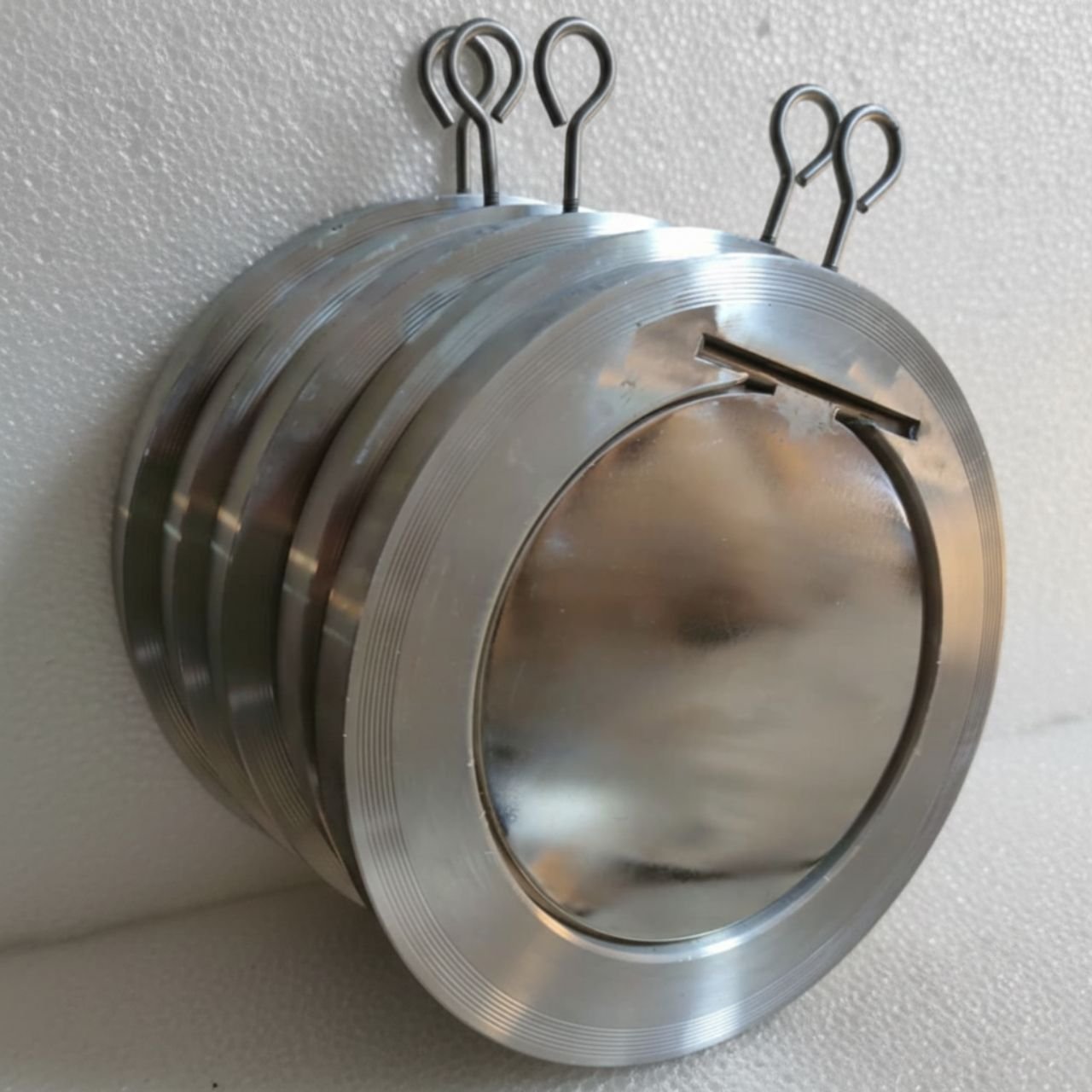
⚡ Quick Reference

MechanismSpring-Loaded Single Disc
Body MaterialSS304 (CF8) / SS316 (CF8M) / CI
Opening Angle65° – 70° from Closed
Cracking Pressure0.3 – 0.7 psi (0.02 – 0.05 bar)
Min Stable Velocity1.5 m/s (Water Service)
Design StandardAPI 594 / ASME B16.34
TestingAPI 598 (Shell + Seat Leakage)
DocumentationMTC 3.1 + Hydrostatic Report

📧 Get Fast Quotation — SS304 / SS316 Wafer Check Valve

WhatsApp size list, quantity, seat material, and pressure class — receive competitive project pricing within 2 hours from our sales engineers.

💬 Get Price on WhatsApp 📩 Get Price by Email
6Internal Components
0.3 psiMin Cracking Pressure
65°–70°Full Disc Opening Angle
<0.1sSpring-Assisted Closing Time

1. What Is a Single Plate Wafer Check Valve?

A single plate wafer check valve (also called a single disc wafer check valve or single plate NRV) is an automatic, non-return valve designed to allow fluid flow in one direction only while preventing reverse flow. It belongs to the wafer-style check valve family defined under API 594, which means the valve has no flanged ends of its own and is installed by sandwiching it between two adjacent pipe flanges using stud bolts and nuts. The compact wafer design makes it the lightest and most space-efficient check valve format available for industrial piping systems.

The term “single plate” refers to the fact that the valve uses exactly one flat or slightly conical disc as the closing element. This disc is mounted on a hinge pin that runs through the valve body and pivots on a single axis. A torsion spring is mounted around the hinge pin to provide the closing force that returns the disc to the sealed position when forward flow ceases or reverses. The combination of a single disc, a hinge pin, and a torsion spring creates a simple yet highly effective non-return mechanism that operates entirely on differential pressure and spring force without requiring any external actuation, manual intervention, or control system input.

Single plate wafer check valves are widely used across industrial piping systems in sizes from DN50 (2 inch) to DN300 (12 inch) at pressure ratings up to Class 150 (PN16) and Class 300 (PN25). They are available in body materials including Stainless Steel 304 (ASTM A351 CF8), Stainless Steel 316 (ASTM A351 CF8M), Cast Iron (ASTM A126 Class B), Ductile Iron, and Carbon Steel (ASTM A216 WCB). Seat material options include EPDM, NBR, Viton (FKM), PTFE, and metal-to-metal configurations depending on the service temperature and chemical compatibility requirements.

Krishna Industries (KELOR) supplies single plate wafer check valves sourced from verified stainless steel valve manufacturers in India who conform to API 594 design requirements and ASME B16.34 pressure-temperature ratings. Every valve undergoes factory hydrostatic shell testing and seat leakage testing per API 598 before dispatch, and MTC 3.1 documentation is provided with each order.

2. Internal Components and Anatomy (With Diagram Description)

Understanding each internal component is essential to understanding how the valve works as a complete system. The single plate wafer check valve contains six primary components that work together to achieve automatic non-return operation. Each component has a specific function in the opening, closing, and sealing cycle, and the precision of their interaction determines the valve performance, leakage rate, service life, and reliability in service.

🖌 Cross-Section Diagram Description — Single Plate Wafer Check Valve (Horizontal Installation)

Imagine a cross-sectional view looking through the centreline of the valve installed horizontally in a pipeline. Flow enters from the left (inlet side) and exits to the right (outlet side). The valve body is a short cylindrical section with a centre bore matching the pipe inside diameter. Near the centre of the body, a hinge pin passes horizontally through the body wall from front to back (perpendicular to the flow direction). The single disc is mounted on this hinge pin at its upper edge, hanging downward like a trapdoor when closed. The disc rests against the body seat ring on the downstream side. A torsion spring is coiled around the hinge pin behind the disc, holding it firmly against the seat. When flow enters from the left, the pressure pushes the disc open, swinging it upward around the hinge pin into the flow passage. When flow stops, the spring pulls the disc back down to seal against the seat, preventing any reverse flow from right to left.

ComponentMaterial (SS304)Function in Valve Operation
Valve BodySS304 (ASTM A351 CF8)Pressure-containing envelope that houses all internal components. Provides the mounting points for the hinge pin, seat ring, and wafer connection flange faces. The body bore diameter matches the pipe inside diameter for smooth flow transition.
Disc (Single Plate)SS304 / SS316The moving closure element that swings open with forward flow and closes against the seat to prevent reverse flow. The disc is typically flat or slightly conical with a sealing face machined to match the seat ring profile. Disc thickness varies from 3 mm to 8 mm depending on size and pressure class.
Hinge PinSS304 / SS316Central pivot axis passing through the body wall on which the disc rotates. The hinge pin is precision-machined to allow free disc rotation with minimal friction while maintaining accurate alignment. The pin is typically secured with set screws or pressed into the body bore.
Torsion SpringSS302 / Inconel / HastelloyProvides the closing force that returns the disc to the sealed position. The torsion spring is coiled around the hinge pin and exerts a calibrated rotational force on the disc. Spring constant determines the cracking pressure and closing speed. Higher spring force = higher cracking pressure but faster closing.
Seat RingEPDM / NBR / FKM / PTFE / MetalThe sealing surface against which the disc closes. Soft seats (EPDM, NBR, FKM, PTFE) provide zero-leakage sealing at low pressures. Metal seats provide high-temperature capability but may have minimal allowable leakage per API 598. The seat is replaceable on many designs.
Gasket Faces (Wafer)Full-face gasketThe sealing surfaces on both sides of the wafer body that mate with the pipe flange gaskets. The valve is clamped between pipe flanges, and the flange gaskets compress against the valve body wafer faces to create a leak-tight joint.

📚 Design Standards Reference

The component dimensions, materials, and pressure-temperature ratings of single plate wafer check valves are governed by API 594 (Check Valves: Wafer, Lug, and Butt-Welding) for the overall design and face-to-face dimensions, ASME B16.34 for pressure-temperature ratings and pressure boundary requirements, and API 598 for inspection and testing procedures including the shell test and seat leakage test that verify correct operation. Material specifications follow ASTM A351 for stainless steel castings (CF8 for SS304, CF8M for SS316), and seat materials conform to applicable ASTM or manufacturer specifications with chemical compatibility data per customer requirements.

3. How the Valve Opens — Forward Flow Mechanism

The opening of a single plate wafer check valve is a purely mechanical process driven by the differential pressure across the disc and the kinetic energy of the flowing fluid. No external power source, manual handle, or control signal is needed. The opening sequence occurs in a continuous, rapid cycle that takes only milliseconds from the moment forward flow begins until the disc reaches its fully open stable position. Understanding this sequence is critical for selecting the correct valve and spring rating for a given application.

Step-by-Step Opening Sequence

1

Rest Position (Closed)

With no flow, the torsion spring holds the disc firmly against the seat ring. The valve is fully sealed and no fluid passes through. The spring force creates the initial sealing pressure between the disc face and the seat surface.

2

Pressure Build-Up

When the pump starts or a control valve opens, forward pressure begins building on the upstream (inlet) side of the disc. This pressure acts on the disc area, creating a force vector that pushes the disc away from the seat against the spring force.

3

Cracking (Initial Opening)

When the forward pressure differential exceeds the spring closing force plus the disc weight component, the disc begins to separate from the seat. This minimum pressure is called the cracking pressure, typically 0.3 to 0.7 psi. A small gap forms between the disc and seat.

4

Disc Swing (Full Opening)

As flow velocity increases, the disc swings upward around the hinge pin. The disc rotates from the 0-degree closed position to approximately 65 to 70 degrees open. At this angle, the disc is parallel to the flow direction and offers minimal flow resistance.

During the opening cycle, the relationship between flow velocity, disc angle, and spring force is dynamic. At the cracking point, the velocity is very low and the disc only begins to lift off the seat. As velocity increases, the hydrodynamic force on the disc increases proportionally to the square of the velocity, causing the disc to swing open progressively wider. The torsion spring extends as the disc opens, storing mechanical energy that will be used later for closing. At the fully open position (approximately 65 to 70 degrees), the disc reaches a stable equilibrium where the hydrodynamic opening force balances the spring torque. The disc remains in this position as long as the flow velocity stays above the minimum stable opening velocity of 1.5 metres per second for water service (higher for more viscous fluids).

🖌 Diagram Description — Disc Positions During Forward Flow

Closed Position (0 degrees): The disc hangs vertically, perpendicular to the flow direction, and is pressed against the seat ring. No fluid passes. The spring is in its relaxed state, providing maximum closing force.
Partially Open (15 to 30 degrees): The disc has just cracked open. A narrow crescent-shaped gap between the disc and seat allows a small initial flow. The spring is partially extended. High velocity through this narrow gap creates additional opening force.
Half Open (35 to 50 degrees): The disc is at an intermediate angle. Flow area is increasing. The spring is significantly extended, providing less closing torque. The disc is approaching the stable region.
Fully Open (65 to 70 degrees): The disc is nearly parallel to the flow. Maximum flow area is achieved. The spring is at maximum extension with minimum closing torque. The disc is in stable equilibrium.

4. How the Valve Closes — Backflow Prevention Mechanism

The closing mechanism of a single plate wafer check valve is equally automatic and relies on the combined action of the torsion spring and the differential pressure across the disc. The closing speed is critical because a slow-closing valve allows reverse flow (backflow) to occur before the disc reaches the seat, which can cause water hammer, pump damage, and contamination of upstream systems. The spring-loaded design of single plate wafer check valves provides one of the fastest closing responses among all check valve types, typically completing the full closing cycle in less than 0.1 seconds under normal conditions.

Step-by-Step Closing Sequence

Phase 1

Flow Velocity Decreases

When the pump slows down, a control valve partially closes, or system demand decreases, the forward flow velocity through the valve begins to drop. As velocity drops, the hydrodynamic force on the disc reduces proportionally.

Phase 2

Spring Force Dominates

When the hydrodynamic opening force drops below the spring closing torque, the spring begins pulling the disc back toward the closed position. The disc starts rotating downward around the hinge pin from the 65-degree open position.

Phase 3

Rapid Disc Swing

The spring accelerates the disc rapidly toward the seat. As the disc approaches the closed position, the effective moment arm of the spring increases, causing the disc to accelerate further. The closing speed increases in the final degrees of travel.

Phase 4

Seat Contact

The disc contacts the seat ring and the spring provides the final sealing force. The momentum of the closing disc plus the spring force creates a tight seal. The closing impact is absorbed by the seat material (soft seats absorb impact energy).

Phase 5

Full Seal Achieved

The disc is fully seated with the spring maintaining sealing pressure. Zero leakage (for soft-seated valves) is achieved. The valve is now in the fully closed position and ready to prevent any reverse flow.

Phase 6

Backflow Blocked

If reverse pressure develops downstream, it acts on the disc in the same direction as the spring force, pressing the disc more firmly against the seat. The reverse pressure actually improves the sealing force rather than challenging it.

The spring-assisted closing mechanism is what distinguishes the single plate wafer check valve from a pure swing check valve. In a swing check valve, closing relies entirely on gravity and reverse flow pressure, which means closing can be slow and unpredictable, especially in systems with low reverse flow pressure. The torsion spring in the single plate wafer design ensures that closing begins the instant forward flow velocity drops below the equilibrium point, regardless of the reverse pressure conditions. This fast, predictable closing response is one of the key advantages of the single plate wafer design and makes it suitable for applications where rapid closure is needed to prevent water hammer and backflow damage.

5. The Role of the Spring in Valve Operation

The torsion spring is arguably the most critical internal component of a single plate wafer check valve because it directly controls three key operational parameters: the cracking pressure (minimum opening pressure), the closing speed, and the sealing force when the valve is closed. Selecting the correct spring rating for the application is essential for reliable valve operation, and this selection is one of the most commonly overlooked aspects of check valve specification in industrial piping projects.

Spring Force and Cracking Pressure: The spring exerts a constant torsional force on the disc through the hinge pin. The disc will remain closed and sealed against the seat as long as the forward pressure force acting on the disc area is less than the spring force. When the forward pressure exceeds the spring force, the disc begins to open (cracking). Therefore, a stronger spring results in a higher cracking pressure, while a softer spring allows the valve to open at lower pressures. Standard springs for single plate wafer check valves produce cracking pressures in the range of 0.3 to 0.7 psi (0.02 to 0.05 bar), which is low enough for most pump-driven systems but may be too high for very low-head gravity flow applications.

Spring Force and Closing Speed: A stronger spring produces faster closing because it has more stored energy to return the disc to the seat. Faster closing is desirable in applications where backflow must be prevented quickly to protect downstream equipment, such as pump discharge lines, heat exchanger circuits, and chemical injection systems. However, excessively fast closing can cause the disc to slam against the seat with excessive force, leading to accelerated seat wear, noise, and potential mechanical damage. The spring rating must be balanced between fast enough closing and gentle enough seating.

Spring Force and Sealing Pressure: When the disc is in the closed position, the spring maintains a constant sealing pressure between the disc face and the seat ring. This sealing pressure ensures zero leakage (for soft seats) or minimal leakage within API 598 allowable limits (for metal seats) even when there is no reverse pressure. A stronger spring provides higher sealing pressure, which is important for applications with very low reverse pressure that would otherwise not provide adequate sealing force on its own.

ParameterSoft SpringStandard SpringStiff Spring
Cracking Pressure0.1 – 0.3 psi0.3 – 0.7 psi0.7 – 1.5 psi
Closing SpeedSlower (~0.15s)Standard (~0.1s)Faster (~0.05s)
Sealing Force (No Flow)LowerStandardHigher
Min Stable Velocity1.0 m/s1.5 m/s2.5 m/s
Disc Flutter RiskLowerModerateHigher
Seat Impact ForceGentleModerateHard (more wear)
Best ApplicationLow-head gravity, HVACGeneral process pipingPump discharge, rapid closure

💡 Spring Selection Tip

When specifying a single plate wafer check valve, always inform the supplier about the minimum and maximum operating flow velocity, the fluid type and viscosity, and whether rapid closure is required. The supplier can then select the appropriate spring rating (soft, standard, or stiff) to match the actual system operating conditions. An incorrectly rated spring is one of the most common causes of premature check valve failure in industrial piping systems. Krishna Industries (KELOR) can help you specify the correct spring rating based on your system parameters when you submit your RFQ with operating conditions.

6. Flow Velocity and Disc Performance

Flow velocity through the valve is the single most important factor that determines whether the disc operates in a stable, fully open condition or enters an unstable fluttering condition. There are three critical velocity thresholds for single plate wafer check valve operation that every piping designer and maintenance engineer must understand: the cracking velocity, the minimum stable opening velocity, and the recommended design velocity.

Velocity ThresholdWater Service (m/s)Oil Service (m/s)Disc Condition
Cracking Velocity0.3 – 0.60.2 – 0.4Disc begins to separate from seat (partially open)
Min Stable Velocity1.51.0 – 1.2Disc holds steady open position (65°–70°)
Recommended Design3.0 – 3.62.0 – 3.0Disc fully stable, minimum pressure drop
Maximum Velocity6.0 – 8.05.0 – 6.0Disc fully open, but erosion risk increases

At velocities below the cracking velocity, the disc remains fully closed against the seat and no flow passes through the valve. Between the cracking velocity and the minimum stable velocity, the disc is partially open and in an unstable region where it may oscillate or flutter. This is the most dangerous operating region for a single plate wafer check valve because the disc is neither fully sealed (allowing some reverse leakage) nor fully open (creating maximum flow disturbance). Above the minimum stable velocity, the disc reaches and maintains its fully open position with stable operation. The recommended design velocity of 3.0 to 3.6 metres per second for water service provides a safe margin above the minimum stable velocity, ensuring reliable disc stability even with minor flow fluctuations.

For systems where the operating velocity falls below the minimum stable velocity, the single plate wafer check valve may not be the best choice. A dual plate wafer check valve has a lower minimum stable velocity (approximately 0.8 to 1.0 m/s) because the two half-discs split the flow and each disc operates with lower velocity and force requirements. Alternatively, a nozzle check valve (also called a non-slam check valve) uses a spring-loaded piston-style disc that operates effectively at even lower velocities and provides the fastest closing response available in a check valve design.

7. Cracking Pressure Explained

Cracking pressure is one of the most fundamental concepts in check valve operation, yet it is frequently misunderstood or overlooked during valve selection and system design. The cracking pressure is the minimum differential pressure across the valve that is required to just begin opening the disc (or disc assembly) from its fully closed, spring-loaded sealed position. It is the pressure at which the forward force on the disc first exceeds the spring closing force, causing the disc to lift off the seat and allow a small amount of flow to pass through.

For single plate wafer check valves, the cracking pressure depends on four factors: the spring constant (k), the initial spring deflection (how much the spring is pre-loaded), the disc area (which determines the force generated by the applied pressure), and the disc weight (which adds to the closing force when the valve is installed horizontally). The cracking pressure formula can be expressed as: P_crack = (F_spring + W_disc_effective) / A_disc, where F_spring is the spring closing force, W_disc_effective is the effective weight component of the disc (which depends on installation orientation), and A_disc is the projected area of the disc exposed to the upstream pressure.

⚠ Important: Cracking Pressure in Low-Head Systems

In low-head gravity flow systems, tank drain lines, and overflow connections where the available driving head is very low (less than 0.5 to 1.0 metre of water column), the cracking pressure of the check valve becomes critical. If the cracking pressure exceeds the available system pressure, the valve will never open and flow will be completely blocked. For these applications, specify a check valve with a soft spring (cracking pressure below 0.2 psi / 0.014 bar) or consider using a dual plate wafer check valve which typically has a lower cracking pressure. Always verify that the system can generate at least twice the valve cracking pressure at the minimum expected flow rate.

Installation OrientationDisc Weight EffectCracking Pressure ImpactNotes
Horizontal (Disc Hanging)Disc weight adds to spring forceStandard cracking pressureMost common installation. Disc hangs vertically from hinge pin. Weight assists closing.
Vertical ↑ (Upward Flow)Disc weight adds to spring forceSlightly higher than horizontalGravity assists closing. Higher cracking pressure because weight opposes opening. Faster closing response.
Vertical ↓ (Downward Flow)Disc weight opposes springSlightly lower than horizontalNot recommended. Gravity opposes closing. Slower closing. Risk of backflow slam.
Angled (45° upward)Partial weight componentBetween horizontal and verticalAcceptable if flow is upward. Specify orientation at time of order.

8. Disc Flutter and Instability — What Causes It?

Disc flutter is the most common operational problem encountered with single plate wafer check valves in industrial service. Flutter occurs when the disc oscillates rapidly and repeatedly between partially open and partially closed positions instead of remaining stable in either the fully open or fully closed state. This oscillation can range from a barely perceptible vibration to violent slamming of the disc against the seat, and it is extremely destructive to the valve, the seat material, the spring, and the surrounding piping system.

Root Causes of Disc Flutter

  • Low Flow Velocity: The most common cause. When the system operates below the minimum stable opening velocity (typically 1.5 m/s for water), the hydrodynamic force is insufficient to hold the disc in the fully open position. The disc partially opens, then the spring pulls it back, then the flow pushes it open again, creating a rapid oscillation cycle.
  • Oversized Valve: Selecting a valve larger than needed for the actual flow rate means the flow velocity through the valve is lower than design conditions. A DN150 valve in a line that only carries flow equivalent to DN100 means the velocity is reduced by approximately 56 percent, likely dropping below the stable opening threshold.
  • Pulsating Flow: Reciprocating pumps, piston compressors, and metering pumps produce pulsating flow with periodic velocity fluctuations. During the low-velocity portion of each pulse cycle, the disc may partially close, then be pushed open again during the high-velocity portion, creating flutter synchronized with the pump cycle.
  • Turbulent Upstream Flow: Elbows, tees, reducers, or control valves located too close to the check valve inlet create turbulent flow with velocity fluctuations and swirl components that destabilise the disc. The minimum straight pipe length upstream of the valve should be at least 5 pipe diameters.
  • Incorrect Spring Rating: A spring that is too stiff for the actual operating conditions raises the cracking pressure and minimum stable velocity above what the system can provide. Conversely, a spring that is too soft may allow the disc to open too easily, making it more susceptible to instability during flow fluctuations.
  • High Viscosity Fluid: Viscous fluids (heavy oils, syrups, slurries) create different flow dynamics around the disc compared to water. The increased viscous drag can cause delayed disc response and irregular opening patterns that promote flutter.

Consequences of Disc Flutter

Failure ModeMechanismTime to Failure
Seat WearRepeated disc impact against the seat surface erodes the seat material. Soft seats (EPDM, NBR) develop grooves and tears. Metal seats develop scoring and deformation.Weeks to months (severe) / 6–12 months (moderate)
Spring FatigueCyclic loading from repeated disc oscillation causes micro-cracks in the spring wire, eventually leading to spring fracture and loss of closing force.3–6 months (severe flutter)
Hinge Pin WearOscillating disc motion causes wear between the disc bore and hinge pin, creating play (looseness) that further destabilises the disc.6–12 months
Piping VibrationFluttering disc transmits vibration to the pipe wall through the valve body, which can loosen flange bolts, damage gaskets, and fatigue pipe welds.Variable
Water HammerFlutter can trigger pressure surges as the disc repeatedly opens and closes, creating pressure spikes that can damage pumps, fittings, and instrumentation downstream.Immediate risk during each flutter cycle

🔧 How to Prevent Disc Flutter

Size the valve correctly: Select the valve size based on the actual flow rate, not the pipe size. The goal is to achieve a flow velocity of 3.0 to 3.6 m/s through the valve at normal operating conditions. If the actual flow rate would produce less than 1.5 m/s in the pipe size, downsize the valve by one or two pipe sizes and use reducers on either side.
Select the right spring: Specify the spring rating based on actual operating conditions. A softer spring lowers the minimum stable velocity but may reduce closing speed. Balance opening stability with closing performance.
Ensure adequate upstream straight pipe: Provide a minimum of 5 pipe diameters of straight pipe upstream of the check valve to allow flow to stabilise before reaching the disc.
Consider a dual plate design: If the operating velocity cannot be raised above the minimum stable threshold, a dual plate wafer check valve provides better stability at lower velocities due to its split-disc design and lower cracking pressure.

9. How It Differs from Dual Plate, Swing, and Lift Check Valves

Understanding the mechanical differences between check valve types is essential for selecting the correct valve for each application. While all check valves perform the same basic function of allowing forward flow and preventing reverse flow, they achieve this through fundamentally different internal mechanisms that result in different performance characteristics. The comparison below focuses on the working mechanism differences, not just the specifications, to help engineers understand why one type may be better suited than another for a specific application.

Working ParameterSingle Plate WaferDual Plate WaferSwing CheckLift (Piston) Check
Closure ElementOne disc on hinge pinTwo half-discs, centre-sprungOne disc on hinge pin (no spring)Piston/disc in bore (spring-loaded)
Opening MotionDisc swings open 65°–70°Two discs swing open like butterfly wingsDisc swings open 60°–70°Piston lifts vertically in guide bore
Closing ForceTorsion spring + reverse pressureTorsion springs + reverse pressureGravity + reverse pressure onlyCompression spring + reverse pressure
Cracking Pressure0.3 – 0.7 psi0.2 – 0.5 psi0.1 – 0.3 psi (gravity only)0.5 – 2.0 psi (depends on spring)
Closing SpeedFast (~0.1s)Very fast (~0.05s)Slow (0.3 – 1.0s)Very fast (~0.05s, non-slam)
Pressure Drop (K)1.5 – 3.50.8 – 1.81.5 – 4.03.0 – 8.0 (highest)
Min Stable Velocity1.5 m/s0.8 – 1.0 m/s2.0 m/sAny (spring-loaded)
Disc Flutter RiskModerateLowHighVery low
Water Hammer RiskLow (spring-assisted)Very lowHigh (gravity closing)Very low (non-slam design)
Installation SpaceVery compact (API 594 short)Very compact (API 594 short)Long face-to-faceTall (vertical preferred)
OrientationHorizontal or vertical upAny orientationHorizontal onlyVertical preferred, any possible
Typical Size RangeDN50 – DN300DN50 – DN600DN50 – DN600+DN15 – DN100
Relative CostLow – ModerateModerate – HighModerateModerate – High

The single plate wafer check valve occupies a middle ground in the check valve spectrum. It offers faster closing than a swing check valve (due to the spring), lower cost and simpler construction than a dual plate wafer or lift check valve, and adequate performance for applications where the flow velocity remains consistently above the minimum stable threshold. Its primary limitations are the moderate disc flutter risk at low velocities and the restriction to horizontal or vertical-upward installation. For applications with highly variable flow, pulsating conditions, or very low velocities, the dual plate wafer or lift check valve designs are mechanically superior choices.

10. Installation Orientation and How It Affects Operation

The orientation in which a single plate wafer check valve is installed has a significant effect on its operation because gravity acts differently on the disc depending on whether the valve is installed horizontally, vertically with upward flow, vertically with downward flow, or at an angle. The disc weight component changes with orientation, which directly affects the cracking pressure, closing speed, and overall stability of the valve. Understanding these effects is critical for correct installation and reliable operation.

🖌 Diagram Description — Installation Orientations

Horizontal Installation (Preferred): Valve installed horizontally with the hinge pin at the top. The disc hangs vertically downward from the hinge pin under gravity. When closed, the disc weight presses down against the seat, assisting the spring. When flow enters from the left, the disc swings upward. This is the most common and preferred installation orientation because it provides the most predictable and balanced operation. The hinge pin must be oriented vertically (perpendicular to the pipe axis) at the top of the valve body.
Vertical Installation (Upward Flow): Valve installed in a vertical pipe with flow travelling upward. The disc hangs down from the hinge pin with gravity pulling the disc toward the closed position. Gravity assists the spring in closing, providing slightly faster closing response. However, gravity also adds to the closing force during opening, meaning the pump must overcome both the spring force and the disc weight to open the valve, resulting in a slightly higher cracking pressure. This orientation is fully acceptable and commonly used in pump discharge lines that go vertical.
Vertical Installation (Downward Flow) — NOT RECOMMENDED: Valve installed in a vertical pipe with flow travelling downward. Gravity pulls the disc away from the closed position, opposing the spring force. This reduces the effective sealing force and creates a very slow, unreliable closing response. When flow stops, the disc cannot close quickly because it must overcome gravity to return to the seat. Reverse flow can occur before the disc seals, causing water hammer. This orientation should be avoided.
Angled Installation: Valve installed at an angle between horizontal and vertical. As long as the flow direction has an upward component, the installation is acceptable. The closer to horizontal, the more neutral the gravity effect. The closer to vertical upward, the more gravity assists closing. Specify the exact installation angle at the time of ordering so the correct spring rating can be selected.

11. Pressure Drop and Flow Characteristics

The pressure drop through a single plate wafer check valve is a function of the internal flow geometry, the disc position (partially open vs fully open), the flow velocity, and the fluid properties. When the disc is fully open and stable, the pressure drop is relatively low because the disc is parallel to the flow direction and presents minimal obstruction. However, if the disc is not fully open (due to low velocity or flutter), the pressure drop increases dramatically because the partially closed disc acts as a restriction in the flow path.

Size (DN)K Value (Fully Open)Cv (GPM / psi)Pressure Drop at 3 m/s (Water)
DN502.5450.4 psi (0.03 bar)
DN802.21000.5 psi (0.03 bar)
DN1002.01800.6 psi (0.04 bar)
DN1501.84000.7 psi (0.05 bar)
DN2001.67000.9 psi (0.06 bar)
DN2501.511001.0 psi (0.07 bar)
DN3001.516001.2 psi (0.08 bar)
Note: The K values above are typical for fully open, stable disc conditions at design flow velocity. Actual K values vary between valve manufacturers and specific internal geometry designs. If the disc is fluttering or partially closed, the effective K value can increase by 3 to 10 times the fully open value, resulting in significantly higher pressure drop. Always design the system to ensure the disc operates in the fully stable range at all expected flow conditions.

12. Common Failure Modes and What They Mean Mechanically

Understanding the mechanical root causes of check valve failure helps maintenance teams diagnose problems quickly and implement corrective actions that address the underlying cause rather than just the symptom. Each failure mode has a specific mechanical explanation that points to a specific root cause or combination of causes.

Observed FailureMechanical Root CauseCorrective Action
Valve Passes Forward Flow but Cannot Prevent BackflowBroken or fatigued spring: the torsion spring has cracked due to cyclic fatigue (often from prolonged flutter), losing its closing force. The disc opens normally with forward flow but cannot close on its own.Replace spring assembly. Check for flutter conditions (velocity, pulsation) that may have caused the fatigue and correct them.
Continuous Leaking (Both Directions)Worn or damaged seat: the seat ring has been cut, grooved, or deformed by repeated disc impact (flutter), chemical attack, or particle abrasion. The disc can no longer achieve a seal even with full spring force.Replace seat ring (if replaceable design) or replace entire valve. Install strainer upstream to prevent particle damage.
Valve Will Not Open (No Forward Flow)Seized hinge pin: corrosion, scale buildup, or foreign material has seized the disc to the hinge pin, preventing rotation. Alternatively, an incorrectly rated spring that is too stiff for the available system pressure.Disassemble, clean hinge pin and disc bore, lubricate if applicable. If spring is too stiff, replace with correct rating.
Excessive Vibration and Noise During OperationDisc flutter: the disc is oscillating due to low velocity, oversized selection, or pulsating flow. This is the most common failure mode and creates vibration that can be felt on the pipe and heard as rattling or chattering.Verify operating velocity. If below 1.5 m/s, consider downsizing valve or switching to dual plate design. Ensure adequate upstream straight pipe length.
Water Hammer on Pump ShutdownSlow closing: the spring force is insufficient to close the disc quickly before reverse flow develops. Often caused by a spring that is too soft or by the valve being oversized for the actual flow rate.Replace with stiffer spring or smaller valve size. For severe water hammer, consider switching to a non-slam nozzle check valve or dual plate design.
Rapid Seat DeteriorationAbrasive media: particles in the fluid (sand, scale, debris) are trapped between the disc and seat during closing, cutting into the seat material. Also caused by high-velocity disc slamming from flutter.Install a strainer or filter upstream. Correct flutter condition. Consider metal-to-metal seat for abrasive service.

13. API 598 Testing — Verifying the Valve Works Correctly

API 598 (Valve Inspection and Testing) is the industry-standard testing procedure that verifies the mechanical integrity and functional performance of a single plate wafer check valve before it leaves the vendor facility. The testing consists of two mandatory tests: the shell test (also called the body test or hydrostatic shell test) and the seat leakage test. Both tests must be passed before the valve is accepted and dispatched to the customer. Understanding what these tests verify and how they relate to the valve working mechanism helps procurement engineers ensure they are receiving properly tested valves.

Shell Test (Hydrostatic Body Test)

The shell test verifies the structural integrity of the pressure-containing body by pressurising the valve interior at a test pressure significantly higher than the maximum allowable working pressure. For Class 150 valves, the shell test pressure is 1.5 times the MAWP at ambient temperature, which equals approximately 425 psi (29.3 bar) for SS304 Class 150. The test medium is typically water with a corrosion inhibitor, and the pressure is held for a minimum duration specified by API 598 (not less than 15 seconds for sizes DN50 and below). During the hold period, the valve body is visually inspected for any leaks, seepage, or weeping from the body walls, body-to-bonnet joints (where applicable), and any other pressure boundary connections.

The shell test confirms that the body casting or forging is free from porosity, cracks, and structural defects that could cause catastrophic failure under operating pressure. It does not test the disc mechanism or seat sealing, which is the purpose of the seat test.

Seat Leakage Test

The seat leakage test verifies that the disc and seat mechanism works correctly by confirming that the disc seals tightly against the seat when pressure is applied from the seat side. For a single plate wafer check valve, this means applying pressure to the upstream side of the disc (simulating reverse flow pressure) while the downstream side is vented to atmosphere. The seat test pressure is typically 1.1 times the MAWP at 38 degrees Celsius (or the equivalent cold differential test pressure per API 598).

During the seat test, the inspector checks for any leakage past the seat. For soft-seated valves (EPDM, NBR, FKM, PTFE seats), the acceptance criterion is typically zero visible leakage or zero measurable leakage for the duration of the test. For metal-seated valves, API 598 Table 4 specifies maximum allowable leakage rates based on valve size and pressure class. The seat test confirms that the spring force is correctly calibrated, the disc and seat surfaces are properly machined and aligned, and the hinge mechanism allows free disc movement to the fully closed position.

📚 API 598 Test Summary for Single Plate Wafer Check Valves

Shell Test: 1.5 x MAWP, minimum hold time per API 598 Table 3, water medium, visual inspection for leaks at all pressure boundary joints. Seat Test: 1.1 x MAWP (or CDT pressure per API 598 Table 2), pressure applied on seat side, zero visible leakage for soft seats or maximum per API 598 Table 4 for metal seats. Backflow Test (Optional): Pressure applied on outlet side to verify disc closure under reverse pressure conditions. Duration: Per API 598 minimum requirements based on valve size. Documentation: Test results recorded in API 598 test certificate with date, pressure, hold time, test medium, results, and inspector identification.

14. MTC 3.1 and Documentation for Quality Assurance

The Mill Test Certificate (MTC) 3.1 per EN 10204 is the primary material quality document that certifies the chemical composition and mechanical properties of the raw materials used to manufacture the valve body, disc, and other pressure-containing components. For single plate wafer check valves made from SS304 (ASTM A351 CF8) or SS316 (ASTM A351 CF8M), the MTC 3.1 confirms that the material conforms to the specified chemical composition limits (chromium, nickel, molybdenum, carbon, manganese, silicon, phosphorus, sulphur) and mechanical properties (tensile strength, yield strength, elongation, hardness) required by the ASTM standard.

The MTC 3.1 is issued by the steel mill or foundry that produced the raw material and must be validated by an independent third-party inspection organisation or the manufacturer’s quality department with EN 10204 3.1 certification authority. The certificate includes the heat number, which is stamped on the valve body, providing full material traceability from the finished valve back to the original heat of steel. This traceability is essential for project procurement in regulated industries including pharmaceutical, food and beverage, chemical processing, and oil and gas, where material verification is a mandatory requirement.

📋 Complete Documentation Package from KELOR

Mill Test Report 3.1Chemical composition and mechanical properties of SS304/SS316 body and disc material per EN 10204, validated by third party.
API 598 Test CertificateShell test and seat leakage test results with test pressure, hold time, medium, and pass/fail confirmation.
Hydrostatic Test ReportFull test documentation with date, pressure, duration, test medium, temperature, and inspector witness signature.
Material TraceabilityHeat number on valve body linked to MTC 3.1, providing full traceability from raw material to finished valve.

Krishna Industries (KELOR) ensures that every single plate wafer check valve supplied from verified vendor partners is accompanied by the complete documentation package including MTC 3.1, API 598 test certificate, hydrostatic test report, and material traceability documentation. For pharmaceutical, food, and other regulated applications, additional certifications such as FDA compliance for seat materials, USP Class VI certification, and dimensional inspection reports can be arranged upon request at the time of order placement. Contact [email protected] to specify your documentation requirements.

15. Applications Where Understanding the Working Mechanism Matters

Pump Discharge Lines

The check valve prevents reverse flow through the pump when the pump stops. Understanding closing speed and cracking pressure is critical to prevent water hammer and pump backspin damage.

Chemical Processing

Check valves isolate chemical circuits and prevent cross-contamination between process streams. Seat material compatibility and zero-leakage sealing are essential for chemical service.

Water Treatment

Prevents reverse flow of treated water into raw water lines. Large-diameter wafer check valves operate at moderate velocities where disc stability is a key design consideration.

HVAC and Chilled Water

Low-velocity systems where cracking pressure and minimum stable velocity must be carefully evaluated. Soft springs are typically required to ensure valve opens under low-head pump conditions.

🛡

API 598 Tested

Every valve is factory-tested per API 598 shell and seat leakage test before dispatch from verified vendor facility.

📄

MTC 3.1 Provided

Mill Test Report 3.1 per EN 10204 with full heat traceability for body and disc material on every order.

Hydrostatic Test Report

Complete hydrostatic test documentation with pressure, hold time, results, and inspector witness signature.

🔍

Verified Vendor Partners

All valves sourced from quality-assured stainless steel valve manufacturers conforming to API 594 and ASME B16.34.

📍

Ahmedabad, Gujarat, India

Krishna Industries (KELOR) headquartered in Ahmedabad supplies to pan-India industrial projects and exporters.

💬

2-Hour Quote Response

WhatsApp or email your requirement with size list, quantity, and seat material — receive competitive pricing within 2 hours.

16. Frequently Asked Questions

+ How does a single plate wafer check valve work?
A single plate wafer check valve works through a spring-loaded disc mechanism mounted on a hinge pin inside a compact wafer-style body. When forward flow enters the valve, the fluid pressure overcomes the spring force and the disc swings open approximately 65 to 70 degrees from the closed position, allowing fluid to pass through with minimal restriction. When flow stops or reverses, the spring force combined with the reverse flow pressure pushes the disc back to the fully closed position against the seat, preventing backflow. The entire opening and closing cycle happens automatically without any external actuation, relying entirely on the differential pressure across the valve and the calibrated spring force to control disc movement.
+ What is cracking pressure in a wafer check valve and why does it matter?
Cracking pressure is the minimum forward pressure differential required to just begin opening the disc of a wafer check valve. For single plate wafer check valves, the cracking pressure is typically in the range of 0.3 to 0.7 psi (0.02 to 0.05 bar) depending on the spring constant and disc weight. Cracking pressure matters because the pump or system must generate at least this much pressure before any fluid can flow through the valve. In low-head gravity flow systems, a high cracking pressure can prevent the valve from opening at all. For reliable full-open operation, the system must maintain a flow velocity of at least 1.5 metres per second, which translates to significantly higher pressure than the cracking pressure.
+ What causes disc flutter in a wafer check valve?
Disc flutter occurs when the disc oscillates rapidly between partially open and partially closed positions instead of remaining stable. Primary causes include insufficient flow velocity below 1.5 m/s, pulsating flow from reciprocating pumps, oversized valve selection, incorrect spring selection, and turbulent upstream flow from elbows or tees located too close to the valve inlet. Disc flutter causes accelerated seat wear, spring fatigue, piping vibration, water hammer, and significantly reduced service life. Solutions include downsizing the valve, selecting a softer spring, using a dual plate design, or installing flow straighteners upstream.
+ Can a single plate wafer check valve be installed vertically?
Yes, a single plate wafer check valve can be installed in vertical piping with upward flow. When installed vertically with upward flow, gravity assists the spring in keeping the disc closed, providing faster closing response and reduced backflow risk. However, the cracking pressure is effectively higher because the disc weight acts in the same direction as the spring force. For vertical downward flow, installation is generally not recommended because gravity works against the closing mechanism. Always specify the installation orientation at the time of ordering so the vendor can supply a valve with the appropriate spring rating.
+ What is the difference between single plate and dual plate wafer check valves in terms of working mechanism?
Both types use spring-loaded discs that open with forward flow and close with reverse flow. However, a single plate wafer check valve has one disc on a single hinge pin that swings open in one direction, while a dual plate wafer check valve has two half-discs (split discs) each on its own hinge pin that swing open from the centre like butterfly wings. The dual plate design splits the flow path into two symmetric passages, resulting in approximately 30 to 40 percent lower pressure drop, lower cracking pressure, better stability at low velocities, faster closing speed, and reduced disc flutter.
+ How is the working performance verified before installation?
Performance is verified through hydrostatic shell testing and seat leakage testing per API 598. The shell test pressurises the body at 1.5 times MAWP to confirm structural integrity. The seat leakage test applies pressure on the seat side at 1.1 times MAWP to verify the disc seals tightly. For soft-seated valves (EPDM, NBR, FKM, PTFE), zero visible leakage is the acceptance criterion. All test results are documented in the API 598 test certificate provided with the valve. Krishna Industries (KELOR) ensures all valves are tested per API 598 before dispatch.
+ What is the typical pressure drop through a single plate wafer check valve?
When the disc is fully open at design flow velocity, the typical pressure drop ranges from 0.5 to 2.0 psi (0.03 to 0.14 bar) at nominal flow velocity of 3.0 to 3.6 m/s. The pressure drop coefficient (K value) is typically 1.5 to 3.5 depending on internal geometry. For comparison, dual plate wafer check valves have a K value of approximately 0.8 to 1.8, and swing check valves have a K value of approximately 1.5 to 4.0. If the disc is not fully open, pressure drop increases dramatically.
+ What documents confirm the valve mechanism and material quality?
The primary documents are the Mill Test Report (MTC) 3.1 per EN 10204 certifying chemical composition and mechanical properties, the API 598 test certificate confirming shell test and seat leakage test were passed, the hydrostatic test report with test pressure, hold time, and results, and material traceability documentation linking the heat number on the valve body to the MTC. For project-critical applications, additional certificates may include dimensional inspection reports and non-destructive examination reports. KELOR arranges all documentation from verified vendor partners.

📧 Source SS304 / SS316 Wafer Check Valves from KELOR — API 598 Tested with MTC 3.1

Verified vendor partners, competitive project pricing, complete documentation package. WhatsApp your requirement now.

💬 Get Price on WhatsApp 📩 [email protected]

The single plate wafer check valve is a elegantly simple yet highly effective automatic non-return device that operates through the interaction of six key components: the body, disc, hinge pin, torsion spring, seat ring, and wafer gasket faces. The spring-loaded disc mechanism provides fast, reliable opening with forward flow and rapid closing to prevent backflow, making it suitable for a wide range of industrial piping applications from water treatment and HVAC to chemical processing and pharmaceutical manufacturing.

Understanding the working mechanism — including the cracking pressure, minimum stable velocity, disc flutter dynamics, installation orientation effects, and pressure drop characteristics — is essential for correct valve selection, proper installation, and reliable long-term operation. Specifying the correct spring rating for actual operating conditions is the single most impactful decision in ensuring valve reliability. Every valve supplied by Krishna Industries (KELOR) from verified vendor partners is tested per API 598 and documented with MTC 3.1 per EN 10204 to ensure mechanical integrity and material quality.

Krishna Industries (KELOR) | Industrial Valves, Fasteners, Gaskets & Safety Equipment | Ahmedabad, Gujarat, India
Instagram: @kelor_india  |  [email protected]

0000000