
Pneumatic Actuated Wafer Butterfly Valve with Limit Switch Box
Complete automated valve solution for process industries. Our pneumatic actuated wafer butterfly valve with limit switch features double acting or spring return actuators, NAMUR-mounted limit switch boxes for remote position feedback, and IP67 protection. Ideal for chemical, pharma, water treatment, and HVAC automation across India.
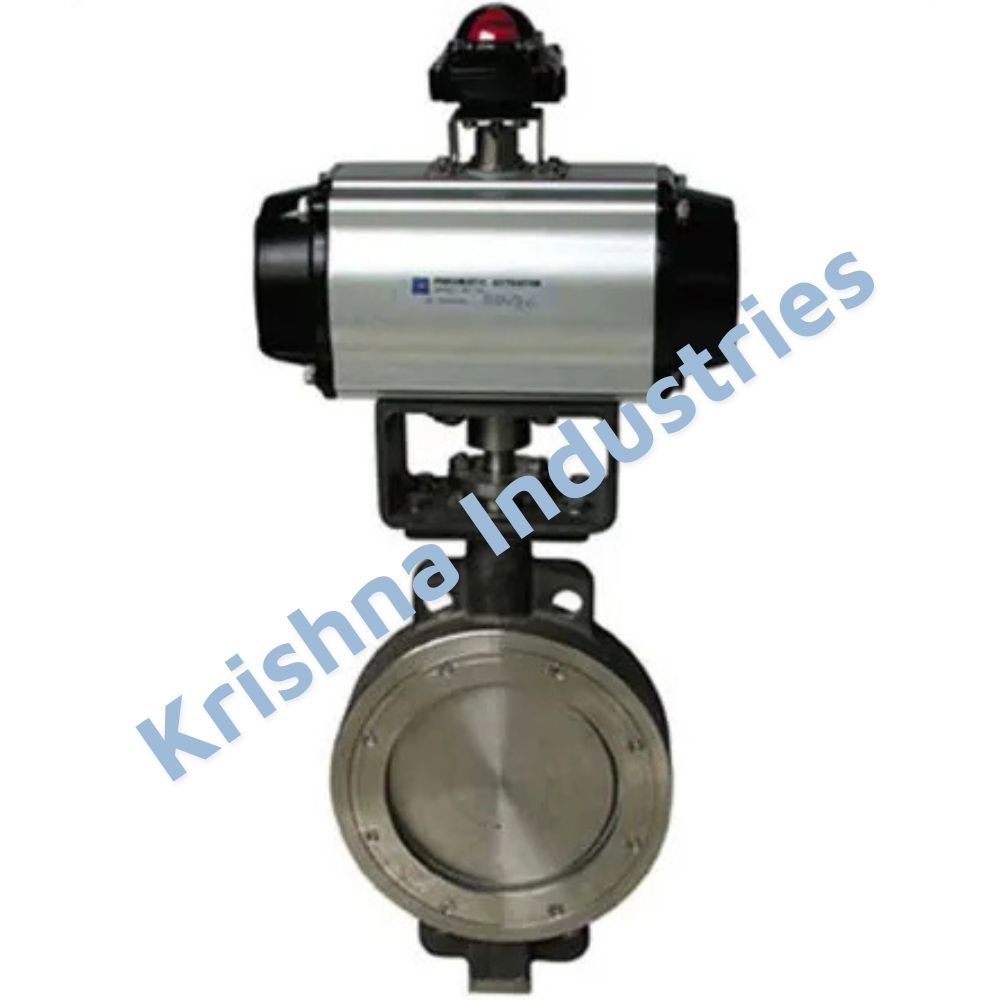
Featured Answer: A pneumatic actuated wafer butterfly valve with limit switch is a fully automated valve system that uses compressed air (4-8 bar) to rotate the disc 90° for flow control. The integrated limit switch box provides electrical feedback signals (open/close position) to PLC, DCS, or SCADA systems, enabling remote monitoring and automated process control. Available in double acting (air-to-open/air-to-close) or spring return (fail-safe) configurations with NAMUR standard mounting for easy accessory integration.
Complete System Specifications
Contents
- 1. Why Choose Pneumatic Actuation with Limit Switch?
- 2. Actuator Types: Double Acting vs Spring Return
- 3. Limit Switch Box: Features & Wiring
- 4. NAMUR Accessories & Control Options
- 5. Technical Specifications & Torque Data
- 6. Installation & Commissioning Guide
- 7. Applications in Indian Industries
- 8. Why EPCs Specify KELOR Automated Valves
- 9. Frequently Asked Questions (PAA)
Why Choose Pneumatic Actuation with Limit Switch?
In modern process industries, manual valve operation is increasingly being replaced by automated solutions for safety, efficiency, and precision. A pneumatic actuated wafer butterfly valve with limit switch offers distinct advantages:
- Rapid Response: Pneumatic actuators provide 1-3 second stroke times, critical for emergency shutdown (ESD) and fast process control loops.
- Remote Position Feedback: The limit switch box sends real-time open/close signals to your control room, eliminating the need for manual verification and enabling integration with PLC/DCS systems.
- Fail-Safe Operation: Spring return actuators automatically move to a safe position (open or closed) upon air or power failure, protecting personnel and equipment.
- Cost-Effective Automation: Pneumatic systems are simpler and more economical than electric actuators for on/off applications, especially in hazardous areas.
- Explosion-Proof: Pneumatic actuators are inherently safe for use in explosive atmospheres (Zone 1, Zone 2) where electric actuators require expensive Ex-proof certification.
Actuator Types: Double Acting vs Spring Return
Choosing the correct actuator type is critical for your application’s safety and operational requirements.
| Feature | Double Acting Actuator | Spring Return (Fail-Safe) Actuator |
|---|---|---|
| Operation Principle | Uses air pressure to open AND close the valve. Requires air supply for both directions. | Uses air pressure to move in one direction; internal spring returns valve to safe position on air failure. |
| Air Consumption | Lower (only during stroke) | Higher (spring compression requires more air) |
| Fail-Safe Position | None (valve stays in last position on air loss) | Normally Open (NO) or Normally Closed (NC) on air loss |
| Cost | Lower (simpler design) | Higher (spring mechanism adds cost) |
| Applications | Non-critical isolation, throttling, batch processes | Emergency shutdown (ESD), fire protection, safety-critical loops |
| Torque Output | Consistent in both directions | Higher in air-stroke direction, lower in spring-return direction |
Selection Guide: Which Actuator Type Do You Need?
Choose Double Acting if: Your process can safely tolerate the valve remaining in its last position during air failure (e.g., non-critical isolation, batch transfer lines).
Choose Spring Return if: Safety requires the valve to move to a defined position on air failure (e.g., fuel lines must close, cooling water must remain open, fire water systems).
Limit Switch Box: Features & Wiring
The limit switch box is the “eyes” of your automated valve, providing critical position feedback to your control system. KELOR supplies NAMUR-standard limit switch boxes with the following features:
Visual Position Indicator
High-visibility mechanical indicator (red/green or open/closed) visible from 360°, allowing field operators to verify valve position at a glance without electrical instrumentation.
Electrical Feedback Contacts
SPDT (Single Pole Double Throw) or DPDT (Double Pole Double Throw) microswitches rated for 10A @ 250V AC/DC. Provides dry contact signals for PLC/DCS integration. Optional proximity switches available for hazardous areas.
IP67 Weatherproof Enclosure
Robust polypropylene (PP) or aluminum housing with IP67 rating, protecting internal switches from dust, water jets, and outdoor weather exposure. Suitable for outdoor installation in Indian monsoon conditions.
NAMUR Mounting Standard
Complies with VDI/VDE 3845 (NAMUR) standard, allowing tool-free mounting of solenoid valves, positioners, and other accessories without drilling or adapters.
Adjustable Cam System
Precision-adjustable cams allow fine-tuning of switch actuation points to ensure signals are sent at exactly 0° (closed) and 90° (open), preventing false position indication.
Conduit Entries
Standard ½” NPT or PG13.5 conduit entries for easy cable gland installation. Explosion-proof versions available with Ex-d or Ex-e certification for Zone 1/Zone 2 areas.
Typical Limit Switch Wiring Configuration
| Terminal | Function | Valve Closed (0°) | Valve Open (90°) |
|---|---|---|---|
| COM (Common) | Common terminal for both switches | Connected | Connected |
| NO (Normally Open) | Closes when valve reaches position | Open Circuit | Closed Circuit (for Open position) |
| NC (Normally Closed) | Opens when valve reaches position | Closed Circuit (for Closed position) | Open Circuit |
NAMUR Accessories & Control Options
Our pneumatic actuated wafer butterfly valves support a complete ecosystem of NAMUR-mounted accessories for advanced control:
Solenoid Valve (3/2 or 5/2 Way)
Electrically operated valve that controls air supply to the actuator. 3/2 way for spring return actuators, 5/2 way for double acting. Available in 24V DC, 110V AC, 220V AC coils with IP65/IP67 protection.
Speed Controller (Flow Control Valve)
Adjustable needle valves that control the exhaust air flow rate, allowing you to precisely adjust the valve opening/closing speed to prevent water hammer or process surges.
Air Filter Regulator Lubricator (FRL)
Ensures clean, dry, regulated air supply (4-8 bar) to the actuator. Removes moisture, oil, and particulates that can damage internal actuator seals and pneumatic components.
Pneumatic Positioner
For modulating control (not just on/off). Receives 4-20mA or 3-15 PSI signal from DCS/PLC and precisely positions the valve at any angle between 0-90° for flow regulation.
Limit Switch with Proximity Sensor
Non-contact inductive or capacitive sensors for hazardous area applications (Ex-proof). No mechanical wear, infinite cycle life, suitable for Zone 1/Zone 2 classified areas.
Manual Override
Top-mounted handwheel or lever allows manual operation during air failure, maintenance, or commissioning without removing the actuator.
Technical Specifications & Torque Data
Proper actuator sizing is critical. Below are typical torque requirements and air consumption data for our pneumatic actuated wafer butterfly valves at PN16 pressure with EPDM seats.
Table: Actuator Sizing & Air Consumption| Valve Size | Required Torque (Nm) | Actuator Model (Double Acting) | Actuator Model (Spring Return) | Air Consumption (L/cycle) | Air Port Size |
|---|---|---|---|---|---|
| DN50 (2″) | 15-25 | DA-52 | SR-52 | 0.8 – 1.2 | 1/4″ NPT |
| DN80 (3″) | 35-50 | DA-63 | SR-63 | 1.5 – 2.0 | 1/4″ NPT |
| DN100 (4″) | 60-85 | DA-75 | SR-75 | 2.5 – 3.5 | 1/4″ NPT |
| DN150 (6″) | 140-190 | DA-88 | SR-88 | 4.0 – 5.5 | 3/8″ NPT |
| DN200 (8″) | 250-340 | DA-100 | SR-100 | 6.5 – 9.0 | 3/8″ NPT |
| DN250 (10″) | 400-550 | DA-125 | SR-125 | 10 – 14 | 1/2″ NPT |
| DN300 (12″) | 600-800 | DA-140 / DA-160 | SR-140 / SR-160 | 15 – 20 | 1/2″ NPT |
| DN400 (16″) | 1100-1450 | Scotch Yoke SY-180 | Scotch Yoke SY-180 | 25 – 35 | 3/4″ NPT |
| DN500 (20″) | 1800-2400 | Scotch Yoke SY-220 | Scotch Yoke SY-220 | 40 – 55 | 3/4″ NPT |
| DN600 (24″) | 2800-3600 | Scotch Yoke SY-280 | Scotch Yoke SY-280 | 60 – 80 | 1″ NPT |
Important Torque Safety Factor
Always apply a minimum 1.5x to 2.0x safety factor when selecting actuators. For example, if your DN150 valve requires 150 Nm, select an actuator rated for at least 225-300 Nm. This accounts for seat friction, pressure surges, temperature variations, and long-term wear. PTFE seats require 20-30% higher torque than EPDM.
Installation & Commissioning Guide
Proper installation ensures reliable operation and extends valve life. Follow these steps for installing pneumatic actuated wafer butterfly valves with limit switches:
Step 1: Pre-Installation Inspection
Verify actuator model matches valve size and torque requirements. Check limit switch wiring diagram. Ensure air supply is clean, dry, and regulated to 4-8 bar. Inspect valve body and disc for shipping damage.
Step 2: Pipeline Preparation
Ensure pipeline is aligned and flanges are parallel. Clean flange faces thoroughly. Install full set of stud bolts and nuts (do not tighten yet). Verify flow direction arrow on valve body matches pipeline flow.
Step 3: Valve Installation
Insert valve between flanges, ensuring disc is in closed position (90° to flow). Tighten bolts in star pattern to specified torque. Do not overtighten wafer valve body.
Step 4: Pneumatic Connections
Connect air supply line to actuator inlet port (marked “IN” or “1”). Install solenoid valve if not pre-mounted. Connect exhaust ports to atmosphere or return line. Install speed controllers if required.
Step 5: Electrical Wiring
Wire limit switch terminals to PLC/DCS per wiring diagram. Use shielded cable for long runs. Verify voltage rating matches control system (24V DC, 110V AC, or 220V AC). Ground the enclosure properly.
Step 6: Commissioning & Testing
Apply air supply slowly. Cycle valve open/close 3-5 times manually via solenoid. Verify limit switch signals at control room. Adjust cam positions if signals are premature or delayed. Check for air leaks at fittings.
Applications in Indian Industries
Chemical & Petrochemical Plants
Widely used in Gujarat GIDC (Ankleshwar, Vapi, Dahej) and Maharashtra MIDC (Tarapur) for automated acid dosing, solvent transfer, and emergency shutdown systems. Spring return actuators ensure safe closure on air failure.
Pharmaceutical Manufacturing
Automated isolation for purified water (PW), water for injection (WFI), and clean steam systems. Limit switch feedback integrates with batch management systems for GMP compliance and audit trails.
Water & Wastewater Treatment
Municipal WTPs and STPs use pneumatic valves for rapid isolation during pump trips, backwash cycles, and chemical dosing control. Double acting actuators are cost-effective for non-safety applications.
HVAC & District Cooling
Large commercial buildings and data centers use automated butterfly valves for chilled water isolation, condenser water control, and BMS (Building Management System) integration via limit switch feedback.
Power Plants (Thermal & Nuclear)
Critical for cooling water isolation, condensate systems, and auxiliary services. Spring return fail-safe actuators protect expensive turbines and condensers during emergency shutdown scenarios.
Food & Beverage Processing
Automated CIP (Clean-in-Place) systems, ingredient dosing, and batch transfer lines. Stainless steel (SS316) bodies with EPDM seats meet FDA and hygiene standards.
Why EPCs Specify KELOR Automated Valves
Complete System Integration
We don’t just supply valves; we deliver complete automated solutions. Every pneumatic actuated wafer butterfly valve is pre-assembled, wired, and tested with limit switch, solenoid, and speed controller as a single unit, reducing site installation time by 60%.
Accurate Torque Sizing
Our engineering team calculates exact torque requirements based on your specific media, pressure, temperature, and seat material. We never undersize actuators, ensuring reliable operation for 10+ years without stalling or failure.
NAMUR Standard Compliance
All our actuators and limit switches comply with VDI/VDE 3845 (NAMUR) standards, ensuring compatibility with major brands (Rotork, Auma, Emerson, Siemens) for future replacements or upgrades.
100% Factory Testing
Every automated valve undergoes comprehensive testing: API 598 hydrostatic test, 100+ cycle actuation test, limit switch signal verification, and air leak test. Test reports and wiring diagrams included with every shipment.
PAN India Support & Spares
Based in Ahmedabad, we provide rapid dispatch to all Indian industrial hubs. We stock critical spares (limit switches, solenoid coils, seal kits) for immediate replacement, minimizing plant downtime.
Technical Documentation
We provide complete documentation: GA drawings, torque charts, wiring diagrams, P&ID symbols, installation manuals, and maintenance schedules. Essential for EPC tender compliance and handover.
Commercial & Ordering Details
Automate Your Process with Confidence
Share your pipeline size, pressure, media, and control requirements. Our automation specialists will recommend the optimal actuator type, limit switch configuration, and accessories. Receive a detailed quotation within 2 hours.
Get Technical Quote via WhatsAppRelated Automated Valve Solutions
Frequently Asked Questions (PAA)
1. What is a pneumatic actuated wafer butterfly valve with limit switch?
2. What is the difference between double acting and spring return pneumatic actuators?
3. What air pressure is required for pneumatic butterfly valves?
4. Can the limit switch be replaced or upgraded?
5. Do you supply valves for hazardous area applications?
6. What is the typical response time for pneumatic actuated valves?
7. Can I modulate (throttle) the valve or is it only on/off?
8. Do you provide wiring diagrams and installation support?
Specify KELOR Automated Valves
Complete pneumatic automation with limit switch feedback, NAMUR accessories, and PAN India support.
- DN50 to DN600 Size Range
- Double Acting / Spring Return Options
- NAMUR Standard Mounting
- IP67 Limit Switch & Solenoid
- 100% Factory Tested & Documented
- 7-10 Day Dispatch from Ahmedabad