
Roots Blower — 50-600 M3/HR Positive Displacement Air Blower for Pneumatic Conveying & Aeration
KELOR Roots Blower — A roots blower is a positive displacement machine that moves a fixed volume of air per revolution with 100% oil-free compression, using two synchronised lobed rotors that never touch each other or the casing. The KELOR roots air blower delivers 50 to 600 M3/HR at 0.5 to 0.7 kg/cm2, driven by 3 to 30 HP IEC-standard motors running at 1200 to 1850 RPM. Ideal for pneumatic conveying applications, ETP/STP aeration and process industries — supplied with corrosion-resistant options for harsh conditions, special air filters depending upon the application and working environment, and customizable configurations for specific applications across India.
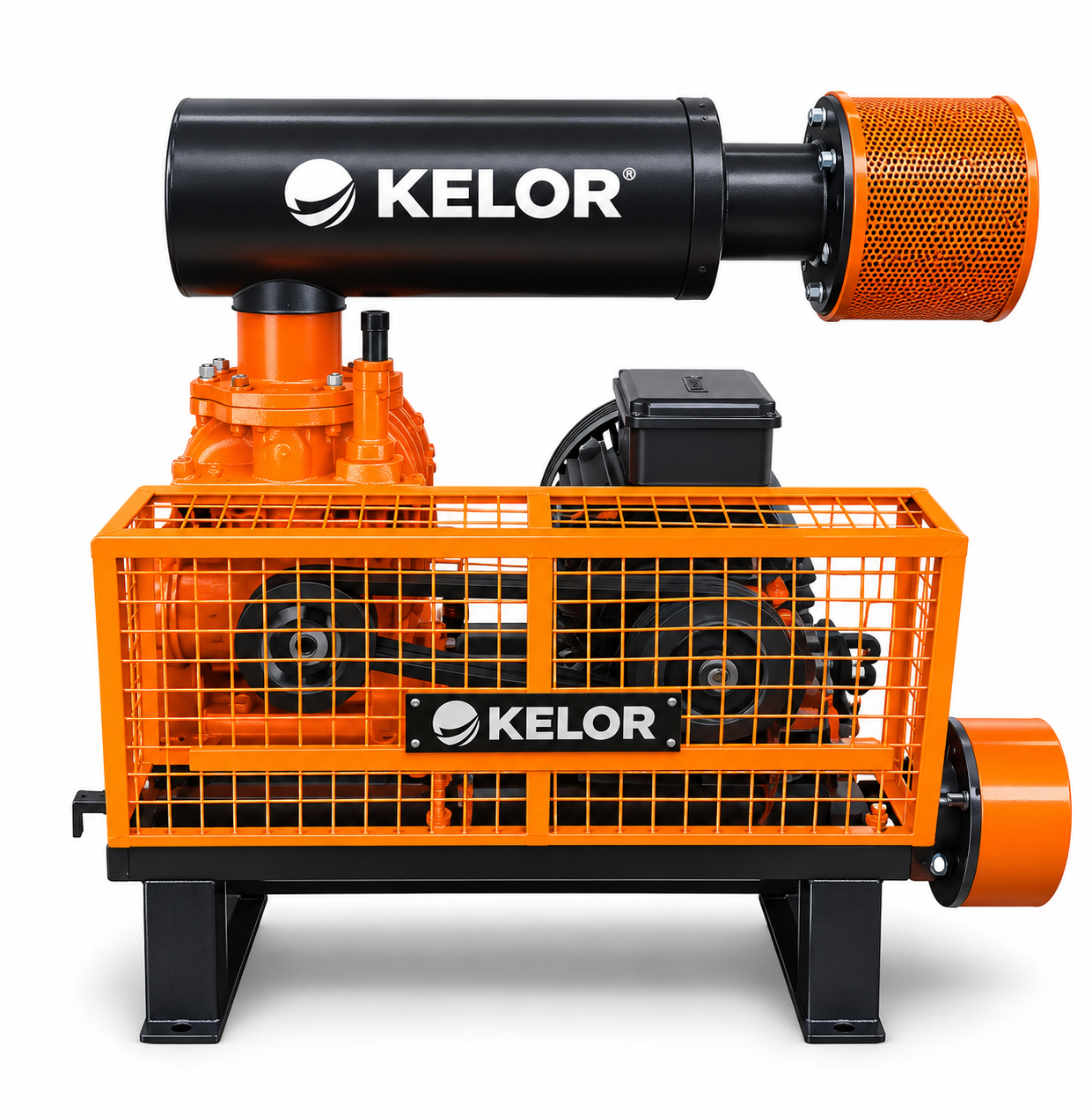
KELOR Roots Blower — 100% oil-free positive displacement air, engineered for continuous industrial duty
Quick Specification
On This Page
- What Is a Roots Blower?
- How a Roots Blower Works
- Technical Specifications
- Roots Blower Price in India
- Key Features
- For Pneumatic Conveying
- Applications & Industries
- Roots vs Tri-Lobe vs Centrifugal vs Screw
- Corrosion-Resistant Options
- Quiet Operation & Tight Spaces
- Special Air Filters
- Custom Configurations & Supply Scope
- How to Select Your Blower
- Maintenance & Troubleshooting
- Supply & Service Across India
- FAQs — 12 Questions Answered
1. What Is a Roots Blower?
A roots blower — also called a roots air blower or a positive displacement blower — is a rotary air machine that moves a fixed volume of air from inlet to outlet on every revolution, using two figure-eight-shaped lobed rotors turning in opposite directions inside a precision-machined casing. The rotors are synchronised by external timing gears so they rotate close together without ever touching each other or the casing wall. Because the air is compressed outside the machine — at the discharge line — rather than inside it, the design is classified as an “external compression” machine built on the Roots principle, named after the Roots brothers who patented the concept in 1860.
The engineering consequence is simple and powerful: at a fixed speed, a roots blower delivers a nearly constant, pulse-steady volume of air regardless of reasonable changes in line resistance. Unlike piston compressors there are no reciprocating parts; unlike oil-injected screw compressors the air chamber is completely separated from lubricant, so the delivered air is 100% oil-free. These two properties — constant flow and oil-free compression — explain why the roots blower is the default air mover for pneumatic conveying lines, sewage and effluent treatment plants, aquaculture farms, cement plants and chemical units across India. KELOR (Krishna Industries), an industrial equipment supplier based in Ahmedabad, supplies this machine range with factory-tested quality and pan-India delivery.
2. How a Roots Blower Works — 4 Stages
Understanding the working principle helps buyers compare quotations correctly and helps operators run the machine at its best. The air path through a roots blower follows four stages:
Stage 1: Air Enters at Inlet
Ambient air passes through the application-specific air filter and inlet silencer into the blower inlet port. Large inlet connections keep suction velocity low, minimising pressure drop and the power cost of drawing air in.
Stage 2: Lobes Trap Air
As the two synchronised lobes rotate past the inlet, a fixed pocket of air is trapped between each lobe and the casing wall. The trapped air is NOT compressed here — its pressure stays at suction level, which keeps power draw predictable.
Stage 3: Transport to Outlet
Each rotation carries the trapped air pockets around the casing walls from the inlet side to the discharge side. Tight, precision-machined clearances between lobes and casing prevent air from leaking backwards, protecting volumetric efficiency.
Stage 4: Compression at Discharge
When the pocket opens to the higher-pressure discharge line, air rushes back momentarily and the pocket pressure equalises — the “external compression” Roots principle. Air then exits through the discharge silencer into your conveying line or aeration grid.
Because each revolution moves a fixed number of air pockets, airflow is directly proportional to speed (RPM). This gives the operator a simple control lever: set the speed between 1200 and 1850 RPM, and get a predictable flow between 50 and 600 M3/HR. And because the lobes never touch — a controlled clearance of a few hundredths of a millimetre separates them — there is no internal friction to lubricate, which is why the machine delivers 100% oil-free air and runs cool enough for continuous 24/7 duty.
100% Oil-Free Compression — How It Is Achieved
The KELOR roots blower achieves oil-free air structurally, not with add-on filters. The air chamber has no internal lubrication because the lobes never make contact. The gear chamber and bearing chambers that do need oil are isolated from the air path by non-contact labyrinth seals, so lubricant physically cannot migrate into the conveyed air. In pneumatic conveying this protects product purity — cement, sugar, flour, pigments and pharma powders stay uncontaminated. In ETP/STP aeration it protects the bacterial cultures that do the biological work; in aquaculture it keeps pond water safe for fish and shrimp. Wherever air touches product, process or biology, 100% oil-free compression is the deciding specification.
3. Technical Specifications — KELOR Roots Blower
The KELOR roots blower is a positive displacement, twin lobe rotary machine offered in six model sizes covering 50 to 600 M3/HR. Every unit ships as a complete set — blower, motor, baseplate and accessories — with shaft height matched to standard IEC motor frames. Application-specific air filters are provided depending upon the application and working environment.
| Parameter | Specification |
|---|---|
| Air Flow | 50 to 600 M3/HR |
| Speed (RPM) | 1200 to 1850 RPM |
| Pressure | 0.5 to 0.7 kg/cm2 |
| Motor Power | 3 to 30 HP, standard IEC frame |
| Compression Principle | Positive displacement, external compression (Roots principle) |
| Air Quality | 100% oil-free compression — no lubricant contacts conveyed air |
| Rotors | Twin lobe, dynamically balanced, precision-machined clearances |
| Bearings | Anti-friction (rolling element), 40,000+ hour L-10 life |
| Shafts | Alloy steel, toughened, ground to close tolerances |
| Seals | Non-contact labyrinth seals isolating oil chambers from air chamber |
| Connections | Large inlet and outlet for minimum pressure loss |
| Motor Mounting | Shaft height matched with IEC motor frame on common baseplate |
| Duty | Continuous 24/7 |
| Options | Corrosion-resistant construction, special air filters, custom configurations |
Model-Wise Selection Chart
| Model | Air Flow | Speed | Pressure | Motor | Typical Duty |
|---|---|---|---|---|---|
| KELOR RB-100 | 50-100 M3/HR | 1450-1850 RPM | 0.5-0.7 kg/cm2 | 3-10 HP | Small ETP/STP, lab air, small ponds |
| KELOR RB-200 | 100-200 M3/HR | 1450-1850 RPM | 0.5-0.7 kg/cm2 | 5-15 HP | Medium ETP/STP, conveying up to 2 TPH |
| KELOR RB-300 | 200-300 M3/HR | 1200-1800 RPM | 0.5-0.7 kg/cm2 | 10-15 HP | Large STP, conveying 2-3 TPH, chemical units |
| KELOR RB-400 | 300-400 M3/HR | 1200-1600 RPM | 0.5-0.7 kg/cm2 | 15-20 HP | Conveying 3-5 TPH, sugar plants, large ponds |
| KELOR RB-500 | 400-500 M3/HR | 1200-1500 RPM | 0.5-0.7 kg/cm2 | 20-25 HP | Cement/fly ash lines 5-6 TPH, industrial parks |
| KELOR RB-600 | 500-600 M3/HR | 1200-1400 RPM | 0.5-0.7 kg/cm2 | 25-30 HP | Heavy conveying 6-8 TPH, multi-tank aeration |
Easy Installation by Design: Shaft Height Matched with IEC Motor Frames
A common installation problem with generic blowers is shaft misalignment with the motor, causing vibration, coupling wear and premature bearing failure. The KELOR roots blower solves this at the design stage: machine shaft height is matched with standard IEC motor frame sizes, so blower and motor align perfectly on the common baseplate supplied with every unit. The result is a compact, single-piece installation that fits tight spaces, needs no special alignment jigs, keeps vibration low for quiet operation, and gets the plant running within hours of delivery.
4. Roots Blower Price in India (2026)
Roots blower prices in India depend primarily on three variables: airflow capacity (M3/HR), operating pressure (kg/cm2) and motor power (HP). The indicative 2026 price bands below help buyers budget conveying and aeration projects before requesting firm quotations. KELOR provides exact pricing within one working day of receiving your airflow and pressure requirement.
| Blower Size | Air Flow | Motor | Typical Application | Indicative Price (INR) |
|---|---|---|---|---|
| Compact (RB-100) | 50-100 M3/HR | 3-10 HP | Small ETP/STP (50-200 KLD), labs, small ponds | 45,000 – 1,20,000 |
| Small (RB-200) | 100-200 M3/HR | 10-15 HP | Medium ETP/STP, conveying up to 2 TPH | 1,20,000 – 1,80,000 |
| Medium (RB-300/400) | 200-400 M3/HR | 15-25 HP | Large STP (1-5 MLD), conveying 2-5 TPH, sugar mills | 1,80,000 – 2,50,000 |
| Large (RB-500/600) | 400-600 M3/HR | 25-30 HP | Cement/power conveying 5-8 TPH, industrial parks | 2,50,000 – 4,50,000 |
What’s included in a complete KELOR supply: blower unit with dynamically balanced twin lobes, inlet filter with silencer, discharge silencer, safety relief valve, pressure gauge, common baseplate with matched IEC motor, belt guard or coupling guard, foundation bolts, and the operation and maintenance manual. When comparing roots blower price quotations from different suppliers, always confirm these accessories are included — a “cheap” quote excluding silencers, filters and the safety valve typically costs 15-25% more once completed.
Three Price Traps Roots Blower Buyers Should Avoid
First, quoting free air delivery (FAD) at “zero pressure” instead of your actual working pressure — a blower that claims 300 M3/HR free-delivery may deliver only 250 M3/HR at 0.6 kg/cm2. Second, excluding the inlet filter, silencers or relief valve from the base price and billing them as “extras”. Third, specifying an IE1 motor instead of IE3 — an IE3 motor costs 8-12% more upfront but saves 2-4% electricity every running hour, paying back within 12-18 months on 24/7 duty. KELOR quotations state FAD at working pressure, include the full accessory package, and specify IE3 motors as standard.
5. Key Features of the KELOR Roots Blower
The KELOR roots blower is a positive displacement machine engineered around the features industrial buyers actually shortlist on — oil-free air, conveying performance, corrosion resistance, quiet running, compact installation and application-specific filtering. Each feature below is built into the machine as standard or offered as a configurable option, not sold as an afterthought.
Feature Set — Standard and Configurable
- Positive displacement blowers — a fixed volume of air is moved per revolution, so flow is constant and predictable at any set speed; output stays stable even when line resistance changes through the day.
- 100% oil-free compression — labyrinth-seal isolation between oil chambers and the air chamber guarantees uncontaminated air for food, pharma, pond water and biological processes.
- Ideal for pneumatic conveying applications — steady, moderate-pressure air keeps cement, fly ash, sugar, grain and powder chemicals suspended and moving through dilute-phase pipelines without pulsation surges.
- Corrosion-resistant options for harsh conditions — epoxy-coated internals, SS304/SS316 air-path parts and PTFE-coated rotors are available for coastal, humid, H2S-bearing and chemically aggressive environments.
- Quiet operation reduces noise levels significantly — dynamically balanced rotors, matched IEC shaft heights and silencer packages bring running noise down from 85-92 dB(A) bare to 75-80 dB(A) silenced.
- Easy installation in tight spaces — compact common-baseplate sets need roughly 0.9 × 0.6 m of floor space in the smallest size, with shaft-height-matched IEC motors removing alignment work entirely.
- Special air filters depending upon the application and working environment — panel, pleated synthetic, high-efficiency cartridge, cyclone pre-cleaner and dual-stage moisture-trap packages are matched to your site’s dust and humidity profile.
- Customizable configurations for specific applications — drive type, motor efficiency class and protection, special voltages, seal types, materials of construction, instrumentation and control panels are configured to the duty.
- Anti-friction bearings rated 40,000+ hour L-10 life — rolling-element bearings support smooth rotation and long maintenance-free intervals on continuous duty.
- Alloy steel toughened shafts ground to close tolerances — hardened, precision-ground shafts resist deflection and wear, holding rotor clearances for years of service.
- Large inlet and outlet connections for minimum loss — generous port sizing keeps suction and discharge velocities low, reducing pressure drop and wasted power.
- Improved volumetric efficiency and reduced operating temperatures — optimised clearances and port geometry return more delivered air per revolution while running cooler.
- Factory engineered, factory guaranteed — every unit is assembled, performance-tested and guaranteed before dispatch, with test documentation supplied.
- User-friendly controls for easy operation — simple start/stop and monitoring arrangements that plant operators can run without specialist training.
6. Roots Blower for Pneumatic Conveying Applications
Pneumatic conveying is the flagship duty for a roots blower. In a dilute-phase conveying line, material is suspended in a fast-moving airstream and pushed through pipeline at moderate pressure — exactly the regime where a positive displacement roots blower outperforms every alternative. Two properties matter: first, flow must stay nearly constant even when line resistance rises (a loaded elbow, a longer route, a partially closed diverter), because a falling flow rate lets particles drop out of suspension and block the line. A roots blower holds flow steady by design; a centrifugal blower does not. Second, the conveyed product — cement, fly ash, sugar, flour, PVC powder, pigments — must never meet lubricating oil, which the 100% oil-free compression guarantees structurally.
Dilute Phase vs Dense Phase — Where the Roots Blower Fits
| Parameter | Dilute Phase (Roots Blower) | Dense Phase (High-Pressure Compressor) |
|---|---|---|
| Solid Loading Ratio | 5-15 kg material per kg air | 20-100+ kg per kg air |
| Working Pressure | 0.5-0.7 kg/cm2 — matched by roots blower | 2-6 bar — needs compressor |
| Conveying Velocity | 15-25 m/s at pipeline end | 3-10 m/s |
| Material Velocity | Particles fully suspended | Slugs/plugs of material |
| Best Materials | Light, free-flowing: fly ash, cement, sugar, grain, PVC powder, pigments | Abrasive/fragile/bulky: sand, glass batch, pellets |
| Machine Choice | Roots blower (this page) — lowest cost, simplest maintenance | Screw compressor + receiver — higher capex |
Conveying Duty to Blower Selection — Quick Mapping
| Conveying Duty | Free Air Required | Working Pressure | Suggested Model | Motor |
|---|---|---|---|---|
| 1-2 TPH over ≤50 m equivalent | 100-150 M3/HR | 0.5-0.6 kg/cm2 | RB-200 | 10-15 HP |
| 2-3 TPH over ≤75 m | 200-300 M3/HR | 0.5-0.7 kg/cm2 | RB-300 | 10-15 HP |
| 3-5 TPH over ≤90 m | 300-400 M3/HR | 0.5-0.7 kg/cm2 | RB-400 | 15-20 HP |
| 5-6 TPH over ≤100 m | 400-500 M3/HR | 0.6-0.7 kg/cm2 | RB-500 | 20-25 HP |
| 6-8 TPH over ≤120 m | 500-600 M3/HR | 0.6-0.7 kg/cm2 | RB-600 | 25-30 HP |
Worked Example: Sizing a Roots Blower for 4 TPH Fly Ash Conveying
Duty: convey 4,000 kg/hr of fly ash through a pipeline of 60 m horizontal plus 15 m vertical lift (≈90 m equivalent length). Step 1 — air demand: at a solid loading ratio of 8 kg material per kg air, air required = 4,000 ÷ 8 = 500 kg/hr of free air ÷ 1.2 kg/m3 ≈ 417 M3/HR. Step 2 — margin: add 10% for filter loading and future route changes ≈ 460 M3/HR. Step 3 — pressure: a 90 m equivalent dilute-phase line typically needs 0.5-0.7 kg/cm2, inside the KELOR roots blower band. Step 4 — selection: RB-600 (500-600 M3/HR) with a 30 HP IE3 motor, running at approximately 1400 RPM. Step 5 — running cost: 30 HP × 0.746 = 22.4 kW; on 24/7 duty at Rs 8/kWh the electricity cost is about Rs 4,300 per day — which is precisely why the 2-4% efficiency gain of an IE3 motor and large low-loss connections matter at this scale.
7. Applications & Industries
The 50-600 M3/HR range with 0.5-0.7 kg/cm2 pressure covers the majority of low-pressure, oil-free air duties in Indian industry. The same roots air blower platform is customised through materials, seals, filters and speed to serve each environment.
Pneumatic Conveying
Cement, fly ash, sugar, grain, flour, PVC powder and pigments moved through dilute-phase pipelines at 0.5-0.7 kg/cm2 with 100% oil-free air that never contaminates product.
ETP & STP Aeration
Diffused aeration for sewage and effluent treatment plants from 50 KLD to 5 MLD. Constant, oil-free air protects bacterial cultures; see our dedicated water treatment blower guide.
Aquaculture Aeration
Shrimp and fish pond aeration with bottom diffusers. Quiet operation matters near farm facilities; oil-free air protects stock and pond water quality.
Cement & Power Plants
Fly ash handling, kiln primary air, fluidising air for silos and hoppers, and dust-collector pulse support in dusty environments — served with cartridge filtration packages.
Sugar Plants & Distilleries
Sugar and bagasse pneumatic handling, mill utilities and effluent aeration. Corrosion-resistant options stand up to hot, humid, acidic site conditions.
Chemical & Pharmaceutical
Low-pressure process air, agitation, stripping and powder transfer. SS316 wetted parts and special seals available for aggressive media.
Biogas & Wastewater Gas
Biogas transfer with special shaft seals and corrosion-resistant internals for H2S-bearing gas from digesters, ETPs and landfill sites.
Food & Grain Processing
Grain aeration, flour conveying and food-grade low-pressure air where 100% oil-free compression is a regulatory requirement, not a preference.
8. Roots Blower vs Tri-Lobe vs Centrifugal vs Screw — Which to Choose?
Buyers evaluating air movers usually compare five families. The right choice depends on pressure band, flow stability requirement and total cost of ownership — not on which machine has the largest brochure.
| Machine Type | Flow Range | Pressure Band | Oil-Free Air | Flow vs Pressure Stability | Relative Cost | Best For |
|---|---|---|---|---|---|---|
| Roots Blower (twin lobe) | 50-600 M3/HR | 0.1-1.0 kg/cm2 | Yes — structural | Near-constant flow regardless of line resistance | Low | Pneumatic conveying, ETP/STP aeration, aquaculture |
| Tri-Lobe Blower | 50-600 M3/HR | 0.1-1.0 kg/cm2 | Yes | Constant; lower pulse and noise than twin lobe | Medium | Noise-sensitive sites, premium installations |
| Centrifugal (Turbo) | 1,000-10,000+ M3/HR | 0.3-1.0 bar | Yes | Flow falls as pressure rises — risky for conveying | Very high | Large municipal STPs above 5 MLD |
| Oil-Free Screw Compressor | 200-2,000 M3/HR | 1-4 bar | Yes | Constant | Very high | High-pressure process air, dense-phase conveying |
| Ring / Side-Channel | 20-200 M3/HR | Up to 0.5 bar | Yes | Constant | Medium | Small ponds, vacuum duty, lab air |
For the 0.5-0.7 kg/cm2 regime specified on this page, the twin lobe roots blower is the most economical and most forgiving choice: it costs a fraction of a turbo or oil-free screw machine, its maintenance is simpler, and its constant-flow behaviour is exactly what a conveying line or aeration grid needs. Specify a tri-lobe only when noise targets below 75 dB(A) are contractual, and move to a screw compressor only when pressure exceeds about 1 bar.
9. Corrosion-Resistant Options for Harsh Conditions
Not every site is a clean, covered plant room. Coastal aquaculture farms run blowers in salt-laden humidity; wastewater plants expose internals to H2S-bearing gas; biogas duty attacks ordinary cast iron within months; chemical units handle acidic vapours. For these harsh conditions, the KELOR roots blower is offered with corrosion-resistant construction options selected against the actual service environment — the right option adds a small percentage to the purchase price and adds years to service life.
| Construction Option | What Changes | Protects Against | Typical Environment |
|---|---|---|---|
| Cast iron + epoxy-coated internals | Two-pack epoxy coating on casing and rotor surfaces | Humidity, salt mist, mild chemical vapour | Coastal STPs, outdoor aquaculture, monsoon exposure |
| SS304 air-path parts | Stainless casing liners, rotor coating or SS hardware in the air stream | Oxidising corrosion, food-grade cleaning washdowns | Food, pharma, grain, dairy air duty |
| SS316 wetted parts | SS316 shafts, hardware and contact surfaces | Chlorides, H2S, acidic condensate | Wastewater headspace gas, chemical plants, marine duty |
| PTFE-coated rotors | Fluoropolymer coating on lobe surfaces | Sticky deposits, aggressive gas chemistry | Biogas, solvent vapours, coating-line exhaust |
| Special shaft seals | Mechanical seals replacing standard labyrinth at shaft exits | Gas leakage inwards or outwards | Biogas transfer, hazardous gas circulation |
Match the Option to the Gas — Don’t Overspecify or Underspecify
Underspecifying is expensive: a plain cast iron blower on H2S-bearing biogas can corrode through within 12-18 months, and a seized rotor set costs more than the original corrosion package. Overspecifying is wasteful: full SS316 construction on a clean indoor ETP duty adds cost with no return. Share the gas composition, temperature and humidity profile of your site with KELOR engineers, and the corrosion-resistant option will be matched to the duty — not to a catalogue default.
10. Quiet Operation & Easy Installation in Tight Spaces
Two practical pain points decide many purchases: how loud the machine is, and where it will physically fit. A bare roots blower measures 85-92 dB(A) at one metre — acceptable in a distant blower house, but a problem next to an operating floor, a farm facility or a residential boundary. The KELOR roots blower attacks noise at the source: dynamically balanced twin lobes reduce vibration excitation, shaft heights matched to IEC motor frames eliminate misalignment hum, and factory-matched silencer packages absorb the residual pulse tone.
Noise Levels by Configuration (Sound Pressure at 1 Metre)
| Configuration | Typical Noise Level | Compliance Note |
|---|---|---|
| Bare unit, no silencers | 85-92 dB(A) | Above 8-hour exposure limit for occupied rooms |
| + Discharge silencer only | 80-86 dB(A) | Acceptable in dedicated blower rooms |
| + Inlet and discharge silencers | 75-80 dB(A) | Comfortable for nearby workstations |
| + Acoustic enclosure | 68-74 dB(A) | Suitable near offices, farm facilities, residential boundaries |
For reference, the Indian Factories Act noise limit for eight-hour exposure is 90 dB(A) — so even the silenced configurations in the table keep staff inside the legal envelope without mandatory hearing protection in most layouts. On aquaculture sites and rooftop installations, the enclosed configuration is usually specified from the start because neighbours are permanent listeners.
Footprint and Clearance — Installation in Tight Spaces
| Model Band | Baseplate Footprint (Approx.) | Service Clearance | Typical Smallest Room |
|---|---|---|---|
| RB-100 / RB-200 | 0.9 × 0.6 m | 0.8 m all round | 2 × 2.5 m corner of a plant room |
| RB-300 / RB-400 | 1.4 × 0.7 m | 1.0 m all round | 3 × 3.5 m dedicated bay |
| RB-500 / RB-600 | 1.8 × 0.8 m | 1.0-1.2 m all round | 4 × 4 m blower house |
Easy Installation Checklist — From Delivery to Running in Hours
KELOR roots blowers arrive as complete sets on a common baseplate: blower, IEC motor, guards and accessories pre-fitted with shaft heights matched. Site work reduces to four steps — set the unit on a flat plinth or anti-vibration pads (heavy foundations are not required), connect the inlet filter-silencer and discharge silencer to your pipework, connect power to the matched IEC motor, and set the relief valve. Overhead clearance of about half a metre above the filter allows cartridge servicing, and the belt or coupling guard opens toward the front for routine checks. This is why the machine installs successfully in congested plant rooms, rooftop shelters and skid-mounted packages where generic blowers need re-engineering.
11. Special Air Filters for Every Application and Working Environment
Suction filtration is the single most consequential accessory on a roots blower: the clearance between lobes and casing is measured in hundredths of a millimetre, and ingested dust rapidly erodes it, dropping volumetric efficiency and raising discharge temperature. That is why special air filters are provided depending upon the application and working environment, rather than one generic filter for all sites. KELOR matches the filter package to measured site dust load and humidity:
| Filter Package | Working Environment | Dust Load | Service Interval |
|---|---|---|---|
| Standard panel filter | Clean indoor ETP/STP blower rooms | Low (below 5 mg/m3) | Clean every 3-6 months |
| Pleated synthetic filter | Outdoor, humid aquaculture and agri sites | Moderate, moisture present | Clean every 3-4 months |
| High-efficiency cartridge filter | Cement, sugar, powder-handling plants | Heavy airborne powder | Inspect monthly, replace every 1-3 months |
| Cyclone pre-cleaner + filter | Grain milling, agricultural dust | Very heavy, fibrous | Empty cyclone monthly, service filter quarterly |
| Dual-stage filter + moisture trap | Coastal, high-humidity installations | Salt-laden humid air | Drain trap monthly, service stage quarterly |
Two sizing rules protect the machine. First, the filter must be sized so suction pressure drop stays below 100 mmWC when new — an undersized filter starves the blower and costs power from day one. Second, clean or replace the element when the differential pressure gauge shows 150-200 mmWC; every additional 100 mmWC of suction loss wastes roughly 2% of motor power and slowly erodes rotor clearances. Every KELOR roots blower quotation includes the matched filter package and differential gauge as standard, not as an extra.
12. Customizable Configurations & Scope of Supply
No two sites buy the same duty point. The KELOR roots blower platform is therefore configured per application — the standard specification below is the starting point, and each row can be adjusted to your process requirement without re-engineering the machine.
| Configuration Item | Standard Supply | Custom Options |
|---|---|---|
| Drive | V-belt drive with guard | Direct coupling; belt ratio set for exact RPM between 1200-1850 |
| Motor | IE3, IP55, 415 V, 3-phase IEC | VFD-ready builds, special voltages (220/380/440 V), increased protection classes |
| Shaft Seals | Non-contact labyrinth | Mechanical seals for biogas and hazardous gas duty |
| Materials | Cast iron casing and rotors | Epoxy-coated, SS304/SS316 air-path parts, PTFE-coated rotors |
| Instruments | Discharge pressure gauge | Filter differential gauge, temperature sensors, hour-run meter, pressure switches |
| Safety | Safety relief valve | Non-return valve, pressure switch, auto-start/duty-changeover control panel |
| Mounting | Common baseplate, anti-vibration pads | Skid mounting with pipework, weather canopy for outdoor duty |
Standard Scope of Supply — Included in Every Quotation
- Roots blower unit with dynamically balanced twin lobes, performance-tested before dispatch
- Inlet filter with matched filter package for your working environment
- Inlet silencer and discharge silencer
- Safety relief valve, set and sealed at the working pressure
- Discharge pressure gauge and non-return valve
- Common baseplate with shaft-height-matched IEC motor (IE3, IP55)
- Belt guard or coupling guard, foundation bolts and anchor template
- Operation and maintenance manual with performance test report
13. How to Select Your Roots Blower — 5-Step Method
Buying a roots blower backwards — from price or from a brochure model number — is the most common cause of undersized installations. The correct sequence starts from the process and ends at the model:
- Quantify the process demand. For aeration: tank volume × BOD load × diffuser count. For pneumatic conveying: material throughput in kg/hr divided by the solid loading ratio (5-15 for dilute phase). For gas transfer: the actual gas volume at suction conditions.
- Convert to free air delivery. Divide air mass requirement by air density (≈1.2 kg/m3) to get M3/HR of free air, then add 10% margin for filter loading and future duty growth.
- Fix the working pressure. Add up pipeline, diffuser or bed losses plus static head. If the total falls between 0.5 and 0.7 kg/cm2, the standard KELOR range fits; above 0.8 kg/cm2 a higher-pressure build must be quoted.
- Select the model one step larger. Choose the RB model whose flow band covers your margined FAD — a blower running at 90% of its maximum speed lives longer and quiets down than one pinned at 100%.
- Verify the energy budget. Motor HP × 0.746 × running hours × tariff = daily electricity cost. At this point many buyers discover the IE3 motor pays for itself and the largest low-loss connections are worth their small premium.
Approximate Motor Power by Duty Point
| Free Air Delivery | At 0.5 kg/cm2 | At 0.6 kg/cm2 | At 0.7 kg/cm2 |
|---|---|---|---|
| 100 M3/HR | 5-6 HP | 5-7.5 HP | 7.5 HP |
| 200 M3/HR | 7.5-10 HP | 10-12.5 HP | 10-15 HP |
| 300 M3/HR | 12.5-15 HP | 15-17.5 HP | 15-20 HP |
| 400 M3/HR | 15-20 HP | 17.5-22.5 HP | 20-25 HP |
| 500-600 M3/HR | 20-25 HP | 22.5-30 HP | 25-30 HP |
Selection Shortcut
Send KELOR just three numbers — required airflow in M3/HR, working pressure in kg/cm2, and daily running hours — plus one line about the site environment (indoor, outdoor, coastal, dusty). Engineers will confirm the model, exact motor rating, filter package and quotation within one working day, including any corrosion-resistant or custom configuration your duty requires.
14. Maintenance Schedule & Troubleshooting
A roots blower is among the lowest-maintenance machines in the plant: the lobes never touch, so there is no internal wear surface to service, and the anti-friction bearings need no greasing between oil changes. The full routine fits in one table:
| Task | Frequency | Detail |
|---|---|---|
| Gear-end oil level check | Monthly | Top up to sight-glass mark with specified oil grade |
| Oil change | First at 500 hrs, then every 2,000-3,000 hrs | More often in hot or dusty sites |
| Air filter differential check | Weekly | Clean/replace element at 150-200 mmWC indicated |
| Belt tension inspection | Quarterly | Re-tension or replace matched belt sets only |
| Safety relief valve test | Annually | Verify lifting and reseating at set pressure |
| Bearing & lobe clearance inspection | Every 10,000-15,000 hrs | Measure clearances, record and compare to commissioning values |
Six Field Symptoms — Causes and Actions
| Symptom | Probable Cause | Action |
|---|---|---|
| No air or flow far below expected | Reverse rotation after electrical work; slack belts | Correct rotation direction, re-tension or replace belt set |
| Discharge temperature rising | Clogged filter; line over-pressure; relief valve seeping | Service filter, verify line pressure, re-seat relief valve |
| Vibration or noise increased | Coupling/belt misalignment; bearing wear | Re-align on baseplate, inspect and replace bearings |
| Relief valve lifting repeatedly | Downstream line blockage; diffuser fouling; undersized machine | Clear line/diffusers; re-verify duty point and resize if needed |
| Oil traces at shaft exits | Labyrinth seal wear after long service | Replace seal set; check bearing condition at the same stop |
| Flow slowly dropping over months | Internal clearance wear from ingested dust; filter clogging | Upgrade filter package; plan lobe/clearance overhaul |
15. Supply & Service Across India
KELOR (Krishna Industries) is an industrial equipment supplier based in Ahmedabad, Gujarat, delivering roots blowers and complete blower packages across India with sizing support, documentation and after-sales service. Typical dispatch follows confirmed technical selection; spares and filter packages are stocked for every model supplied, and scheduled on-site service is available for plants in Gujarat and surrounding states.
Gujarat — Ahmedabad, Vadodara, Surat, Rajkot
Home region with scheduled on-site service visits, same-week spare part dispatch and factory-direct application engineering for conveying and aeration projects.
Mumbai & Pune, Maharashtra
Chemical, pharmaceutical and ETP installations served with corrosion-resistant builds, IE3 documentation and filter packages matched to humid coastal air.
Chennai & Coimbatore, Tamil Nadu
Strong base in aquaculture, textile and sugar industries; dual-stage moisture-trap filter packages specified for coastal humidity.
Delhi NCR — Delhi, Gurugram, Noida, Faridabad
Industrial park utilities, food processing and STP projects with quiet-operation configurations for mixed-use premises.
Hyderabad & Telangana, Andhra Pradesh
Pharma powder transfer and shrimp farm aeration — the two fastest-growing roots air blower duties in the region.
Kolkata & East India
Steel, cement and jute-sector conveying lines plus municipal STP aeration, served with full documentation and remote troubleshooting support.
16. Frequently Asked Questions — Roots Blowers
Need a Roots Blower Quotation?
Share your airflow (M3/HR), pressure (kg/cm2) and application — KELOR engineers will confirm the model, motor rating, filter package and exact price within one working day.
Email: sales@kelorvalves.com WhatsApp Us