
Twin Lobe Roots Blower for ETP, STP & RO Plants — Aeration Air Blower with Price, Specs & Selection Tables
KELOR Twin Lobe Roots Blower for ETP, STP & RO Plants — Biological treatment lives or dies on dissolved oxygen, and the twin lobe roots blower is the machine that keeps it alive. The KELOR aeration blower delivers a constant, 100% oil-free volume of air from 50 to 600 M3/HR at 0.2 to 0.8 kg/cm2, driven by 3 to 50 HP IEC-standard motors running at 1200 to 1850 RPM — steady flow that holds dissolved oxygen stable even when diffuser back-pressure changes. Corrosion-resistant options for H2S-bearing and humid treatment environments, special air filters for every working environment, duty-standby packages with automatic changeover, and customizable configurations for specific applications — supplied across India for effluent treatment plants, sewage treatment plants and RO plant utilities.
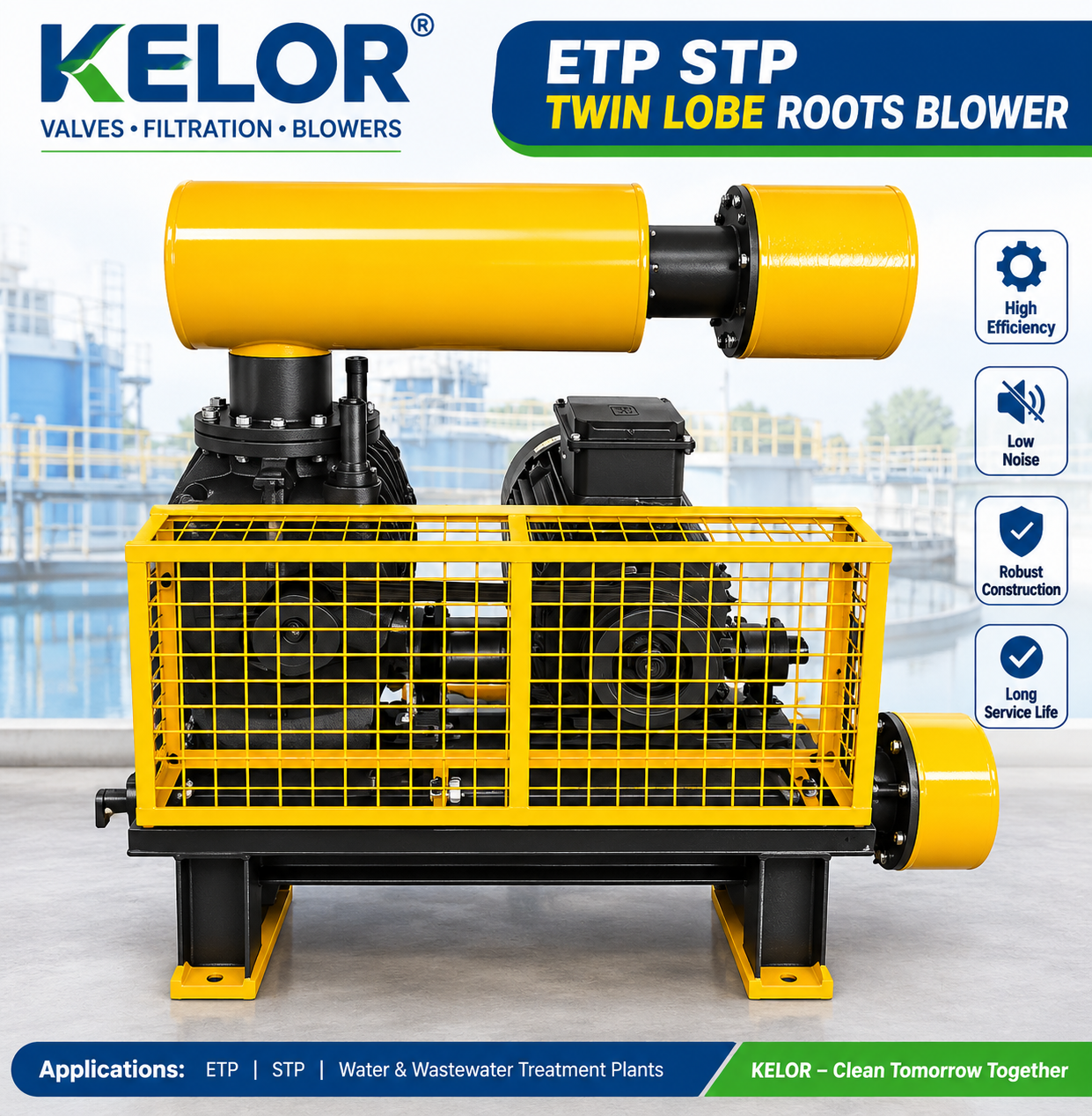
KELOR Twin Lobe Roots Blower for ETP, STP & RO plants — 100% oil-free aeration air, continuous 24/7 duty
Quick Specification
On This Page
- Why ETP, STP & RO Plants Depend on It
- Where the Blower Works in Each Plant
- How the Twin Lobe Blower Works
- Technical Specifications
- Blower Selection by Plant Size
- Price in India (2026)
- Blower Duties in RO Plants
- Features for Treatment Duty
- Energy Cost of Aeration
- Quiet Operation & Easy Installation
- Special Air Filters
- Maintenance & Troubleshooting
- Supply & Service Across India
- FAQs — 12 Questions Answered
1. Why ETP, STP & RO Plants Depend on a Twin Lobe Roots Blower
Every biological treatment plant is a living system. In an effluent treatment plant (ETP) and a sewage treatment plant (STP), colonies of bacteria consume the organic pollution in the water — and those bacteria need dissolved oxygen delivered continuously, around the clock, without interruption. In a reverse osmosis (RO) plant, air plays three supporting roles: agitating filter beds during backwash, stripping dissolved gases from water, and running the aeration grid of the reject-management ETP that treats the plant’s concentrated waste stream. In all three plants, the machine that delivers this air is overwhelmingly the twin lobe roots blower.
The reason is the physics of positive displacement. A twin lobe roots blower moves a fixed volume of air per revolution, so its output stays nearly constant even when the system back-pressure changes — when diffusers foul gradually over months, when valves modulate, when headers warm up in the afternoon sun. Centrifugal machines lose flow in exactly these situations, starving the biology. The twin lobe design also delivers 100% oil-free air, because its lobes never touch anything and its oil chambers are sealed away from the air path by labyrinth seals — so nothing contaminates the bacterial cultures, the treated water, or the RO membranes’ pretreatment stream. KELOR (Krishna Industries), an industrial equipment supplier based in Ahmedabad, supplies this machine range to treatment plants across India with plant-specific selection engineering.
What Happens When the Aeration Blower Fails
Within hours of a blower stoppage, dissolved oxygen in the aeration tank collapses and bacterial cultures begin to die. Within a day, the plant discharges untreated or partially treated effluent — a consent-violation risk carrying penalties, closure notices and months of biology rebuilding time. This is why serious treatment plants never run a single blower: duty-plus-standby sets with automatic changeover are the industry standard, and KELOR configures the pair, the non-return valves and the control panel as one package.
2. Where the Blower Works in Each Plant Type
The same twin lobe roots blower platform serves three distinct duty profiles across ETP, STP and RO installations. The table below maps each plant type to its blower role, typical operating point and special requirements:
| Plant Type | Blower Role | Typical Duty Point | Special Requirement |
|---|---|---|---|
| ETP — Effluent Treatment | Diffused aeration of biological reactor; equalization tank agitation to keep solids suspended | 0.4-0.7 kg/cm2, continuous; airflow scales with BOD load | Corrosion-resistant options for acidic, chemical-laden effluents |
| STP — Sewage Treatment | Aeration grid for activated sludge / MBBR / SBR basins; sludge digestion air where used | 0.3-0.7 kg/cm2, continuous 24/7; duty-standby mandatory | Quiet operation near residential boundaries; H2S-resistant builds for headspace gas |
| RO — Reverse Osmosis | Backwash air-scouring of multi-media/activated carbon filters; decarbonator stripping; reject ETP aeration | 0.3-1.0 kg/cm2 intermittent bursts; reject ETP grid continuous at 0.4-0.7 kg/cm2 | Dedicated backwash blower separate from the continuous aeration blower |
| Packaged / Container Plants | All-in-one aeration for package STPs and skid-mounted ETPs | 0.3-0.6 kg/cm2, compact footprints | Easy installation in tight spaces; low noise; vibration pads instead of foundations |
3. How the Twin Lobe Roots Blower Works
The full engineering detail is on our twin lobe air blower guide; here is the four-stage path the air takes, because it explains the machine’s fitness for aeration duty:
Stage 1: Filtered Air Enters
Ambient air passes through the application-specific filter and inlet silencer into the blower port. Large inlet connections keep suction loss low — important because every mmWC of suction drop is paid for in electricity.
Stage 2: Lobes Trap Fixed Volume
Two synchronised lobes trap a fixed pocket of air between rotor and casing. Nothing is compressed yet — the pocket stays at suction pressure, keeping power draw predictable.
Stage 3: Transport Without Contact
The pockets travel around the casing walls to the discharge side. The lobes never touch each other or the casing — clearances of a few hundredths of a millimetre, with no internal friction to lubricate.
Stage 4: External Compression
At the discharge port, the pocket opens into the higher-pressure line and equalises — the Roots principle. Air exits through the discharge silencer into the diffuser grid at a steady, pulse-managed rate.
Why This Design Suits Biological Treatment Best
Two properties decide aeration reliability. First, constant flow: because output is proportional to speed, the operator sets RPM once and the diffuser grid receives the same air volume day after day — dissolved oxygen stays inside its band without constant attention. Second, oil-free delivery: labyrinth seals keep gear oil out of the air chamber, so the bubbles rising through the mixed liquor carry nothing that coats bacterial flocs. Both properties are structural, not optional add-ons — which is why the twin lobe roots blower remains the default aeration machine across Indian ETPs and STPs.
4. Technical Specifications — KELOR Twin Lobe Roots Blower for Treatment Duty
KELOR twin lobe blowers are offered in two engineered performance ranges covering treatment plant requirements from package plants to municipal basins. Both ranges share the same core architecture — synchronised twin lobes, anti-friction bearings, toughened alloy steel shafts ground to close tolerances — with sizing and motor selection optimised for each flow band.
| Parameter | Range A — Standard Duty | Range B — High Flow |
|---|---|---|
| Air Flow | 50 to 600 M3/HR | 100 to 500 M3/HR |
| Speed (RPM) | 1200 to 1850 RPM | 1400 RPM |
| Pressure | 0.5 to 0.7 kg/cm2 | 0.2 to 0.8 kg/cm2 |
| Motor Power | 3 to 30 HP | 5 to 50 HP |
| Motor Frame | Standard IEC frame, shaft height matched | Standard IEC frame, shaft height matched |
| Air Quality | 100% oil-free | 100% oil-free |
| Bearings | Anti-friction (rolling element) | Anti-friction (rolling element) |
| Shafts | Alloy steel, toughened, ground to close tolerances | Alloy steel, toughened, ground to close tolerances |
| Connections | Large inlet and outlet for minimum loss | Large inlet and outlet for minimum loss |
| Duty | Continuous 24/7 | Continuous 24/7 |
| Typical Treatment Use | ETP/STP aeration up to 1 MLD, package plants, RO backwash | STP basins 1-5 MLD, deep tanks, reject ETP grids |
Shaft Height Matched with IEC Motor Frames
Treatment plant blower rooms are cramped, and misaligned generic blowers cause vibration, coupling wear and bearing failure in exactly those tight installations. The KELOR twin lobe blower matches machine shaft height with standard IEC motor frame sizes, so blower and motor align perfectly on the common baseplate supplied with every unit. Installation reduces to setting the set on a plinth or anti-vibration pads, connecting pipework and power — no alignment jigs, no re-engineering, quiet running from the first hour.
5. Blower Selection by Plant Size — KLD to MLD Mapping
The fastest way to start a selection is from plant capacity. The mapping below links treatment plant size to airflow band, suggested KELOR model and motor rating — engineers then confirm the exact duty point from BOD load, tank depth and diffuser data before quotation.
| Plant Size | Typical Aeration Duty | Airflow Band | Suggested Model | Motor |
|---|---|---|---|---|
| 50-200 KLD (ETP/STP) | Small biological reactor, package plant | 50-100 M3/HR | RB-100 | 5-10 HP (Range A) |
| 200-500 KLD (ETP/STP) | Medium reactor, single aeration grid | 100-200 M3/HR | RB-200 | 10-15 HP (Range A) |
| 500 KLD-1 MLD (STP/ETP) | Large grid, first municipal scale | 200-400 M3/HR | RB-300 / RB-400 | 15-25 HP (Range A) |
| 1-5 MLD (STP, industrial park) | Multi-tank or deep-basin aeration | 400-600 M3/HR | RB-500 / RB-600 | 25-50 HP (Range A/B) |
| RO plant 10-50 KLM backwash | Air-scouring of MMF/AC filter beds | 100-300 M3/HR bursts | RB-200 / RB-300 | 10-15 HP (Range A) |
Worked Example: 1 MLD STP Aeration Blower
A 1 MLD activated-sludge STP with an influent BOD of 250 mg/L removes roughly 250 kg BOD per day. At 1.75 kg O2 per kg BOD removed, oxygen demand is about 437 kg O2/day; fine-bubble diffusers at practical field efficiency need approximately 55 Nm3 of air per kg O2 — call it 24,000 Nm3/day, or about 1,000 Nm3/HR average. Split across a two-tank grid with a peaking factor, the realistic blower duty becomes 500-600 M3/HR — matched by an RB-600 on Range A, or by two RB-300 units in duty-standby for redundancy. Send your BOD, tank depth and diffuser count to KELOR and the same calculation is run on your plant’s numbers within one working day.
6. Twin Lobe Roots Blower Price for ETP/STP Duty (2026)
Treatment plant blower pricing follows the same three variables as any roots blower — airflow, pressure and motor power — plus the scope of accessories. The indicative 2026 bands below are aligned with plant capacity so municipal and industrial buyers can budget before tendering.
| Plant Scale | Air Flow | Motor | Typical Plant | Indicative Price (INR) |
|---|---|---|---|---|
| Compact | 50-100 M3/HR | 5-10 HP | 50-200 KLD ETP/STP, package plants | 45,000 – 1,20,000 |
| Small | 100-200 M3/HR | 10-15 HP | 200-500 KLD plants, RO backwash sets | 1,20,000 – 1,80,000 |
| Medium | 200-400 M3/HR | 15-25 HP | 500 KLD-1 MLD plants, hospital/campus STPs | 1,80,000 – 2,50,000 |
| Large | 400-600 M3/HR | 25-50 HP | 1-5 MLD municipal basins, industrial parks | 2,50,000 – 4,50,000 |
What a complete KELOR treatment-plant supply includes: blower unit, inlet filter with silencer, discharge silencer, safety relief valve, non-return valve for changeover protection, discharge pressure gauge, common baseplate with matched IEC motor, belt guard or coupling guard, foundation bolts, and the operation and maintenance manual with performance test report. A duty-standby pair is quoted as two complete sets plus a changeover control panel — compare supplier quotations on this full scope, because excluding silencers, filters, NRVs and the relief valve can hide 15-25% of the real cost.
Three Tender Traps in Treatment Plant Blower Quotes
First, FAD quoted at zero pressure instead of the diffuser’s actual operating point — always insist airflow is stated at your tank’s working pressure. Second, standby omitted: a single-blower ETP is a consent violation waiting to happen, so any quote saving money by deleting the standby set is not a saving. Third, IE1 motors in place of IE3: on 24/7 duty the 8-12% premium for IE3 pays back in 12-18 months through 2-4% lower consumption every running hour. KELOR quotations state FAD at working pressure, include the full accessory package, and specify IE3 motors as standard.
7. Blower Duties in RO Plants — Backwash, Decarbonation & Reject ETP
RO plants purchase blowers for three distinct jobs, and sizing each correctly matters because they behave differently:
Job 1: Filter Backwash Air-Scouring
Before water backwash, a burst of low-pressure air agitates the multi-media or activated carbon bed, breaking up compaction and mud balls so the subsequent water flush removes more trapped solids. Air-scour flow is typically specified per square metre of filter bed area — a 2.5 m diameter filter (about 5 m2 of bed) commonly needs 200-300 M3/HR of air at line pressure for the scour duration. Because the duty is intermittent and pressure peaks only during scouring, a dedicated RB-200/RB-300 set is standard; tying backwash into the continuous aeration blower is a false economy that disturbs the biology every backwash cycle.
Job 2: Decarbonator / Degasifier Stripping
Where RO permeate or pretreated feed passes through a decarbonator, the blower strips dissolved CO2 from the water film, raising pH stability and reducing load on downstream polishing. This is a continuous low-pressure duty — usually a smaller RB-100/RB-200 unit running at 0.2-0.4 kg/cm2 with the airflow set by the decarbonator’s water loading.
Job 3: Reject ETP Aeration
RO recovery of 60-75% means 25-40% of feed flow leaves as reject — carrying the plant’s full salt and organic load. That reject must be biologically treated before disposal, and its aeration grid runs continuously at 0.4-0.7 kg/cm2, sized from the reject stream’s BOD exactly like any ETP. Because this duty never stops, the duty-standby configuration with automatic changeover applies here as strictly as in any municipal plant.
| RO Plant Blower Duty | Nature | Typical Point | Configuration |
|---|---|---|---|
| Backwash air-scouring | Intermittent bursts during filter backwash | 0.3-1.0 kg/cm2, 200-300 M3/HR for a 2.5 m filter | Dedicated RB-200/RB-300 set, timed control |
| Decarbonator stripping | Continuous, low pressure | 0.2-0.4 kg/cm2, airflow from water loading | RB-100/RB-200 set |
| Reject ETP aeration | Continuous 24/7, critical | 0.4-0.7 kg/cm2, sized from reject BOD | RB-300-RB-600 pair, duty-standby with auto changeover |
8. Features of the KELOR Twin Lobe Roots Blower for Treatment Duty
Treatment plants run the toughest continuous duty of any blower application: 24/7 operation, humid and often corrosive air, critical reliability and strict neighbours. The KELOR twin lobe roots blower is built and configured around exactly these constraints:
Feature Set — Built for ETP, STP & RO Duty
- 100% oil-free aeration air — labyrinth-seal isolation between gear/bearing oil chambers and the air chamber protects bacterial cultures, treated water quality and downstream RO pretreatment streams.
- Positive displacement flow stability — near-constant output as diffusers foul and back-pressure drifts, holding dissolved oxygen inside its band without operator intervention.
- Corrosion-resistant options for harsh conditions — epoxy-coated internals, SS304/SS316 air-path parts and special shaft seals for H2S-bearing headspace gas, humid blower rooms and chemically loaded effluents.
- Quiet operation reduces noise levels significantly — dynamically balanced rotors, IEC shaft-height matching and silencer packages bring running noise down to 75-80 dB(A) silenced, 68-74 dB(A) enclosed — vital for STPs beside residential areas.
- Easy installation in tight spaces — compact common-baseplate sets from roughly 0.9 × 0.6 m of floor area, vibration pads instead of heavy foundations, perfect for package plants and retrofit blower rooms.
- Special air filters depending upon the application and working environment — panel, pleated synthetic and dual-stage moisture-trap packages matched to humid treatment plant air.
- Customizable configurations for specific applications — duty-standby control panels with automatic changeover, non-return valves, hour-run meters, fault annunciation and VFD-ready motor builds.
- Anti-friction bearings rated 40,000+ hour L-10 life — rolling-element bearings that need no greasing between oil changes, keeping treatment plant maintenance light.
- Alloy steel toughened shafts ground to close tolerances — precision-ground shafts hold rotor clearances through years of continuous duty.
- Large inlet and outlet connections for minimum loss — every mmWC of pressure drop saved is electricity saved, at aeration’s 24/7 running profile.
- Improved volumetric efficiency and reduced operating temperatures — more delivered air per revolution, cooler running, longer seal and bearing life.
- Factory engineered, factory guaranteed — every unit performance-tested and guaranteed before dispatch, with test documentation for tender records.
9. Energy: Aeration Is the 50-70% Cost Centre
Aeration typically consumes 50-70% of a treatment plant’s electricity — which makes blower selection the single biggest operating-cost decision in the plant. The arithmetic is unforgiving because the machine never stops:
| Blower Motor | Power Draw | Daily Cost (24/7, Rs 8/kWh) | Monthly Cost |
|---|---|---|---|
| 5 HP | 3.7 kW | Rs 716 | Rs 21,500 |
| 10 HP | 7.5 kW | Rs 1,433 | Rs 43,000 |
| 15 HP | 11.2 kW | Rs 2,150 | Rs 64,500 |
| 25 HP | 18.7 kW | Rs 3,580 | Rs 1,07,400 |
| 30 HP | 22.4 kW | Rs 4,300 | Rs 1,29,000 |
Three Permanent Savings Built Into KELOR Supply
First, IE3 motors as standard: 2-4% lower consumption every running hour, paying back the 8-12% premium within 12-18 months and saving for the machine’s remaining life. Second, large low-loss inlet and outlet connections with matched silencers: unnecessary pressure drop is pure waste at 24/7 duty. Third, correct sizing with a duty-standby pair: an oversized single blower throttled back wastes more money annually than a correctly sized pair costs to buy. Send your duty hours and tariff with the airflow requirement and the quotation will include the running-cost calculation.
10. Quiet Operation & Easy Installation in Tight Spaces
Treatment plants live next to their neighbours — residential boundaries around municipal STPs, office blocks around campus plants, farm facilities around effluent lagoons. A bare roots blower measures 85-92 dB(A) at one metre; the KELOR package brings that down at the source:
| Configuration | Typical Noise Level | Where It Fits |
|---|---|---|
| Bare unit, no silencers | 85-92 dB(A) | Distant dedicated blower houses only |
| + Inlet and discharge silencers | 75-80 dB(A) | Standard treatment plant blower rooms |
| + Acoustic enclosure | 68-74 dB(A) | STPs beside residential boundaries, rooftop plants |
The Indian Factories Act 8-hour exposure limit is 90 dB(A), so the silenced configurations keep plant staff clear of mandatory hearing-protection thresholds while keeping neighbours comfortable. Installation effort is equally contained: shaft heights matched to IEC motor frames eliminate alignment work, the common baseplate needs only a flat plinth or anti-vibration pads, and compact footprints — roughly 0.9 × 0.6 m for small sets up to 1.8 × 0.8 m for the largest — fit the tight blower rooms typical of retrofitted ETPs and package STPs. Allow one metre of service clearance and half a metre above the filter for cartridge servicing.
Commissioning Checklist — Delivery to Running in Hours
Set the complete baseplate set on the plinth with anti-vibration pads; connect inlet filter-silencer and discharge silencer; install the non-return valve and relief valve on the discharge header; connect power to the matched IEC motor and verify rotation; set the relief valve and record the pressure gauge reading. For duty-standby pairs, wire the changeover panel and test automatic switch-over under load. KELOR supplies commissioning instructions with every package, and on-site commissioning support is available for plants in Gujarat and surrounding states.
11. Special Air Filters for Treatment Plant Environments
Treatment plant blower rooms have their own air profile — humid, sometimes corrosive, often outdoors or in semi-enclosed process buildings. Rotor clearances of a few hundredths of a millimetre mean ingested dust and moisture attack the machine from inside, so the filter package is matched to the site rather than defaulted:
| Filter Package | Treatment Environment | Dust/Moisture Load | Service Interval |
|---|---|---|---|
| Standard panel filter | Covered, clean ETP/STP blower rooms | Low | Clean every 3-6 months |
| Pleated synthetic filter | Semi-open treatment plants, monsoon exposure | Moderate + moisture | Clean every 3-4 months |
| Dual-stage filter + moisture trap | Coastal STPs, humid lagoon sites, pump-house corners | Salt/humidity laden | Drain trap monthly, service stage quarterly |
| High-efficiency cartridge filter | Industrial ETPs inside dusty process buildings | Heavy airborne powder | Inspect monthly, replace every 1-3 months |
Two sizing rules protect the machine. Keep suction pressure drop below 100 mmWC when new — an undersized filter starves the blower and wastes power from day one — and clean or replace the element when the differential gauge shows 150-200 mmWC, because every extra 100 mmWC of suction loss wastes roughly 2% of motor power around the clock. The matched filter package and differential gauge are included in every KELOR treatment-plant quotation as standard.
12. Maintenance Schedule & Troubleshooting for Treatment Plants
The twin lobe roots blower is among the lowest-maintenance machines in a treatment plant — lobes never touch, so there is no internal wear surface, and anti-friction bearings need no greasing between oil changes. The routine fits one table:
| Task | Frequency | Detail |
|---|---|---|
| Gear-end oil level check | Monthly | Top up to sight-glass mark with specified oil grade |
| Oil change | First at 500 hrs, then every 2,000-3,000 hrs | Alternating duty-standby units extends intervals naturally |
| Air filter differential check | Weekly | Clean/replace element at 150-200 mmWC indicated |
| Belt tension inspection | Quarterly | Re-tension or replace matched belt sets only |
| Safety relief valve test | Annually | Verify lifting and reseating at set pressure |
| Bearing & lobe clearance inspection | Every 10,000-15,000 hrs | Measure clearances, record against commissioning values |
Six Field Symptoms in Treatment Plants — Causes and Actions
| Symptom | Probable Cause | Action |
|---|---|---|
| Dissolved oxygen falling while blower runs | Diffuser fouling raising back-pressure; filter clogging | Service diffusers (clean/soak per OEM), service blower filter, verify duty point |
| Discharge pressure gauge rising over months | Gradual diffuser fouling — normal ageing | Schedule diffuser cleaning; confirm blower still inside its pressure band |
| Blower discharge temperature high | Clogged filter; over-pressure; relief valve seeping | Service filter, verify line pressure, re-seat relief valve |
| Vibration or noise increased | Misalignment; bearing wear; belt imbalance | Re-align on baseplate, inspect bearings, replace matched belt set |
| Relief valve lifting at start-up | Closed discharge valve; header blockage; diffusers isolated | Re-open valving, clear header, verify start-up sequence |
| Oil traces at shaft exits | Labyrinth seal wear after long service | Replace seal set; inspect bearings at the same stop |
13. Supply & Service Across India
KELOR (Krishna Industries) is an industrial equipment supplier based in Ahmedabad, Gujarat, supplying twin lobe roots blowers for ETP, STP and RO duties across India — with plant-size selection support, duty-standby package configuration, documentation for tenders and after-sales service with stocked spares and filter packages for every model supplied.
Gujarat — Ahmedabad, Vadodara, Surat, Rajkot
Chemical-industry ETPs and municipal STPs across the home region, with scheduled on-site service visits and same-week spare dispatch.
Mumbai & Pune, Maharashtra
Campus and industrial-park STPs, dyeing and chemical ETPs — corrosion-resistant builds with IE3 documentation for tender compliance.
Chennai & Coimbatore, Tamil Nadu
Tannery and textile effluent plants, municipal sewage schemes and coastal RO utilities with dual-stage moisture-trap filter packages.
Delhi NCR — Delhi, Gurugram, Noida, Faridabad
Sewage treatment upgrades, hospital and hotel STPs, and RO reject management with quiet-operation configurations for mixed-use premises.
Hyderabad & Telangana, Andhra Pradesh
Pharma ETP aeration at strict compliance sites, municipal STP basins and aquaculture-linked treatment — the region’s fastest-growing duties.
Kolkata & East India
Tannery, jute and steel-sector effluent plants plus municipal sewage schemes, served with full documentation and remote troubleshooting.
14. Frequently Asked Questions — Twin Lobe Blowers for ETP, STP & RO
Need a Blower for Your ETP, STP or RO Plant?
Share plant capacity (KLD/MLD), BOD load, tank depth and diffuser count — KELOR engineers will confirm the model, duty-standby configuration and exact price within one working day.
Email: sales@kelorvalves.com WhatsApp Us