
PTFE Seat Wafer Butterfly Valve for Acid & Chemical Dosing
Engineered for aggressive chemical processing. Our PTFE seat wafer butterfly valve chemical grade models feature SGI/CI bodies, CF8M discs, and pure PTFE (Teflon) liners. Designed to withstand concentrated acids, strong alkalis, and corrosive solvents up to 180°C. The definitive choice for Indian chemical, pharma, and ETP plants.
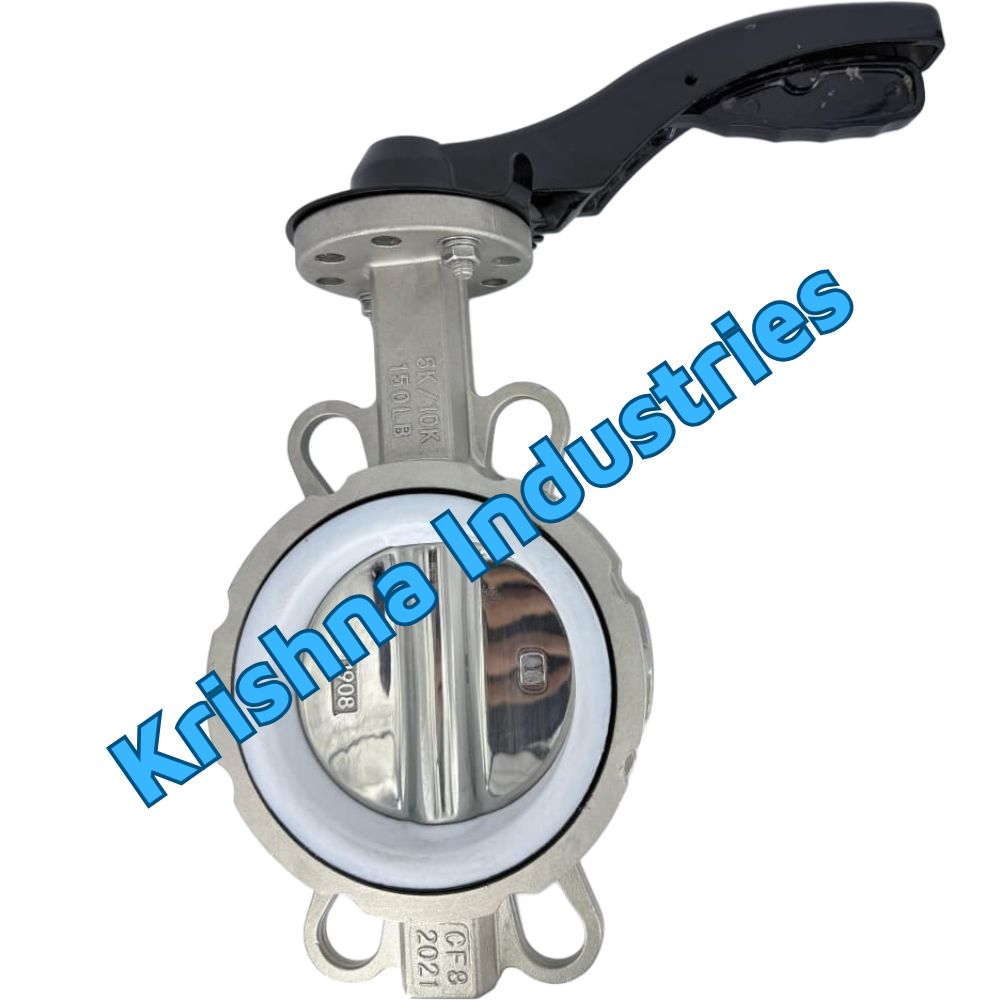
Featured Insight: A PTFE seat wafer butterfly valve is the industry standard for aggressive chemical and acid dosing applications. Unlike EPDM or NBR rubber, PTFE (Polytetrafluoroethylene/Teflon) provides near-universal chemical inertness, resisting concentrated HCl, H₂SO₄, HNO₃, and caustic soda without swelling, degrading, or leaching. Combined with a corrosion-resistant CF8M (SS316) disc and robust SGI/CI body, it ensures zero-leakage, long-term reliability in India’s harshest chemical processing environments.
At-A-Glance Specifications
Contents
- 1. Why PTFE/Teflon is Mandatory for Chemical Dosing
- 2. Advanced Engineering & Design Features
- 3. Chemical Compatibility Guide
- 4. Torque Considerations for PTFE Seats
- 5. Technical Dimensions & Standards
- 6. Target Industries & Applications in India
- 7. Why Chemical EPCs Specify KELOR Valves
- 8. Frequently Asked Questions (PAA)
Why PTFE/Teflon is Mandatory for Chemical Dosing
In chemical processing, valve failure is not just an operational inconvenience; it is a severe safety and environmental hazard. Standard elastomeric seats (EPDM, NBR, Viton) have distinct chemical limitations. When exposed to strong oxidizing acids, halogens, or aggressive solvents, elastomers swell, harden, or dissolve, leading to catastrophic fugitive emissions or pipeline leaks.
PTFE (Polytetrafluoroethylene), universally known as Teflon, is a fluoropolymer with a unique carbon-fluorine bond that renders it chemically inert to almost all industrial media. A PTFE seat wafer butterfly valve provides:
- Universal Chemical Resistance: Withstands pH levels from 0 to 14, including concentrated hydrochloric, sulfuric, and nitric acids.
- Thermal Stability: Maintains structural integrity and sealing capability from -20°C up to 180°C, covering most steam and hot chemical processes.
- Zero Contamination: Non-stick, non-leaching properties ensure the process fluid remains pure, critical for fine chemical and pharmaceutical dosing.
Advanced Engineering & Design Features
KELOR’s ptfe seat wafer butterfly valve chemical grade models are not generic valves with a swapped seat. They are engineered from the ground up for corrosive service:
Perforated / Muffler Disc Design
Our CF8M discs feature a precision-machined perforated (muffler) profile. This reduces fluid turbulence, minimizes cavitation during throttling, and significantly lowers the operating torque required to shear through viscous or crystallizing chemical slurries.
Fugitive Emission Stem Sealing
Chemical plants cannot afford stem leakage. Our valves utilize a multi-ring PTFE V-packing or bellows seal arrangement around the stem, ensuring zero fugitive emissions of toxic or volatile chemicals to the atmosphere.
Full PTFE Encapsulation
The PTFE liner completely encapsulates the inner body wall, ensuring the aggressive process fluid never contacts the cast iron or SGI body. This prevents internal graphitic corrosion and extends valve life exponentially.
Blow-Out Proof Stem
The stem is integrally cast or machined with the disc and secured with a blow-out proof design, ensuring the valve remains intact and safe even under extreme reverse-pressure surges or water hammer events.
Chemical Compatibility Guide
While PTFE is highly resistant, proper material pairing is essential. Below is a quick reference for pairing our PTFE seat wafer butterfly valves with common chemical plant media.
| Process Media | Recommended Body | Recommended Disc | PTFE Suitability |
|---|---|---|---|
| Hydrochloric Acid (HCl) | SGI / CI (PTFE Lined) | CF8M (SS316) / Hastelloy | Excellent (All concentrations) |
| Sulfuric Acid (H₂SO₄) | SGI / CI (PTFE Lined) | CF8M (SS316) | Excellent (Up to 98%, <100°C) |
| Sodium Hydroxide (NaOH) | CI / SGI | CF8 / CF8M | Excellent (All concentrations) |
| Chlorine / Hypochlorite | SGI (PTFE Lined) | Titanium / CF8M | Excellent (Wet or Dry) |
| Organic Solvents (Toluene, Acetone) | CI / SGI | CF8M | Excellent (Superior to Viton/NBR) |
| Abrasive Chemical Slurries | SGI (Rubber Lined) | CF8M | Caution: Use Rubber Lined for high abrasion; PTFE is for corrosion. |
Engineering Warning: Abrasion vs. Corrosion
While PTFE is chemically invincible, it is relatively soft. If your chemical dosing line contains high levels of suspended abrasive solids (e.g., catalyst particles, sand), the PTFE seat may wear prematurely. For abrasive + corrosive service, specify a Rubber Lined (EPDM/NBR) butterfly valve instead, as rubber offers superior resilience against physical wear while maintaining good chemical resistance.
Torque Considerations for PTFE Seats
A critical factor often overlooked in chemical valve specification is operating torque. PTFE is a rigid, non-elastic polymer. To achieve a bubble-tight seal, the PTFE seat must be compressed firmly against the disc. This results in a significantly higher breakaway and running torque compared to elastomeric (EPDM) seats.
- DN50 to DN80: Can be operated with a heavy-duty lever, but a short-handle gear operator is recommended for frequent cycling.
- DN100 and above: A worm gear operator is mandatory. Manual levers will not provide sufficient mechanical advantage and may lead to operator injury or stem shearing.
- Actuated Valves: If specifying pneumatic or electric actuators, the actuator must be sized with a minimum 1.5x to 2.0x safety factor over the published PTFE seat torque values to account for chemical crystallization or temperature-induced expansion.
Technical Dimensions & Standards
Our valves are designed for seamless integration into existing chemical pipelines, conforming to global dimensional standards.
Table: Standard Face-to-Face & Pressure Ratings| Size (DN) | 50 | 80 | 100 | 150 | 200 | 250 | 300 | 400 | 500 | 600 |
|---|---|---|---|---|---|---|---|---|---|---|
| Face-to-Face (mm) | 43 | 46 | 52 | 56 | 60 | 68 | 78 | 102 | 127 | 140 |
| PN10 / PN16 (Bar) | 16 | 16 | 16 | 16 | 16 | 16 | 16 | 16 | 16 | 16 |
| Class 150 (PSI) | 285 | 285 | 285 | 285 | 285 | 285 | 285 | 285 | 285 | 285 |
Design Standards: API 609, BS EN 593, ISO 5752 Series 20 (Short Pattern). Testing: API 598.
Target Industries & Applications in India
Chemical Manufacturing (GIDC/MIDC)
Widely deployed in Gujarat (Ankleshwar, Vapi, Dahej) and Maharashtra (Tarapur) for acid transfer, reactor feed lines, and neutralization dosing. The PTFE seat prevents degradation from aggressive batch chemistries.
Pharmaceutical & Fine Chemicals
Used in solvent recovery, API synthesis, and waste treatment lines. The non-leaching nature of PTFE ensures compliance with strict purity and contamination standards.
Effluent Treatment Plants (ETP/ZLD)
Critical for dosing lines handling concentrated lime, ferric chloride, and sulfuric acid in Zero Liquid Discharge (ZLD) systems, where standard rubber valves fail within months.
Textile & Dyeing Industries
Handles corrosive dye baths, bleaching agents (hydrogen peroxide, sodium hypochlorite), and acidic wastewater without the swelling issues common with NBR seats.
Why Chemical EPCs Specify KELOR Valves
Verified Material Integrity
We use only 100% virgin PTFE for our seats and liners, backed by Material Test Certificates (MTC). We do not use recycled PTFE blends that compromise chemical resistance and thermal stability.
100% API 598 Hydrostatic Testing
Every single valve is tested for shell integrity (1.5x rated pressure) and seat leakage (1.1x rated pressure) before dispatch. Test reports are included with every shipment.
Actuation Expertise
Buying a PTFE valve is only half the battle. Our team calculates the exact torque requirements for your specific size and temperature, ensuring your gear operator or actuator is perfectly sized to prevent stem failure.
PAN India Chemical Hub Support
With our base in Ahmedabad, we provide rapid 3–7 day dispatch to all major Indian chemical corridors. We are fully equipped to handle bulk BOQs for EPC tenders with complete QA/QC documentation.
Commercial & Ordering Details
Stop Chemical Valve Failures. Specify PTFE.
Share your chemical media, temperature, pressure, and size requirements. Our engineering team will recommend the optimal PTFE seat wafer butterfly valve configuration and provide a competitive quote within 2 hours.
Get Technical Quote via WhatsAppRelated Chemical Process Valves
Frequently Asked Questions (PAA)
1. Why choose a PTFE seat wafer butterfly valve for chemical dosing?
2. What is the maximum temperature for a PTFE seated butterfly valve?
3. Do PTFE seat butterfly valves require higher operating torque?
4. Can this valve be used in Gujarat GIDC or Maharashtra MIDC chemical plants?
5. What is the difference between a PTFE seat and a full PTFE lined butterfly valve?
Specify KELOR Chemical Valves
Engineered for corrosion resistance, tested for safety, and dispatched PAN India.
- 100% Virgin PTFE (Teflon) Seat
- CF8M (SS316) Corrosion-Resistant Disc
- SGI / CI Body with PTFE Encapsulation
- API 598 Tested with MTC Provided
- 5-7 Day Dispatch from Ahmedabad