
Working Principle of Twin Lobe Roots Blower and Its India Demand
Two questions decide every twin lobe roots blower purchase in India: how exactly does the machine work, and why is demand for it accelerating across the country? This guide answers both. First, the working principle — the four-stage cycle, the external compression model and the three operating laws that govern flow, power and slip. Then, the India demand map: the 40,000+ MLD sewage treatment shortfall, the cement and infrastructure conveying build-out, aquaculture’s export engine, the chemical-cluster and compressed-biogas push — with prices, a buyer’s checklist and the supply landscape.
From the KELOR engineering desk (Krishna Industries, Ahmedabad) — supplier of twin lobe roots blowers from 50 to 600 M3/HR at 0.5-0.7 kg/cm2 with 3-30 HP IEC motors, serving treatment plants, cement lines, aquaculture farms and process industries across India.
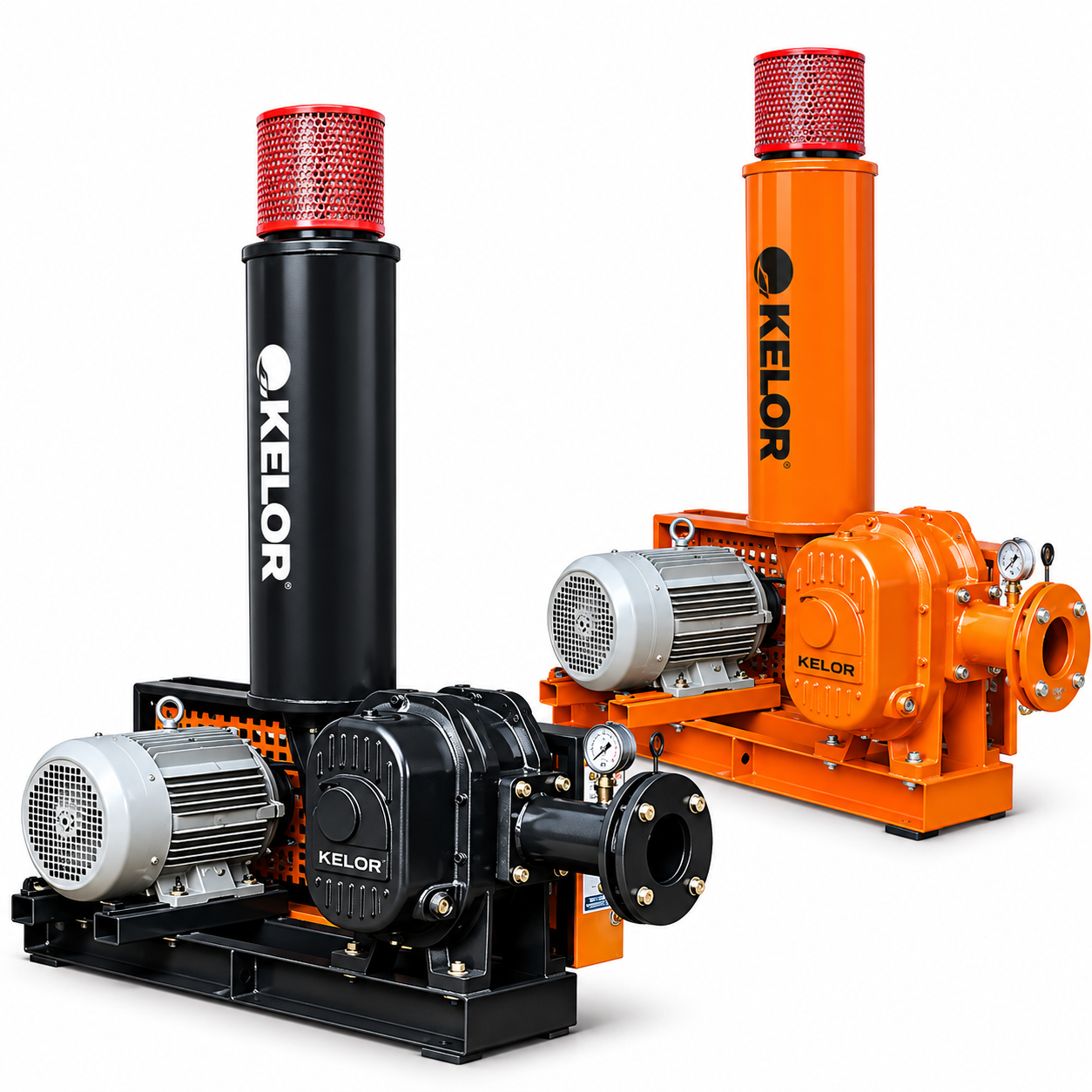
KELOR Twin Lobe Roots Blower — the machine behind India’s aeration and conveying build-out
The Machine and the Market, in Four Lines
On This Page — 16 Sections
- What Is a Twin Lobe Roots Blower — and Why India Runs on It
- Working Principle: What Happens in One Revolution
- The External Compression Model: Why Compression Happens Outside
- The Three Operating Laws of Twin Lobe Behaviour
- What the Working Principle Means at Your Plant
- India Demand Driver 1 — The Sewage & Effluent Treatment Push
- India Demand Driver 2 — Cement, Infrastructure & Conveying
- India Demand Driver 3 — Aquaculture & Food Processing
- India Demand Driver 4 — Chemicals, Pharma, Textiles & Biogas
- Where the Demand Concentrates: India’s Twin Lobe Map
- How Indian Buyers Specify: The Six-Point Checklist
- Twin Lobe Blower Price in India (2026)
- Matching Machine to Duty: Twin Lobe vs the Alternatives
- Energy: Why the Working Principle Decides Your Power Bill
- How KELOR Serves India’s Twin Lobe Demand
- FAQs — 12 Questions on Principle and Demand
1. What Is a Twin Lobe Roots Blower — and Why India Runs on It
A twin lobe roots blower is a rotary positive displacement air machine: two identical rotors, each machined with two lobes into the classical figure-eight profile, turn in opposite directions inside a precision-machined casing. External timing gears keep the rotors in exact phase so their lobes pass each other without ever touching the casing or each other. Every revolution traps a fixed volume of air at the inlet, carries it around the casing wall and pushes it into the discharge line — nothing more, nothing less. That mechanical simplicity is the machine’s genius: no contact inside the air path, no oil in the compression space, and a flow rate set purely by rotor geometry and speed.
Now overlay the Indian industrial map on that capability. The country is building sewage and effluent treatment capacity at a pace never seen before, driven by a treatment shortfall measured in tens of thousands of MLD. Its cement industry is the world’s second largest, moving fly ash and powder through conveying pipelines around the clock. Its frozen shrimp exports depend on pond aeration that cannot tolerate a single drop of oil. Its chemical and pharmaceutical clusters in Gujarat, Maharashtra and Tamil Nadu run stripping, sparging and conveying duty in plants packed shoulder-to-shoulder. All of these processes live in the same operating envelope — steady airflow at 0.5-0.7 kg/cm2 — and that is precisely the envelope the twin lobe roots blower owns.
That is why this machine matters to two audiences at once. For the plant engineer, understanding the working principle is the difference between a blower that runs fifteen years and one that fights from day one. For anyone tracking Indian industrial demand, the twin lobe blower is a proxy indicator: where it sells, treatment capacity, conveying infrastructure and export agriculture are growing. This guide serves both — principle first, then the demand picture.
2. Working Principle: What Happens in One Revolution
Follow one parcel of air through one revolution of the machine — four stages, repeated four times per revolution, hundreds of times per minute:
Stage 1 · Intake
As a lobe rotates away from the inlet port, the space between lobe and casing wall grows. The atmosphere pushes air in to fill it — no suction stroke, no valves, just expanding volume drawing air.
Stage 2 · Trapping
The approaching lobe of the second rotor seals the parcel from the inlet. The volume is now fixed — set entirely by rotor geometry — and isolated between lobe, casing and end plate.
Stage 3 · Carry-over
The sealed parcel travels around the casing wall at exactly inlet pressure. Nothing is compressed yet — this silent transfer is the step that keeps flow constant.
Stage 4 · Back-flow and delivery
The parcel reaches the discharge port. Pressurised line air back-flows in for a fraction of a revolution, pressures equalise, and the following lobe pushes the parcel out into the line.
| Stage | Pressure Inside Parcel | What the Operator Sees |
|---|---|---|
| 1. Intake | Atmospheric | Steady suction; filter gauge reading stable when clean |
| 2. Trapping | Atmospheric | Nothing — the volume is simply sealed |
| 3. Carry-over | Atmospheric (constant) | Nothing — the invisible constant-flow step |
| 4. Back-flow & delivery | Rises to line pressure | The pulse source — managed by the discharge silencer |
Two rotor lobes, two rotors, four parcels per revolution: at 1450 RPM the machine completes over 96 parcel deliveries per second, which is why the delivered flow appears perfectly steady to the process. The lobes never meet — the timing gears hold a phase offset (typically 90 degrees on a two-lobe machine) so a lobe of one rotor always arrives at the mesh point exactly as the gap of the other opens to receive it. No contact means no wear inside the air chamber, and no lubrication means nothing ever contaminates the air.
3. The External Compression Model: Why Compression Happens Outside
Here is the fact that surprises every first-time buyer: a roots blower does not compress air inside itself. The trapped parcel travels the full width of the machine at inlet pressure, and compression only happens the instant the discharge port opens — pressurised air from the line rushes back into the parcel, equalising pressures before the parcel is swept out. Thermodynamicists call this isochoric external compression, and it is the defining characteristic of the entire Roots family.
Ideal shaft power = delivered volume (m3/s) × differential pressure (kPa). Power tracks pressure, not flow — the single most important energy fact about the machine.
Why choose a design that pays an energy penalty for external compression? Because the alternative — internal compression in screws and pistons — demands oil, valves, close-fitting contact surfaces or reciprocating masses in the air path. The roots principle removes all of them. The lobes run clear of everything; timing gears, bearings and their oil live outside the air path, separated by non-contact labyrinth seals. What you trade in a few points of compression efficiency you gain back in uptime, serviceability, oil-free air and a construction so simple that any plant technician can strip and rebuild it. For 0.5-0.7 kg/cm2 duty — where nearly every Indian aeration and conveying application lives — that trade wins decisively, and it is why the external compression machine dominates this pressure band worldwide.
Practical consequence: the pressure band defines the machine
Air-cooled twin lobe units are comfortable up to about 1.0 kg/cm2 differential; the KELOR standard range is rated 0.5-0.7 kg/cm2. Inside that band, external compression costs little and the machine runs cool for decades. Push far beyond it and the recompressed slip air heats the air path — which is why high-pressure duties belong to screw compressors, not blowers.
4. The Three Operating Laws of Twin Lobe Behaviour
Everything a twin lobe roots blower does in a plant follows from three laws. Learn them once and every operating decision — speed setting, filter change, VFD tuning, motor sizing — becomes arithmetic instead of guesswork.
Law 1 — Flow is proportional to speed
Q = delivered airflow (M3/HR) · D = displacement per revolution (fixed by geometry) · N = speed (RPM). Double the RPM, double the flow — minus a small slip correction.
The blower is a fixed-volume pump for air: each revolution moves the same number of parcels, so airflow tracks rotor speed almost linearly. This is the property that makes a twin lobe blower predictable — set 1450 RPM and the machine delivers the same M3/HR in Delhi summer, Mumbai monsoon or a Kolkata winter. It is also what makes a VFD the natural controller for the machine: trim speed, trim flow, almost perfectly linearly.
Law 2 — Power is proportional to differential pressure
Ideal power rises with the pressure the line demands — not with the volume you deliver. Cleaning filters and smoothing pipelines saves kilowatts; throttling the inlet saves almost nothing.
Because flow is fixed by speed, the only way the machine absorbs more power is when the discharge line demands more pressure: a clogged filter, a scaling diffuser grid, a longer or dirtier pipeline. Worked example: 200 M3/HR at 0.6 kg/cm2 (58.8 kPa) needs about 3.3 kW of air power — roughly 4.7 kW of shaft power at 70% overall efficiency, or a 7.5 HP motor. Raise Δp by letting the filter blind, and power climbs even though the process gets less air. That asymmetry is why the plant’s cheapest energy project is always the filter gauge.
Law 3 — Slip rises with pressure and falls with speed
Slip = air leaking back through the running clearances (0.08-0.30 mm typical). More Δp means more leak-back; higher RPM gives leaks less time per revolution.
The running clearance that keeps lobes from touching also lets a small fraction of air escape back to the inlet each revolution — typically 5-8% at normal duty. Slip grows as differential pressure rises (bigger pressure difference, stronger leak) and shrinks as speed rises (less time per revolution for air to escape). Two operational truths follow: the same machine delivers more air at 1850 RPM than at 1200 RPM, and a worn air end shows itself as a slow drop in delivered flow at unchanged speed and pressure — the number to watch in your logbook.
5. What the Working Principle Means at Your Plant
Translate the three laws into shop-floor behaviour and the twin lobe blower tells you exactly how it wants to be run:
The operating rules that follow directly from the principle
- Constant flow is the product — aeration basins get stable dissolved oxygen even as diffusers age, because line resistance changes barely move the flow. Size the blower for the air demand, not the resistance spikes.
- Never throttle the inlet to save air — on a positive displacement machine, throttling saves almost no power and raises suction temperature. Control flow with speed (VFD) or let it flow; never with a suction damper.
- Keep the discharge path open, always — flow continues regardless of resistance, so a blocked line or closed valve dead-heads the machine against its own pressure. The pressure relief valve and non-return valve are not accessories; they are the machine’s survival equipment.
- Watch the filter differential gauge — every millimetre of clogged-filter Δp is paid for in kilowatts around the clock (Law 2). Clean below 100 mmWC when new; clean or replace at 150-200 mmWC.
- Trend delivered flow — because flow = D × N − Slip, a falling flow at fixed speed and pressure is your early warning of clearance growth. Log it monthly; act when the trend turns.
- Respect the pressure band — the twin lobe principle is built for 0.5-0.7 kg/cm2 (about 1.0 kg/cm2 maximum air-cooled). Above that, temperature rise — not the motor — becomes the limiting factor.
The one mistake that destroys more twin lobe blowers than any other
Running against a closed discharge — a shut valve, a blinded line, a removed relief valve. The machine will happily keep turning, recompressing its own slip air until the air end overheats and the rotors contact. Every KELOR package ships with the relief valve set just above working pressure and an NRV against back-spin; keep both installed and the working principle will reward you with years of steady service.
6. India Demand Driver 1 — The Sewage and Effluent Treatment Push
Nothing drives twin lobe roots blower demand in India like wastewater. The scale of the gap is documented in CPCB’s National Inventory of Sewage Treatment Plants (2021): urban India generates 72,368 MLD of sewage against an installed treatment capacity of 31,841 MLD across 1,469 STPs — and only 20,235 MLD of that capacity was actually operational and utilised. In round numbers, the country treats less than half its sewage, leaving a shortfall of roughly 40,000 MLD. Industrial effluent adds another dimension: CPCB-cited studies put industrial wastewater generation at about 13,468 MLD, with only around 60% treated before discharge.
Every plant built to close that gap is, at its heart, an aeration project. Activated sludge processes, extended aeration, MBBR and SBR variants — the dominant sewage treatment technologies in India — all depend on blowers pushing air through diffusers continuously. A 5-MLD STP typically runs multiple twin lobe blowers sized 50-300 M3/HR each; large municipal works stack machines into the 400-600 M3/HR class. Multiply across the national build-out and the arithmetic explains itself: wastewater aeration is the single largest, most stable demand base for twin lobe roots blowers in India.
Compliance pressure keeps the demand curve rising. State pollution control boards and the National Green Tribunal have progressively tightened discharge norms and enforcement on municipalities and industries alike, converting “build a treatment plant” from an aspiration into a licence-to-operate requirement. Meanwhile the operating economics reinforce the machine choice: aeration typically consumes 50-70% of a treatment plant’s electricity, so buyers who understand the working principle — constant flow, power tracking pressure, slip falling with speed — consistently specify twin lobe blowers with VFD control and clean-filter discipline, and reap the savings for decades.
What this means for a buyer
If you are building or upgrading an ETP or STP, you are buying aeration air — and the working principle in Sections 2-4 is your specification tool. Demand stated airflow and pressure against your actual water depth and diffuser count, 100% oil-free construction to protect the biology, material packages (SS316/PTFE options) for H2S-bearing streams, and VFD-ready builds. The KELOR ETP/STP blower guide maps plant capacities from 50 KLD to multi-MLD against blower models and motors.
7. India Demand Driver 2 — Cement, Infrastructure and the Conveying Build-Out
India ranks second in world cement capacity, with roughly 700 MTPA installed across about 264 plants (163 of them integrated units) — and every one of those plants moves powder by air. Fly ash from the boiler house to the silo, raw meal to the blend silo, finished cement to packing and dispatch: dilute-phase pneumatic conveying lines powered by twin lobe roots blowers run continuously in this industry, at solid loading ratios of 8-10 kg of material per kg of air.
The same conveying logic radiates outward through the infrastructure economy. Thermal power plants convey ash; steel and sponge iron units move dust and additives; grain processors and sugar mills convey, dry and aerate stock; and the national build-out of highways, metros and housing keeps cement demand — and therefore ash conveying, dust collection and burner air demand — growing. A worked example shows the machine sizing involved: conveying 4,000 kg/hr of fly ash at an SLR of 8 needs about 500 kg/hr of free air, roughly 460 M3/HR delivered at 0.5-0.7 kg/cm2 — squarely in the 25-30 HP class of the twin lobe range.
Why does the working principle favour the twin lobe in conveying? Because a conveying line is a resistance problem that changes as it runs: powder surges, bends load up, filters blind gradually. A centrifugal mover would sag as resistance rises; a twin lobe blower holds flow and simply works against the pressure the line demands — up to the limit its relief valve enforces. And because conveyed material meets the air directly, the structural oil-free guarantee (no oil chamber anywhere near the air path) is not a luxury but a product-quality requirement.
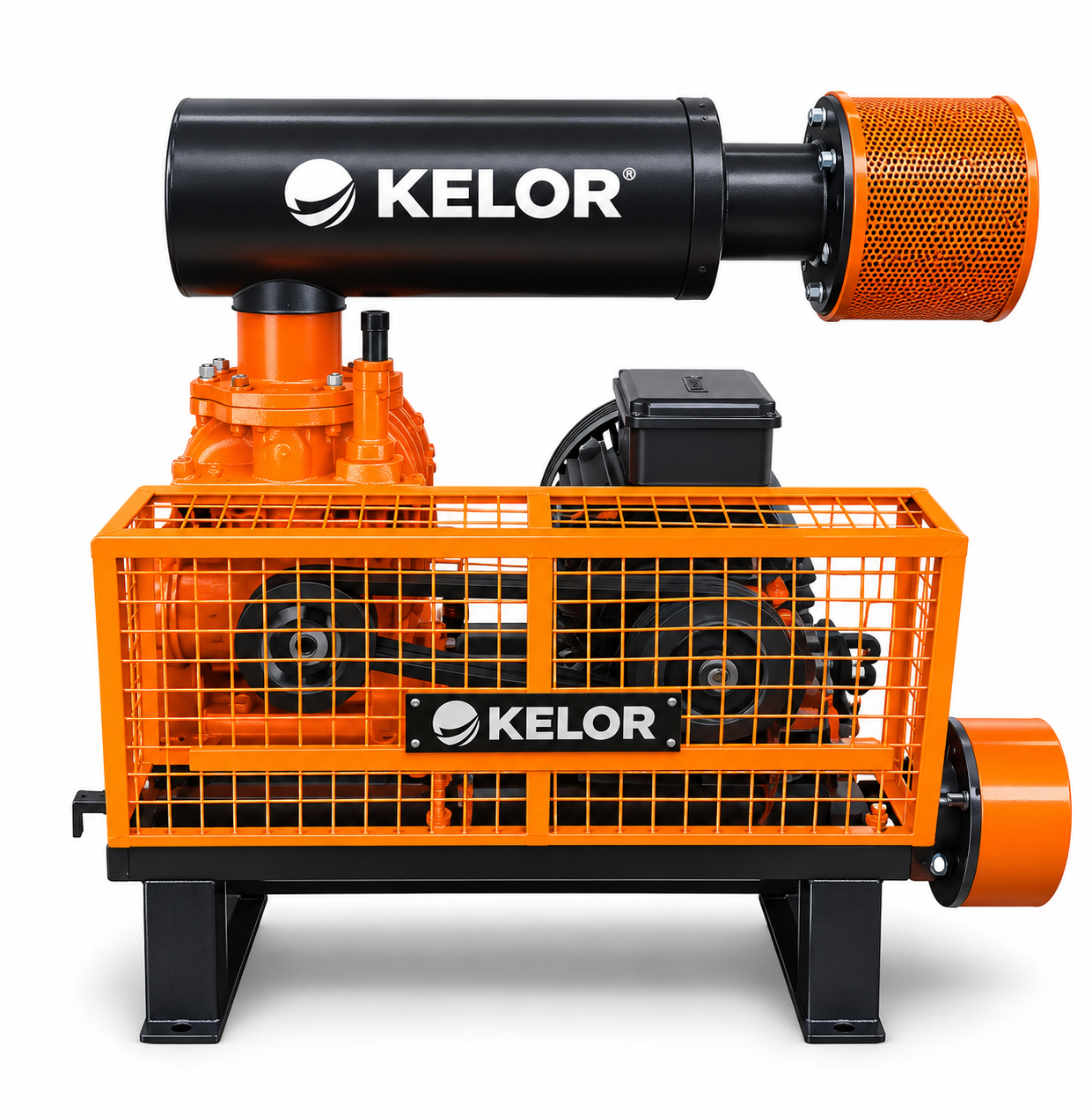
Baseplate-mounted twin lobe package for conveying duty — the workhorse configuration across Indian cement and power plants
8. India Demand Driver 3 — Aquaculture and Food Processing: The Export Engine
Pond aeration is the quiet giant of Indian blower demand. India’s frozen shrimp exports reached about 7.16 lakh tonnes in FY 2023-24 (MPEDA data), and total seafood exports earned roughly US$7.45 billion in FY 2024-25, with frozen shrimp contributing the largest share. Behind every one of those tonnes sits an intensive aquaculture pond that must be aerated continuously: paddle wheels alone cannot hold dissolved oxygen through the night, and commercial farms across Andhra Pradesh, Odisha, Gujarat and West Bengal depend on roots blowers feeding diffuser grids and airlift systems.
The working principle is exactly why. Shrimp are as sensitive to oil as they are to oxygen, so the structural 100% oil-free guarantee — no lubricant anywhere in the air path, labyrinth seals between chambers — makes the twin lobe the default machine. Constant flow keeps DO stable through bio-load swings. And the low-pressure envelope of pond aeration (shallow water, low line losses) sits perfectly inside the 0.5-0.7 kg/cm2 band where these machines are most economical. Special air filters matched to humid coastal atmospheres — pleated synthetic and dual-stage with moisture traps — complete the package.
Food processing extends the same demand curve inland. Flour mills, spice processors, sugar refineries and cereal plants convey product pneumatically; bakeries and premix plants aerate and cool; fermentation and brewing sparge with clean air. Wherever food touches conveying air, the audit trail starts with the blower’s construction — and the twin lobe answer (SS304 air path, high-efficiency filtration, oil-free by geometry rather than by filter claim) is increasingly what food-safety auditors expect to see.
9. India Demand Driver 4 — Chemicals, Pharma, Textiles and Compressed Biogas
The fourth demand pillar is the process-industry belt. India’s chemical and pharmaceutical manufacturing concentrates in dense clusters — Vapi, Ankleshwar, Nandesari and Panoli in Gujarat; Hyderabad and Visakhapatnam in Telangana and Andhra; Baddi in Himachal; and the Tiruppur-Coimbatore textile corridor in Tamil Nadu. These plants consume twin lobe blowers for stripping columns, sparging, agitation, vacuum pick-up and effluent aeration at the plant boundary. Textile dyeing units in Tiruppur and Surat run ETP aeration around the clock under water-quality compliance; pharmaceutical plants add oil-free air for product-contact applications.
The newest and fastest-growing driver is compressed biogas. The national SATAT scheme targets 5,000 CBG plants; by mid-2025 roughly 108 plants were commissioned with 1,094 active letters of intent in the pipeline (SATAT portal, July 2025), and biogas upgrading, digester mixing and gas boosting all fall inside the twin lobe duty envelope. Biogas is corrosive and moist — H2S-bearing, saturated — so the demand it generates skews toward the corrosion-resistant end of the construction ladder: SS316 wetted parts, PTFE-coated rotors and dual-stage moisture-trap filtration, exactly the options the KELOR range supplies.
Chemical clusters
Stripping, sparging, agitation and ETP aeration across Gujarat’s Vapi-Ankleshwar-Panoli belt and beyond.
Pharmaceutical
Oil-free process air, fermentation aeration and effluent duty with SS304/SS316 air paths for audit compliance.
Textiles
Dye-house ETP aeration in Tiruppur, Surat and Bhiwadi; constant-flow blowers keep biology stable under load swings.
Compressed biogas
Digester agitation and low-pressure gas boosting for the SATAT build-out — SS316/PTFE packages for H2S duty.
10. Where the Demand Concentrates: India’s Twin Lobe Map
Twin lobe demand does not spread evenly — it follows the water-stress map, the cement belt and the chemical corridors. Six regions anchor the national picture, and KELOR maintains supply and service coverage across all of them:
Ahmedabad & Gujarat Belt
The densest twin lobe market in India: chemical estates from Vapi to Ankleshwar, textile ETPs in Surat, pharma in Ahmedabad and Vadodara, plus the state’s STP pipeline. Home base of KELOR (Krishna Industries).
Mumbai-Pune & Maharashtra
CETP hubs, pharmaceutical clusters and sugar-season conveying duty; a mature service market where spares availability decides purchases.
Tiruppur, Coimbatore & Tamil Nadu
Dye-house ETP aeration, knitwear-industry effluent compliance and pump-set manufacturing — steady replacement plus expansion demand.
Delhi NCR & North India
Yamuna-action STPs, industrial parks in Haryana and UP, and paper-mill duty — public procurement shapes volumes here.
Hyderabad & Chennai Belt
Pharma-led demand (API clusters in Telangana and Andhra) plus aquaculture supply lines along the east coast.
Kolkata & East India
Jute, paper and leather-cluster ETPs, shrimp farming in Odisha and West Bengal, and growing municipal STP tenders.
11. How Indian Buyers Specify: The Six-Point Checklist
The working principle tells you what the machine can do; the checklist below turns it into a purchase order that survives commissioning. Indian buyers who work through these six points rarely face the classic failure modes — undersized motors, blinded filters, dead-headed air ends:
The six-point twin lobe specification checklist
- 1. Airflow in M3/HR, stated against your process — not “sized later”. Aeration: from tank volume, BOD load and diffuser count. Conveying: throughput divided by SLR. Quote the number; make the supplier confirm it.
- 2. Working pressure in kg/cm2, inside the 0.5-0.7 band — water depth + diffuser losses + line friction for aeration; pipeline profile for conveying. If your number exceeds ~1.0 kg/cm2, you need a different machine, not a bigger blower.
- 3. 100% oil-free construction, confirmed structurally — labyrinth seals, no lubrication in the air path. Ask how it is achieved, not just whether it is claimed.
- 4. Material package matched to the gas — cast iron for clean air; epoxy for humid outdoor duty; SS316/PTFE for H2S sewage and biogas; SS304 for food and pharma contact.
- 5. Special air filters for your working environment — panel filters for clean indoor rooms; pleated for humid coastal sites; cartridge for cement and sugar dust; dual-stage with moisture traps for biogas and coastal atmospheres.
- 6. Motor and control details — IEC-rated 3-30 HP to match your duty, IE3/IP55 where energy norms apply, VFD-ready builds for DO control and conveying trim, and the full accessory list: silencers, NRV, relief valve, baseplate, guard.
One comparison habit worth borrowing
Send the same six points to every supplier and ask each to answer them explicitly — airflow confirmed against duty, pressure band, oil-free method, material grade, filter package and motor spec. KELOR answers all six on the quotation itself, with a confirmed model inside one working day. Comparing answers, not prices, is how Indian plants end up with machines that run fifteen years.
12. Twin Lobe Blower Price in India (2026)
Prices for factory-tested twin lobe roots blowers in India in 2026 follow four size bands, consistent across the KELOR range:
| Size Class | Motor | Airflow | Price Range (2026) |
|---|---|---|---|
| Compact | 3-10 HP | 50-100 M3/HR | Rs 45,000 – 1,20,000 |
| Medium | 10-15 HP | 100-200 M3/HR | Rs 1,20,000 – 1,80,000 |
| Large | 15-25 HP | 200-400 M3/HR | Rs 1,80,000 – 2,50,000 |
| Heavy | 25-30 HP | 400-600 M3/HR | Rs 2,50,000 – 4,50,000 |
What moves the final number inside each band: the material package (SS304 or SS316 air path versus standard cast iron), the filter package matched to your dust environment, silencers and acoustic treatment, instrumentation, and drive arrangement (V-belt versus direct). Beware quotations that win on price by stripping the accessory list — a twin lobe blower without its relief valve and NRV is a failure scheduled in advance. KELOR prices the complete, factory-tested package and issues exact quotations within one working day of receiving your airflow, pressure and duty hours.
13. Matching Machine to Duty: Twin Lobe vs the Alternatives
The working principle defines a duty envelope — and the envelope is exactly where Indian demand lives. Here is how the twin lobe compares when the alternatives knock:
| Machine | Working Principle | Duty Envelope | Verdict for Indian Duty |
|---|---|---|---|
| Twin lobe roots | Positive displacement, external compression | 50-600+ M3/HR at 0.5-0.7 kg/cm2, 24/7 | The default for aeration and conveying — cheapest per M3/HR, simplest service |
| Tri-lobe roots | Same principle, three lobes per rotor | Same band, smoother pulses | Pays a 10-25% premium for a few dB less noise — niche demand |
| Screw compressor | Internal compression, oil-flooded or dry | High pressure 4-10+ bar | Wrong tool below 1 kg/cm2 — overkill cost per M3/HR for aeration/conveying |
| Centrifugal blower | Dynamic, flow falls as resistance rises | Large volumes at low Δp | Suits big STPs with steady grids; struggles with variable conveying lines |
The pattern is consistent: inside the 0.5-0.7 kg/cm2 band, the twin lobe principle wins on total value — capital cost, service simplicity, oil-free construction and constant-flow predictability. Outside the band, other machines take over: screws above it, dynamic machines for very large low-pressure grids. That is precisely why Indian demand concentrates on twin lobe construction — the country’s aeration and conveying duties sit inside its envelope.
14. Energy: Why the Working Principle Decides Your Power Bill
Run the power law (P ≈ Q × Δp) across a plant’s life and the economics of the working principle become the economics of the whole process. An STP aeration grid demanding 200 M3/HR at 0.6 kg/cm2 absorbs about 4.7 kW of shaft power continuously — roughly 41,000 kWh a year if run 24/7. Every point of efficiency in that number is a function of how well the working principle is respected:
- Speed buys flow (Law 1) — so a VFD matching blower speed to real-time air demand, driven by a dissolved-oxygen probe, removes the biggest waste in treatment aeration: running full-speed at night when load drops.
- Pressure buys power (Law 2) — so keep the inlet filter clean (replace at 150-200 mmWC differential), keep diffusers descaled, and design pipelines short and smooth. A filter left blinded can add measurable kilowatts while delivering less air.
- Slip punishes wear (Law 3) — so trend delivered flow monthly; when it falls at fixed speed and pressure, clearances are growing and overhaul scheduling starts paying for itself.
- Motor sizing matters — the 7.5 HP motor that is right for 200 M3/HR at 0.6 kg/cm2 trips on hot afternoons if a competitor undersized it. Run the P ≈ Q × Δp arithmetic before accepting any quotation.
The energy audit shortcut
For any existing twin lobe installation, read three numbers this week: filter differential gauge, delivered flow at fixed speed, and absorbed motor current. Compare against commissioning records. In most Indian plants, the filter gauge alone explains several percent of the power bill — and fixing it costs the price of a filter, not a retrofit.
15. How KELOR Serves India’s Twin Lobe Demand
KELOR (Krishna Industries), based in Ahmedabad, supplies twin lobe roots blowers engineered for the duty envelope this guide describes: airflow from 50 to 600 M3/HR at 0.5-0.7 kg/cm2, driven by 3-30 HP IEC-standard motors at 1200-1850 RPM, with 100% oil-free compression, quiet silenced operation (75-80 dB(A); 68-74 dB(A) under acoustic enclosures) and easy installation in tight spaces on common baseplates with matched IEC framing.
Around the air end, the range adapts to the demand drivers in Sections 6-9: corrosion-resistant options for harsh conditions — epoxy-coated internals, SS304 air paths for food and pharma, SS316 wetted parts and PTFE-coated rotors for H2S-bearing sewage and biogas; special air filters depending on the application and working environment — panel, pleated, high-efficiency cartridge, cyclone pre-cleaners and dual-stage moisture-trap packages; and customizable configurations for specific applications — drive type, IE3/IP55 motors, VFD-ready builds, special voltages, instrumentation and control panels.
Supply reaches across India — the Gujarat belt, Mumbai-Pune, Tiruppur-Coimbatore, Delhi NCR, Hyderabad-Chennai and Kolkata-East — with factory testing before dispatch, stocked genuine spares for every model supplied, and sizing support that runs the arithmetic of Sections 2-4 for your actual duty. Share your airflow, pressure and duty hours, and KELOR returns a confirmed model and quotation within one working day.
16. Frequently Asked Questions — Principle and Demand
Buying Into India’s Twin Lobe Demand? Start With the Right Machine.
KELOR (Krishna Industries), Ahmedabad, supplies factory-tested twin lobe roots blowers — 50-600 M3/HR, 0.5-0.7 kg/cm2, 3-30 HP IEC motors — with corrosion-resistant options, special air filters for your working environment and customizable configurations, delivered across Gujarat, Maharashtra, Tamil Nadu, Delhi NCR, Telangana-Andhra, Kolkata-East and all India. Send your airflow, pressure and duty hours — confirmed model and quotation within one working day.
Email sales@kelorvalves.com WhatsApp Our Blower Desk